书单
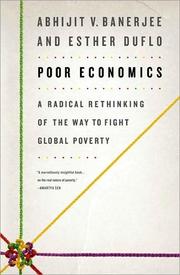
贫穷经济学 (2011)
百科
《贫穷经济学:对抗全球贫困的彻底反思》(英文:Poor economics: a radical rethinking of the way to fight global poverty) (2011 年)是麻省理工学院 (MIT) 经济学教授阿比吉特·班纳吉 和 艾丝特·杜芙若 的非小说类书籍。 中信出版社2018年的中文班译名为,《贫穷的本质:我们为什么摆脱不了贫穷》。
这本书报告了使用基于证据的随机对照试验方法解决全球贫困问题的有效性。 该书获得了 2011 年金融时报和高盛年度商业图书奖。阿比吉特·班纳吉和艾丝特·杜芙若获得了 2019年诺贝尔经济学奖。
以上文字摘自维基百科「贫穷经济学」(去掉了参考文献等尾部小节),按 CC BY-SA 4.0 使用,作者为维基百科的各位编者。
中文维基百科的条目比较短,下面附上英文维基百科的内容(英文原文):
Poor Economics: A Radical Rethinking of the Way to Fight Global Poverty (2011) is a non-fiction book by Abhijit V. Banerjee and Esther Duflo, both professors of Economics at Massachusetts Institute of Technology (MIT) and Nobel Memorial Prize in Economic Sciences laureates. The book reports on the effectiveness of solutions to global poverty using an evidence-based randomized control trial approach. It won the 2011 Financial Times and Goldman Sachs Business Book of the Year Award.
Overview
Poor Economics lays out a middle ground between purely market-based solutions to global poverty, versus "grand development plans." It rejects broad generalizations and formulaic thinking. Instead, the authors help to understand how the poor really think and make decisions on such matters as education, healthcare, savings, entrepreneurship, and a variety of other issues. They advocate the use of observation, using rigorous randomized controlled testing on five continents, and most importantly by actually listening to what the poor have to say. Often the answers are startling and counter-intuitive, but make the utmost sense when circumstances are understood. In addition, the universal traps of Ignorance, Ideology, and Inertia often stymie policies and institutions, but may be avoided.
From this empirical approach, the authors believe that the best strategies for eradicating poverty can emerge. However, they resist laying out a broad set of conclusions. Instead they draw some simple yet powerful lessons, and believe that small changes can have big effects. The authors conclude on the optimistic note that we are all part of the solution.
Authors
Abhijit V. Banerjee is the Ford Foundation International Professor of Economics at MIT and a founder of the Abdul Latif Jameel Poverty Action Lab (J-PAL). He is a fellow of the American Academy of Arts and Sciences and the Econometric Society and has been a Guggenheim Fellow. He has also received the inaugural Infosys Prize 2009 in Social Sciences and Economics. He has been featured in Foreign Policy's Top 100 Global Thinkers in 2011. In 2019, he shared the Nobel Memorial Prize in Economic Sciences with Esther Duflo and Michael Kremer.
Esther Duflo is the Abdul Latif Jameel Professor of Poverty Alleviation and Development Economics at MIT and a founder and director of the Abdul Latif Jameel Poverty Action Lab (J-PAL). Duflo has received numerous academic honors and prizes, including the Nobel Memorial Prize in Economic Sciences (2019), the John Bates Clark Medal (2010), and a MacArthur Fellowship (2009). She has also been featured in Foreign Policy's Top 100 Global Thinkers and Fortune 40 under 40.
The two authors married each other in 2015.
Reception
The book has been well received. Robert Solow commented:
"Abhijit Banerjee and Esther Duflo are allergic to grand generalizations about the secret of economic development. Instead they appeal to many local observations and experiments to explore how poor people in poor countries actually cope with their poverty: what they know, what they seem (or don't seem) to want, what they expect of themselves and others, and how they make the choices that they can make. Apparently there are plenty of small but meaningful victories to be won, some through private and some through public action, that together could add up to a large gains for the world's poor, and might even start a ball rolling. I was fascinated and convinced."
Madeleine Bunting reviewed the book for The Guardian, writing:
"[Banerjee and Duflo] offer a refreshingly original take on development, and they are very aware of how they are bringing an entirely new perspective into a subject dominated by big polemics from the likes of Jeffrey Sachs and William Easterly... they are clearly very clever economists and are doing a grand job to enrich their discipline's grasp of complex issues of poverty – so often misunderstood by people who have never been poor."
Nicholas Kristof reviewed the book for The New York Times, writing:
以上文字摘自英文维基百科「Poor Economics」(有删节,去掉了参考文献等尾部小节),按 CC BY-SA 4.0 使用,作者为维基百科的各位编者。
资料卡
- 原题
- Poor Economics
- 原作语言
- 英语
- 首次出版
- 2011 年 4 月 26 日
- 体裁
- 非虚构作品
- 首版出版社
- 公共议题
- 主题
- 经济学
资料卡来自 Wikidata Q7228769(CC0),众包数据,个别字段可能不全。