 书单
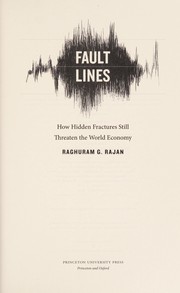
Fault Lines: How Hidden Fractures Still Threaten the World Economy (2010)
百科
这个词条暂时没有中文维基百科条目,下面是英文维基百科的内容(英文原文):
Fault Lines: How Hidden Fractures Still Threaten the World Economy is a 2010 book by Indian economist Raghuram Rajan on the underlying causes of the 2008 financial crisis, and the structural weaknesses present in the world economy. It won the
Financial Times and McKinsey Business Book of the Year award in 2010.
Background
Rajan was one of the earliest economists to draw attention to the possibility of an impending financial crisis. The Jackson Hole Conference, organised every year by the Federal Reserve Bank of Kansas City at Jackson Hole, Wyoming, is one of the longest-standing central banking conferences in the world. It brings together participants from both the public and the private sectors to discuss long-term policy issues in banking. The 2005 conference was to be the last for the Federal Reserve Chairman, Alan Greenspan, and the theme was the legacy of the Greenspan era. Rajan presented a paper titled "Has Financial Development Made the World Riskier?" which argued that banks had become more exposed to risk over the previous decade owing to skewed incentives that drove bankers to take on more complex forms of risk. While Rajan received extensive criticism at the time, the eventual collapse of financial markets in 2008 led to his views being seen as prescient.
Summary
Rajan’s analysis of the roots of the 2008 financial crisis focuses on three fundamental stresses: widening income inequality in the US, trade imbalances in the global economy arising out of historical trajectories followed by late-developing countries, and the clash between arm’s length financial systems, as present in the US and Britain, and relationship-based financial systems, as present in China and Japan.
Income inequality in the US
Rajan illustrates his thesis with regard to widening income inequality by directing attention to the growing disparity in wages, the most important constituent of incomes in the US, across the general population. The wages of a person at the 90th-percentile – that is, a person earning more than 90 percent of the general population – increased by about 65 percent more than one at the 10th-percentile over the thirty-year period from 1975 to 2005. A multitude of factors, such as widespread deregulation and the consequent increases in competition, changes in tax rates, reduced unionisation, and increase in immigration, played a part in widening income inequality. The most important reason, however, was the gap between the supply and demand of skilled workers arising out of deficiencies in education. While politicians understood this, they realised it would be hard to improve the quality of education in a short span of time. Growing inequality also led to greater polarity in the political establishment, reducing the possibility of politicians across party lines coming together on matters of taxation and redistribution. And therefore succeeding administrations resorted to easing access to credit, specifically in the form of housing credit.
Political pressure to broaden access to housing credit and home ownership distorted lending in the financial sector, with both government-sponsored agencies, such as Fannie Mae and Freddie Mac, as well as banks directing money into low-income housing. As the housing agencies bought subprime mortgage-backed securities in large quantities, these created perverse incentives for brokers to originate loans without investigating borrowers’ creditworthiness. Initially these issues were masked by rising house prices and low default rates. As house prices kept rising between 1999 and 2007, households borrowed against existing home equity. Eventually, when prices stopped rising, a large number of borrowers were forced to default. This led to the Subprime mortgage crisis which in turn precipitated the wider 2008 financial crisis.
Trade imbalances
Late-developing economies, especially those that became independent after World War II, pursued a policy of export-led growth. Typically, national savings were directed through a state-controlled financial system to a small set of favoured firms. Governments protected their domestic market from foreign imports through erecting entry barriers in the form of high tariffs and import restrictions. They also provided incentives to domestic firms for being export-oriented, while doling out tax breaks and subsidies to support their development. Low household demand, historical government policies, and vested domestic interests kept traditional exporters strongly dependent on exports, and reliant on international demand for growth. The surpluses put out by these countries in the global goods market were absorbed by developing countries. In the process, these developing countries ran trade deficits, their spending financed by foreign-debt.
Following the financial crises of the 1990s, these countries sought to generate trade surpluses rather than simply being export oriented. This allowed them to also build foreign-exchange reserves. In order to invest these reserves, the exporters needed a country whose spending outstripped domestic production, along with a strong financial system that was both capable of attracting inflows as well as ensuring the safety of these investments. A large part of these reserves came to be invested in the United States.
以上文字摘自英文维基百科「Fault Lines: How Hidden Fractures Still Threaten the World Economy」(有删节,去掉了参考文献等尾部小节),按 CC BY-SA 4.0 使用,作者为维基百科的各位编者。
资料卡
- 原题
- Fault Lines: How Hidden Fractures Still Threaten the World Economy
- 原作语言
- 英语
- 首次出版
- 2010 年
- 体裁
- 非虚构作品
- 首版出版社
- 普林斯顿大学出版社
- 页数
- 260
- 主题
- 经济学
- 获奖
- 2018年金融时报和麦肯锡年度最佳商业书籍奖(2010)
资料卡来自 Wikidata Q24887731(CC0),众包数据,个别字段可能不全。