书单
百科
这个词条暂时没有中文维基百科条目,下面是英文维基百科的内容(英文原文):
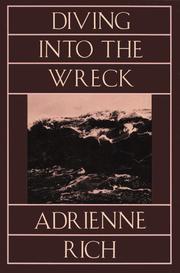
Diving into the Wreck: Poems 1971–1972 is an anthology of poems written by Adrienne Rich. Published in 1973, it won the National Book Award for Poetry in 1974.
Description
Diving into the Wreck: Poems 1971–1972 is Rich's seventh book of poetry, first published in 1973. It is a collection of exploratory and often angry poems, split the 1974 National Book Award for Poetry with Allen Ginsberg, The Fall of America. Rich declined to accept the award individually and was joined by the two other feminist poets nominated—Alice Walker and Audre Lorde—to accept it on behalf of all women "whose voices have gone and still go unheard in a patriarchal world."
The anthology consists of twenty-five poems separated into four sections including the poem 'Diving into the Wreck' after which the collection is titled. Like much of Rich’s work, the anthology contains deep political themes and critiques of society, reflecting the poet’s position as a feminist and activist.
Poems
"Diving into the Wreck"
The eponymous metaphorical poem describes a deep-sea diver before and during the exploration of a shipwreck.
“Diving into the Wreck” is one of the most famous poems of the anthology. The symbols of the wreckage and the diver bravely entering an unknown world have been examined in relation to existentialism, post-structuralism and feminism.
The diver’s act of exploration and discovery within the wreck is linked to scholarly and literary ideas of the ‘new self’. It is used as a metaphor for self-discovery and the internal and spiritual journey that individuals must undertake in order to understand themselves and their place in the world.
Unsurprisingly considering Rich’s stance as a feminist, “Diving into the Wreck” became an important part of feminist literature. The so-called ‘book of myths’ referred to in the first line of the poem and again in the closing lines is described as a symbol of or reference to “patriarchal society” and “the myth making that has ruined lives of women”. The speaker’s entry into the water and the wreck is not only part of a journey of self-discovery but also represents how women can reclaim their freedom amid the wreckage of the history and identities of forgotten women. These acts of exploration, courage and reclamation link to Rich’s own reclamation of women’s spaces in the literary sphere and the absence or romanticization of the female body and mind in literature and historical records.
Some scholars interpret the diver as being male, or at least as a figure who emulates the behaviors and traits of the typical, solitary male hero found in literature, seeking domination over nature through the use of the mask which supports the diver’s exploration. By the end of the poem, ambiguity arises amid an emergence of both masculinity and femininity resulting in the androgynous figure of the diver. Rich suggests the acceptance of both traits or, taking it a step further, the deconstruction of both as myths to be shrugged off in favor of androgyny.
The water itself is another metaphor – representing knowledge and memory, acting as a separate space detached from the familiar world where intense change and evolution is facilitated. It is a large, intimidating space into which the diver enters willingly. The diver’s use of equipment, including a suitable outfit, enables them to safely search for the desired knowledge.
Rich suffered from mobility issues, had to attend physical therapy and developed a fear of going down staircases. It is worth noting her use of a ladder for descending into the water, how uncomfortable that may have been for her, and her descriptions of the movement-restricting gear the diver wears and how they have to learn to move in the environment, which may also be related to her lived experiences.
“Diving into the Wreck” has also been associated with Rich’s time at the City College of New York where she taught literature to black students within the Search for Education, Elevation, and Knowledge program. It was during this time that Rich was working on the anthology. Rich was vocal about the lack of black women in academic settings and her deconstruction of myths and history, skewed in favor of the oppressors, has a meaning that can be appreciated from a multitude of angles.
"Song"
“Song” is a poem that describes the loneliness of the speaker while also including journeying and exploration. The speaker compares their feelings of loneliness to a plane and a woman travelling by car. This woman notes the places she may have stopped and lived in and how that too would have been lonely. The woman could have become a housewife but chooses solitary life on the road. Within “Song” Rich reframes loneliness and suggests that it may be better to explore and stand alone, rather than be confined.
"Rape"
"Rape" is a poem that describes the plight of a woman who has been raped, forced to seek justice from a callous and patronizing male-dominated world. As in many of Rich's poems, "Rape" highlights the struggle of women against sexism and its sometimes cruel consequences, and can be seen as an effort to call women to action. "Rape" was published in 1973 in Diving into the Wreck: Poems 1971-1972.
Critical response
The anthology was met upon release, and in the years since, with mixed reviews; at the time, it was Rich’s most largely read work.
After its initial release, the content was criticized and judged to be poorly written; the political nature of her work was deemed to have diminished Rich’s creative skills. In one newspaper, The Hudson Review, William Pritchard was particularly critical of “Rape” which he dismissed as propaganda. Within his review, he states that a requirement of poetry is that it please the reader, which Rich did not do.
以上文字摘自英文维基百科「Diving into the Wreck: Poems 1971–1972」(有删节,去掉了参考文献等尾部小节),按 CC BY-SA 4.0 使用,作者为维基百科的各位编者。
资料卡
- 原题
- Diving into the Wreck
- 首次出版
- 1973 年
资料卡来自 Wikidata Q18610061(CC0),众包数据,个别字段可能不全。