书单
百科
这个词条暂时没有中文维基百科条目,下面是英文维基百科的内容(英文原文):
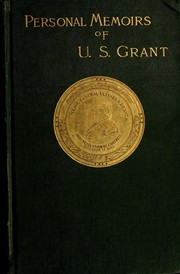
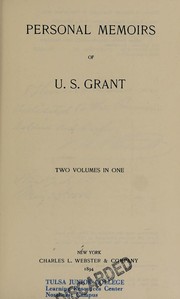
The Personal Memoirs of U. S. Grant are an autobiography, in two volumes, of Ulysses S. Grant, the 18th President of the United States. The work focuses on his military career during the Mexican–American War and the American Civil War. The volumes were written in the last year of Grant's life, amid increasing pain from terminal throat cancer and in an effort to restore the Grant family's finances and provide for his widow after his bankruptcy at the hands of an early Ponzi scheme. The set was published by Mark Twain shortly after Grant's death in July 1885.
Twain, a literary superstar and personal friend of Grant, created a marketing system to reach millions of veterans with a patriotic appeal just as the general's death was being mourned. Ten thousand agents canvassed the North for orders, following a script that Twain had devised. Many were Union veterans dressed in their old uniforms, who went door-to-door offering the two-volume set at prices ranging from $3.50 to $12, depending on the binding ($130 to $430 in 2025).
These efforts sold 350,000 two-volume sets in advance of the book's actual printing. This made the Memoirs one of the bestselling books of the 19th century. In its first year, it outsold even the publishing behemoth Uncle Tom's Cabin. For comparison, the 1876 publication of memoirs of Grant's colleague William Tecumseh Sherman was deemed a great success for selling 25,000 copies in its first decade. Grant's widow, Julia, received about $450,000 ($16,100,000 in 2025) from Twain during the first three years of publication.
Despite being explicitly written for money, and with a focus on those aspects of Grant's life most likely to induce sales, the combination of an honest man exploited in a financial scheme and then marked for death by cancer lent the Memoirs immense contemporary interest. The Personal Memoirs of U. S. Grant received universal acclaim on its publication and has remained highly regarded by the general public, military historians, and literary critics. Grant's prose has been praised as lean, intelligent and effective. He candidly depicts his battles against both the Confederates and his internal Army foes.
Background
World tour and money troubles
Grant and his wife Julia took a trip around the world in 1877 after his second term in office. Personally financed, this tour left him short on liquid assets on his return. He was nearly 60 and he looked for something to engage his time and replenish his finances. In 1878, he moved to New York City and entered into business with his son Buck (Ulysses S. Grant, Jr.) and Ferdinand Ward. Ward was a young investor and personal friend of the junior Grant. Ward was described by his great-grandson Geoffrey Ward as "a very plausible, charming, unobtrusive, slender person with a genius for finding older people and pleasing them, which he learned early on."
Ponzi scheme, personal bankruptcy and cancer diagnosis
The firm of Grant & Ward did well at first, bolstered by Ward's skills and Grant's name. The former president bragged to friends that he was worth two and a half million dollars, and family members and friends poured money into the firm. But Grant was largely disengaged from the company's business, often signing papers without reading them. This proved disastrous, as Ward had used the firm as a Ponzi scheme, taking investors' money and spending it on personal items, including a mansion in Connecticut and a brownstone in New York City. Grant & Ward failed in May 1884, leaving Grant penniless. That fall, the elder Grant was diagnosed with terminal throat cancer.
Century Company publishing deal
Long before his diagnosis Grant wrote a series of articles analyzing many of the battles he had overseen. The Century Company published these articles in their flagship periodical, Century Magazine. Century paid Grant a flat author's fee of $500 (nearly $17,000 in 2024) per article. The essays were well received by critics and in 1876 the editor of Century Magazine, Robert Underwood Johnson, suggested Grant expand them into a memoir, as William Tecumseh Sherman had recently done to great acclaim. Facing his own mortality and the prospect of his family's destitution after his death, Grant approached Century with a proposal to publish his personal memoirs, serially and then in bound volumes. Century agreed to publish the work and drew up a contract in which the dying man would receive 10% of every sale of the book.
Mark Twain intervenes
Grant's personal friend Samuel Clemens (better known by his pen name, Mark Twain) soon heard news of this publishing deal. He was unable to conceal his disapproval at how little money he thought Grant stood to earn if the dying man agreed to Century's terms. Twain dropped everything and rushed to New York City from his home in Hartford, Connecticut. When Twain entered the Grant home on 66th St. he noticed Grant's eldest son, Frederick reviewing the Century contract one final time before his father signed it. Twain recalled that Grant was on the point of picking up his pen as the novelist arrived.
Twain intervened in the signing and asked to know the terms of the contract. In his autobiography, Twain stated, "He [Grant] read the rough draft aloud and I didn't know whether to cry or laugh." After hearing the terms, Twain declared the terms of the contract giving Grant 10% of all sales was insultingly low and amounted to exploitation of the former president's dire situation. Twain insisted that he could secure a far more favorable publishing contract for Grant and pressed him for his proxy in new negotiations. Grant felt a personal loyalty to the executives of Century, and considered it dishonorable to back out of his contract after all details had been agreed upon and papers drawn up. Twain grew exasperated and confessed that he himself had far better terms from his own publisher, the American Publishing Company.
以上文字摘自英文维基百科「Personal Memoirs of U. S. Grant」(有删节,去掉了参考文献等尾部小节),按 CC BY-SA 4.0 使用,作者为维基百科的各位编者。
资料卡
- 原题
- Personal Memoirs of U. S. Grant
- 原作语言
- 美国英语
- 首次出版
- 1885 年
- 体裁
- 回忆录
- 首版出版社
- Charles L. Webster and Company
资料卡来自 Wikidata Q7170526(CC0),众包数据,个别字段可能不全。