书单
百科
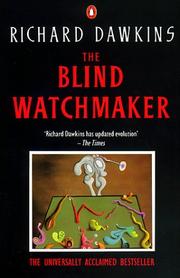
《盲眼钟表匠》(英语:The Blind Watchmaker)是理查德·道金斯于1986年出版的书,主要关于基于自然选择的进化论。他提出了一些观点以反驳他的上本书自私的基因所引起的争论(两本书都围绕着基因中心进化论)。
另有同名科普节目。
以上文字摘自维基百科「盲眼钟表匠」(去掉了参考文献等尾部小节),按 CC BY-SA 4.0 使用,作者为维基百科的各位编者。
中文维基百科的条目比较短,下面附上英文维基百科的内容(英文原文):
The Blind Watchmaker: Why the Evidence of Evolution Reveals a Universe without Design (1986) is a popular science book by Richard Dawkins. It explains how the cumulative, nonrandom process of natural selection creates complexity. Dawkins develops themes from, and refutes criticisms of, his first book, The Selfish Gene (1976). It was illustrated by Liz Pyle.
It won the Los Angeles Times Book Prize for Current Interest and the Heinemann Award. An audiobook was released, read by Dawkins and Lalla Ward. A computer program of the same name was released and it was the basis for a BBC documentary of the same name.
The Economist called it "As readable and vigorous a defense of Darwinism as has been published since 1859."
Background
The title refers to the watchmaker analogy made by William Paley in Natural Theology or Evidences of the Existence and Attributes of the Deity (1802). Paley posited the complexity of living organisms was evidence of the existence of a divine creator. He argued by analogy with a watch compelling belief in the existence of a watchmaker. Charles Darwin, in On the Origin of Species (1859), argued that cumulative, nonrandom natural selection can create complexity. Dawkins dubs natural selection the blind watchmaker, "blind because it does not plan ahead, does not plan consequences, has no purpose in view. Yet the living results of natural selection overwhelmingly impress us with the illusion of design and planning. The purpose of this book is to resolve this paradox to the satisfaction of the reader."
Synopsis
1. Explaining the Very Improbable
Dawkins writes “We animals are the most complicated things in the known universe. … Complicated things, everywhere, deserve a very special kind of explanation." The explanation discovered by Charles Darwin and Alfred Russel Wallace is natural selection. Dawkins emphasizes that is nonrandom (since only adaptive traits are selected for) and cumulative (as adaptive traits accumulate).
2. Good Design
Dawkins looks at echolocation as an example of a complex adaptation. When Donald Griffin and Robert Galambos elucidated echolocation in bats, sonar was a secret. But nature invented it independently, to varying degrees.
3. Accumulating Small Change
Dawkins looks at the evolution of complexity. He notes that adaptations are too complex to have arisen by chance, and asks: "How then, did they come into existence? The answer, Darwin's answer, is by gradual, step-by-step transformations from simple beginnings. ... Each successive change in the gradual evolutionary process was simple enough, relative to its predecessor, to have arisen by chance. But the whole sequence of cumulative steps constitutes anything but a chance process. ... The cumulative process is directed by non-random survival."
Dawkins illustrates random variation coupled with nonrandom selection with his weasel program. He describes his experiences with a more sophisticated computer simulation of artificial selection implemented in the computer program The Blind Watchmaker, which was sold separately as a teaching aid.
4: Making Tracks Through Animal Space
Dawkins looks at convergent evolution, starting with the evolution of eyes. Many animals have a patch of light-sensitive cells. "In a continuous series from flat sheet of light-sensitive cells, through shallow cup to deep cup, each step in the series, however small (or large) the step, would be an optical improvement. Now, if you make a cup very deep and turn the sides over, you eventually make a lensless pinhole camera.” Such an eye is seen in the chambered nautilus. The addition of a lens results in the cephalopod eye. "For each of these types of eye, stages corresponding to evolutionary intermediates exist as working eyes among modern animals." In fact, eyes have evolved as many as forty times independently.
以上文字摘自英文维基百科「The Blind Watchmaker」(有删节,去掉了参考文献等尾部小节),按 CC BY-SA 4.0 使用,作者为维基百科的各位编者。
资料卡
- 原题
- The Blind Watchmaker
- 原作语言
- 英语
- 首次出版
- 1986 年
- 体裁
- 随笔
- 前作
- 延长的表型
- 续作
- 伊甸园之河
- 主题
- 进化生物学
资料卡来自 Wikidata Q477792(CC0),众包数据,个别字段可能不全。
改编作品
电影1
名单来自 Wikidata(CC0):只列条目里写明「改编自 / 取材于」这本书的作品,不按名字猜;众包数据,可能不全。