书单
百科
这个词条暂时没有中文维基百科条目,下面是英文维基百科的内容(英文原文):
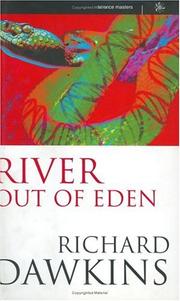
River Out of Eden: A Darwinian View of Life is a 1995 popular science book by Richard Dawkins. The book is about Darwinian evolution and summarizes the topics covered in his earlier books, The Selfish Gene, The Extended Phenotype and The Blind Watchmaker. It is part of the Science Masters series and is Dawkins's shortest book. It is illustrated by Lalla Ward, Dawkins's then-wife. The book's name is derived from Genesis 2:10 relating to the Garden of Eden. The King James Version reads "And a river went out of Eden to water the garden; and from thence it was parted, and became into four heads."
River Out of Eden has five chapters. The first chapter lays down the framework on which the rest of the book is built, that life is like a river of genes flowing through geological time where organisms are mere temporary bodies. The second chapter shows how human ancestry can be traced via many gene pathways to different most recent common ancestors, with special emphasis on the African Eve. The third chapter describes how gradual enhancement via natural selection is the only mechanism which can create the observed complexity of nature. The fourth chapter describes the indifference of genes towards organisms they build and discard, as they maximise their own utility functions. The last chapter summarises milestones during the evolution of life on Earth and speculates on how similar processes may work in alien planetary systems.
Summary
The digital river
Dawkins explains that everyone alive today has a continuous line of ancestors who survived to adulthood and reproduced, tracing all the way back to the very first single-celled organism, even though many organisms die without reproducing.
If the success of an organism is measured by its ability to survive and reproduce, then all living organisms can be said to have inherited "good genes" from successful ancestors. Each generation of organisms is a sieve against which replicated and mutated genes are tested. Good genes fall through the sieve into the next generation while bad genes are removed. This explains why organisms become better and better at whatever it takes to succeed, and is in stark contrast to Lamarckism, which would require successful organisms to refine their genes during their lifetime.
Following this gene-centered view of evolution, it can be argued that an organism is no more than a temporary body in which a set of companion genes (actually alleles) co-operate toward a common goal: to grow the organism into adulthood, before they go their separate ways in bodies of the organism's progeny. Bodies are created and discarded, but good genes live on as replicas of themselves, a result of a high-fidelity copy process typical of digital encoding.
Through meiosis (sexual reproduction), genes share bodies with different companion genes in successive generations. Thus genes can be said to flow in a river through geological time. Even though genes are selfish, over the long run every gene needs to be compatible with all other genes in the gene pool of a population of organisms, to produce successful organisms.
A river of genes may fork, mostly due to the geographical separation between two populations of organisms. Because genes in the two branches never share the same bodies, they may drift apart until genes from the two branches become incompatible. Organisms created by these two branches form separate, non-interbreeding species, completing the process of speciation.
All Africa and her progenies
When tracing human lineage back in time, most people look at parents, grandparents, great-grandparents and so on. The same approach is often taken when tracing descendants via children and grandchildren. Dawkins shows that this approach is misguided, as the numbers of ancestors and descendants seem to grow exponentially as generations are added to the lineage tree. In just 80 generations, the number of ancestors can exceed a trillion trillion.
This simple calculation does not take into account the fact that every marriage is really a marriage between distant cousins which include second cousins, fourth cousins, sixteenth cousins and so on. The ancestry tree is not really a tree, but a graph.
Dawkins prefers to model ancestry in terms of genes flowing through a river of time. An ancestor gene flows down the river either as perfect replicas of itself or as slightly mutated descendant genes. Dawkins fails to explicitly contrast ancestor organism and descendant organisms against ancestor genes and descendant genes in this chapter. But the first half of the chapter is really about differences between these two models of lineage. While organisms have ancestry graphs and progeny graphs via sexual reproduction, a gene has a single chain of ancestors and a tree of descendants.
Given any gene in the body of an organism, we can trace a single chain of ancestor organisms back in time, following the lineage of this one gene, as stated in the coalescent theory. Because a typical organism is built from tens of thousands of genes, there are numerous ways to trace the ancestry of organisms using this mechanism. But all these inheritance pathways share one common feature. If we start with all humans alive in 1995 and trace their ancestry by one particular gene (actually a locus), we find that the farther we move back in time, the smaller the number of ancestors become. The pool of ancestors continues to shrink until we find the most recent common ancestor (MRCA) of all humans alive in 1995 via this particular gene pathway.
In theory, one can also trace human ancestry via a single chromosome, as a chromosome contains a set of genes and is passed down from parents to children via independent assortment from only one of the two parents. But genetic recombination (chromosomal crossover) mixes genes from non-sister chromatids from both parents during meiosis, thus muddling the ancestry path.
以上文字摘自英文维基百科「River Out of Eden」(有删节,去掉了参考文献等尾部小节),按 CC BY-SA 4.0 使用,作者为维基百科的各位编者。
资料卡
- 原题
- River Out of Eden
- 插图
- 莱拉·沃德
- 原作语言
- 英语
- 首次出版
- 1995 年
- 体裁
- 大众科学
- 首版出版社
- 基础书籍出版社
- 前作
- 盲眼钟表匠
- 续作
- Climbing Mount Improbable
- 主题
- 进化生物学
资料卡来自 Wikidata Q937556(CC0),众包数据,个别字段可能不全。