 书单
百科
这个词条暂时没有中文维基百科条目,下面是英文维基百科的内容(英文原文):
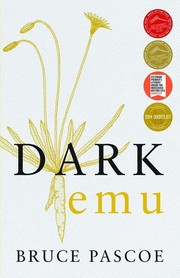
Dark Emu: Black Seeds: Agriculture or Accident? is a 2014 non-fiction book by Bruce Pascoe. It re-examines colonial accounts of Aboriginal people in Australia, and cites evidence of pre-colonial agriculture, engineering and building construction by Aboriginal and Torres Strait Islander peoples. A second edition, published under the title Dark Emu: Aboriginal Australia and the Birth of Agriculture was published in mid-2018, and a version of the book for younger readers, entitled Young Dark Emu: A Truer History, was published in 2019.
Both the first and the children's editions were shortlisted for major awards, and the former won two awards in the New South Wales Premier's Literary Awards. The book has also proved very popular with the Australian public, selling 250,000 copies by mid-2021. Its strengths have been said to lie in the storytelling style, making it more accessible to the general reader than the more scholarly examinations of Aboriginal history in the past.
According to the Australian Broadcasting Corporation, the publication of Dark Emu "ignited a culture war". The book has been praised for stimulating debate about the diversity of Indigenous economic and land management practices. However, academics have challenged some of its claims, especially Pascoe's thesis that Indigenous Australian society was based to such a large extent on sedentary agriculture rather than hunting and gathering.
Editions
The first edition, entitled Dark Emu: Black Seeds: Agriculture or Accident?, was published by Magabala Books in 2014. The title refers to what is known as the Emu in the sky constellation in Aboriginal astronomy, known as Gugurmin, or "dark emu" to the Wiradjuri people.
A second edition, entitled Dark Emu: Aboriginal Australia and the Birth of Agriculture was published in June 2018, and a version of the book for younger readers, entitled Young Dark Emu: A Truer History, was published in 2019. The 2019 version was shortlisted for the 2020 Adelaide Festival Awards for Literature in the Children's Literature Award section.
Contents
In Dark Emu Pascoe draws on the writings of early British settlers and recent decades of scholarship to argue that traditional Aboriginal society was characterised by agriculture, aquaculture, elaborate engineering, villages of permanent structures, and other features which are incompatible with the view that Aboriginal Australians were only hunter-gatherers. He states, "The belief that Aboriginal people were 'mere' hunter-gatherers has been used as a political tool to justify dispossession."
Pascoe quotes Charles Sturt, Thomas Mitchell and other explorers and settlers who describe Aboriginal hayricks, stooks, crops and villages, and Aboriginal people practising seed selection, soil preparation, crop harvesting, and storing surplus crops. He also describes Sturt's 1845 encounter with hundreds of Aboriginal people who were living in a village near Cooper Creek and offered him water, roast duck, cake and a hut to sleep in. Pascoe concludes that, "most Aboriginal Australians were ... in the early stages of an agricultural society, and, it could be argued, ahead of many other parts of the world".
Pascoe provides evidence of Aboriginal dams, weirs, sluices and fish traps, and argues that pre-colonial Aboriginal people practiced aquaculture. He cites the work of archaeologist Heather Builth and palynologist Peter Kershaw and concludes that sites at Lake Condah in western Victoria are elaborately engineered eel and fish traps associated with permanent stone buildings built by the Gunditjmara people around 8,000 years ago.
Pascoe quotes nineteenth century accounts of Aboriginal people living in villages and towns with sturdy huts, the largest of which could accommodate 30–40 people. Sturt reported a town of 1,000 people on the Darling River. Pascoe states that towns such as the collection of stone structures at Lake Condah are evidence of sedentary or semi-sedentary Aboriginal culture. He concludes, "Permanent housing was a feature of the pre-contact Aboriginal economy, and marked the movement towards agricultural reliance."
Pascoe acknowledges his debt to the work of Rupert Gerritsen, who in 2008 published Australia and the Origins of Agriculture, which argued that some Aboriginal people were farmers as much as hunter-gatherers. Pascoe also draws on the work of historian Bill Gammage, author of The Biggest Estate on Earth: How Aborigines Made Australia (2012), which looks at how Aboriginal people used fire, dams and cropping to support themselves sustainably in their environment.
In the last two chapters of Dark Emu, titled "Australian Agricultural Revolution" and "Accepting History and Creating the Future", Pascoe advocates for changes in current Australian methods of agriculture and lifestyle. Pascoe says that Australia could learn from Indigenous culture and landcare, replacing wheat with native grasses and eating kangaroo rather than cattle.
Reception
Sales and reviews
The book received critical acclaim, winning two NSW Premier's Literary Awards (Book of the Year and the Indigenous Writers' Prize) and being shortlisted for two other prizes (the History Book Award in the Queensland Literary Awards and Victorian Premier's Award for Indigenous Writing), as well as mainstream recognition. It was reviewed by three Australian teachers' associations, earned positive reviews in other media, and, with the highest number of nominations by members of the public, was chosen to be the first book discussed in the inaugural meeting of the Parliamentary Book Club. A new edition was published in 2018. By mid 2021 the book had sold 250,000 copies. There is an audiobook and ebook version.
以上文字摘自英文维基百科「Dark Emu」(有删节,去掉了参考文献等尾部小节),按 CC BY-SA 4.0 使用,作者为维基百科的各位编者。
资料卡
- 原题
- Dark Emu
- 原作语言
- 英语
- 首次出版
- 2014 年 3 月 1 日
- 改编作品
- Young Dark Emu
资料卡来自 Wikidata Q78724811(CC0),众包数据,个别字段可能不全。