书单
百科
这个词条暂时没有中文维基百科条目,下面是英文维基百科的内容(英文原文):
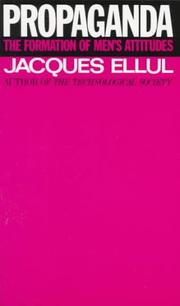
Propaganda: The Formation of Men's Attitudes (1965/1973) (French: Propagandes; original French edition: 1962) is a book on the subject of propaganda by French philosopher, theologian, legal scholar, and sociologist Jacques Ellul. It presents a sophisticated taxonomy for propaganda, including such paired opposites as political–sociological, vertical–horizontal, rational–irrational, and agitation–integration. The book contains Ellul's theories about the nature of propaganda to adapt the individual to a society, to a living standard, and to an activity aiming to make the individual serve and conform.
Author
After being discharged as a professor from French universities by the Vichy regime Ellul became a leader in the French resistance during World War II. After the Liberation of France, he became a professor at the University of Bordeaux and wrote 58 books and numerous articles over his lifetime, the dominant theme of which has been the threat to human freedom created by modern technology.
Background history
As early as 1928, Edward Bernays recognized propaganda as a modern instrument to produce productive ends and "help bring order out of chaos". Because of its secrecy it has been difficult to determine what constitutes propaganda and what the nature of propaganda is.
For a time from 1920 to around 1933, propaganda was simplistically viewed as being able to modify sentiments and attitudes of individuals without their being conscious. That limited perspective of propaganda as being able to influence the individual psychologically was prevalent.
The Institute for Propaganda Analysis from 1937, inspired by Harold Lasswell defined propaganda as "the expression of opinions or actions carried out deliberately by individuals or groups with a view to influencing the opinions or actions of other individuals or groups for predetermined ends and through psychological manipulations".
This definition seemed more accurate and was supported by others such as Goebbels, a German propagandist, who stated, "We do not talk to say something, but to obtain a certain effect". Similarly, F.C. Bartlett held an interpretation of the goal of propaganda as not merely an instrument to increase political understanding of events, but as a means to obtain results through action. Ellul supports the idea that propaganda is made primarily because of a will to action for the purpose of effectively arming policy made by the state.
Leonard Doob, an American specialist, defined propaganda in 1948 as "the attempt to affect the personalities and to control the behavior of individuals towards desired ends". Unending definitions show the uncertainty among specialists and the inability of definitions to encompass all that is propaganda. Just because the term propaganda cannot be defined with any degree of precision does not mean that attempts to define it should be abandoned. Ellul's definition in 1973 was as follows:
"Very frequently propaganda is described as a manipulation for the purpose of changing idea or opinions of making individuals 'believe' some idea or fact, and finally of making them adhere to some doctrine—all matters of the mind. It tries to convince, to bring about a decision, to create a firm adherence to some truth. This is a completely wrong line of thinking: to view propaganda as still being what it was in 1850 is to cling to an obsolete concept of man and of the means to influence him; it is to condemn oneself to understand nothing about propaganda. The aim of modern propaganda is no longer to modify ideas, but to provoke action. It is no longer to change adherence to a doctrine, but to make the individual cling irrationally to a process of action. It is no longer to transform an opinion but to arouse an active and mythical belief."
In this book Ellul but argued that modern propaganda was intended to spark action towards a desired response by developing learned attitudes, and that it drew from scientific analyses of psychology and sociology. Ellul took the view that prior attempts to define propaganda generally left out the sociological side.
Summary of chapters
Propaganda: The Formation of Men's Attitudes is divided into five substantive chapters discussing Ellul's analysis.
Introduction
Regardless of the State, propaganda should be viewed as situated at the center of the growing powers of governmental and administrative techniques.
"Differences in political regimes matter little; differences in social levels are more important; and most important is national self-awareness. Propaganda is a good deal less the political weapon of a regime (it is that also) than the effect of a technological society that embraces the entire man and tends to be a completely integrated society. Propaganda stops man from feeling that things in society are oppressive and persuades him to submit with good grace."
Chapter One: Characteristics of Propaganda
Modern propaganda is a technique that requires an analysis of both environment and individual to be subjected to propaganda. Therefore, it is based on scientific analyses of psychology and sociology. Sufficient understanding of these two areas creates the most effective propaganda, and without the scientific research of modern psychology and sociology there would be no propaganda.
"Step by step the propagandist builds the techniques on the basis of his knowledge of man, his tendencies, his desires, his needs, his psychic mechanisms, his conditioning, and as much on social psychology as on depth psychology."
Part One: External Characteristics
以上文字摘自英文维基百科「Propaganda: The Formation of Men's Attitudes」(有删节,去掉了参考文献等尾部小节),按 CC BY-SA 4.0 使用,作者为维基百科的各位编者。
资料卡
- 原题
- Propagandes
- 译者
- Konrad Kellen
- 原作语言
- 法语
- 首次出版
- 1962 年
资料卡来自 Wikidata Q941243(CC0),众包数据,个别字段可能不全。