 书单
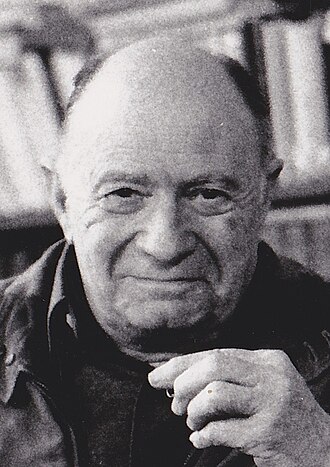
雅克·埃吕尔
- 生卒
- 1912 – 1994
- 国籍
- 法国
- 外文名
- Jacques Ellul
照片:Jan van Boeckel, ReRun Productions,CC BY-SA 4.0,来自维基共享资源「Jacques Ellul, 1990 (cropped).jpg」(经缩小)。
生平与创作
雅克·埃吕尔(法语:Jacques Ellul,/ɛˈluːl/,法语:[ɛlyl],1912年1月6日—1994年5月19日)是法国著名的哲学家,社会学家和教授。作为一个多产的作家,埃吕尔著有60多本书并发表过超过600篇文章,其中着重讨论了宣传,科技对于社会的影响,以及宗教和政治的相互影响。
以上文字摘自维基百科「雅克·埃吕尔」(去掉了参考文献等尾部小节),按 CC BY-SA 4.0 使用,作者为维基百科的各位编者。
中文维基百科的条目比较短,下面附上英文维基百科的内容(英文原文):
Jacques Ellul (French: [ɛlyl]; 6 January 1912 – 19 May 1994) was a French-born philosopher, sociologist, lay theologian, resistance fighter and professor. Noted as a Christian anarchist, Ellul was a longtime professor of History and the Sociology of Institutions on the Faculty of Law and Economic Sciences at the University of Bordeaux. A prolific writer, he authored more than 60 books and more than 600 articles over his lifetime, many of which discussed propaganda, the impact of technology on society, and the interaction between religion and politics.
The dominant theme of Ellul's work proved to be the threat to human freedom and religion created by modern technology. He did not seek to eliminate modern technology or technique but sought to change our perception of them to that of a tool rather than regulator of the status quo. Among his most influential books are The Technological Society and Propaganda: The Formation of Men's Attitudes.
Considered by many to be a philosopher, Ellul was trained as a sociologist, and approached the question of technology and human action from a dialectical viewpoint. His writings are frequently concerned with the emergence of a technological tyranny over humanity. As a philosopher and theologian, he further explored the religiosity of the technological society. In 2000, the International Jacques Ellul Society was founded by a group of former Ellul students. The society, which includes scholars from a variety of disciplines, is devoted to continuing Ellul's legacy and discussing the contemporary relevance and implications of his work.
Life and influences
Jacques Ellul was born in Bordeaux, France, on 6 January 1912, to Marthe Mendes (Protestant; French-Portuguese) and Joseph Ellul (initially an Eastern Orthodox Christian, but later a Voltairian deist by conviction; born in Malta to an Italo-Maltese father and Serbian mother). As a teenager he wanted to be a naval officer but his father made him study law. He married Yvette Lensvelt in 1937.
Ellul was educated at the universities of Bordeaux and Paris. In World War II, he was a leader in the French resistance. For his efforts to save Jews he was awarded the title Righteous among the Nations by Yad Vashem in 2001.
Ellul was best friends with Bernard Charbonneau, who was also a writer from the Aquitaine region and a protagonist of the French personalism movement. They met through the Protestant Student Federation during the academic school year of 1929–1930. Both men acknowledged the great influence each had on the other.
By the early 1930s, Ellul's three primary sources of inspiration were Karl Marx, Søren Kierkegaard, and Karl Barth. Ellul was first introduced to the ideas of Karl Marx during an economics lecture course taught by Joseph Benzacar in 1929–30; Ellul studied Marx and became a prolific exegete of his theories. During this same period, he also came across the Christian existentialism of Kierkegaard. According to Ellul, Marx and Kierkegaard were his two greatest influences, and the only two authors whose work he read in its entirety. Also, he considered Karl Barth, who was a leader of the resistance against the German state church in World War II, the greatest theologian of the 20th century. In addition to these intellectual influences, Ellul also said that his father played a great role in his life and considered him his role model.
In large measure, and especially in those of his books concerned with theological matters, Ellul restated the viewpoints held by Barth, whose polar dialectic of the Word of God, in which the Gospel both judges and renews the world, shaped Ellul's theological perspective. In Jacques Ellul: A Systemic Exposition Darrell J. Fasching claimed Ellul believed "That which desacralizes a given reality, itself in turn becomes the new sacred reality".
以上文字摘自英文维基百科「Jacques Ellul」(有删节,去掉了参考文献等尾部小节),按 CC BY-SA 4.0 使用,作者为维基百科的各位编者。
资料卡
- 母语名
- Jacques Ellul
- 本名
- Jacques César Émile Ellul
- 出生
- 1912 年 1 月 6 日
- 出生地
- 波尔多
- 逝世
- 1994 年 5 月 19 日
- 逝世地
- 佩萨克
- 职业
- 神学家、哲学家、社会学家、大学教师、法国抵抗运动战士
- 使用语言
- 法语
- 就读学校
- 波尔多大学
- 文学运动 / 流派
- 去增长、人格主义
- 受谁影响
- 卡尔·马克思、Bernard Charbonneau、艾曼纽·穆尼埃、吉尔伯特·斯蒙顿、居伊·德博、马歇尔·麦克卢汉、让·鲍德里亚
- 代表作
- The Technological Society、The Political Illusion、Autopsy of Revolution、De la révolution aux révoltes、Anarchy and Christianity、Le Système technicien、Changer de révolution. L'inéluctable prolétariat
- 获奖
- 国际义人(2001);另有 2 项只有外文名
资料卡来自 Wikidata Q322922(CC0),众包数据,个别字段可能不全。
本站收录的作品(1)

作品年表(2 本)
本站书库里署名雅克·埃吕尔的书(Open Library 上至少 10 人加过书架的才收),按首版年份排(有本站书页的用 Wikidata 记的首版年,其余用 Open Library 的);年份偶尔记成后来的版本或译本,以原书为准。全部作品见 Open Library。
- 1962Propaganda: the formation of men's attitudes书架 31
- 1964The Technological Society书架 29