书单
百科
这个词条暂时没有中文维基百科条目,下面是英文维基百科的内容(英文原文):
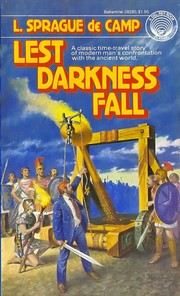
Lest Darkness Fall is a 1939 alternate history science fiction novel by the American author L. Sprague de Camp. Lest Darkness Fall is similar in concept to Mark Twain's A Connecticut Yankee in King Arthur's Court, but the treatment is very different.
Plot
American classical archaeologist Martin Padway is visiting the Pantheon in Rome in 1938. A thunderstorm arrives, lightning cracks, and he finds himself transported to Rome in 535 AD. The Italian Peninsula is under the rule of the Kingdom of the Ostrogoths. The novel depicts their rule as a relatively benevolent despotism, allowing freedom of religion and maintaining the urban Roman society they had conquered, though slavery is common and torture the normal method of interrogation.
Padway initially wonders whether he is dreaming or delusional, but he quickly accepts his fate. As an archaeologist, he has enough understanding of various devices used before his time, but after the 6th century, to be able to reproduce them by the means available. He can speak both modern Italian and Classical Latin, and quickly learns enough Vulgar Latin to communicate effectively. Most crucially, Padway has read with great attention the book of the historian Procopius, who described the Gothic War (535–554) at whose outset Padway finds himself. He recalls the book in great detail, down to details of the time and route of the various armies' moves and their tactical and strategic considerations, as well as the convoluted and violent power struggles of the various contenders for the Gothic Kingship. Thus Padway, in effect, knows the direct, immediate future of the country where he lives and of some individual people whom he meets (at least, until he acts in a way that changes that future). In addition to this specialized and uniquely useful knowledge of the current war, Padway has taken a general interest in military history, which he is eventually able to put to very practical purposes.
Padway's first idea is to make a copper still and sell brandy for a living. He persuades a banker, Thomasus the Syrian, to lend him seed money to start his endeavor. He teaches his and Thomasus's clerks Arabic numerals and double entry bookkeeping. He eventually develops a printing press, issues a newspaper, and builds a crude semaphore telegraph system utilizing small telescopes. However, he fails to produce a mechanical clock, and temporarily halts his experiments attempting to reinvent gunpowder and cannons. He becomes increasingly involved in the politics of the state as Italy is invaded by the Byzantines and also threatened from the north.
Padway rescues the recently deposed king Thiudahad and becomes his quaestor. He uses the king's support to gather forces to defeat the formidable Byzantine general Belisarius. He manages to surprise Belisarius with tactics never used in the ancient world. Then, deceiving the Dalmatian army, Padway reinstates the senile Thiudahad and imprisons King Wittigis as a hostage. In 537, when Wittigis is killed and Thiudahad descends into madness, Padway has a protégé of his, Urias, married to Mathaswentha and crowned king of the Ostrogoths. He tricks Justinian I into releasing Belisarius from his oath of allegiance and quickly enlists the military genius to command an army against the Franks.
The landing of a Byzantine army at Vibo, led by Bloody John, and a rebellion, led by Thiudahad's son, threaten the Ostrogothic kingdom and its army is destroyed at Crathis Valley. Padway assembles a new force, spreads an "emancipation proclamation" to the Italian serfs and recalls Belisarius after his defeat of the Franks. The armies clash near Calatia and then Benevento. Despite the lack of discipline of his Gothic forces, some simple tactical tricks and the nick-of-time arrival of Belisarius secure Padway's victory.
At the end of the novel, Padway has stabilized the Italo-Gothic kingdom, introduced a constitution, arranged the end of serfdom, liberated the Burgundians, and is having boats built for an Atlantic expedition to acquire tobacco. The king of the Visigoths has appointed Urias as his heir, reunifying the Goths. Ultimately, due to Padway's actions, Europe will not experience what Enlightenment thinkers retrospectively named the Dark Ages: "darkness will not fall".
Principal characters
Martin Padway (self-Latinized as Martinus Paduei): Protagonist. Transported from 1938 Rome to its 535 equivalent.
Nevitta, Nevitta Gummund's son: Gothic farmer, Padway's best friend in ancient Rome.
Thomasus the Syrian: Banker and confidant of Padway. Often invokes God's name, especially while bickering.
Fritharik, Staifan's son: Deposed Vandal noble, who becomes Padway's bodyguard and right-hand man. Often laments the loss of his beautiful Carthage estate and remarks that they will eventually all end up in unmarked graves.
Julia from Apulia: A servant hired by Padway who has a one-night stand with him.
Dorothea: Daughter of Cornelius Anicius and love interest for Padway.
Leo Vekkos: Greek physician called in by Nevitta, against Padway's protests, to treat his cold.
Count Honorius: City prefect/governor.
Liuderis: Commander of the Goths' garrison in Rome.
Thiudahad: King of the Ostrogoths and Italians. He is deposed and replaced by Wittigis, but is brought back under Padway's influence.
Thiudegiskel: The pompous son of Thiudahad. He is usually found surrounded by his posse of friends, using his position to put anyone who wrongs him in trouble.
Urias: Nephew of Wittigis and an ally of Padway's. Becomes king with Padway's help after Thiudahad is no longer fit to rule.
Mathaswentha: Daughter of Amalswentha and the other love interest for Padway. Their brief romance is cut short when she decides, to Padway's horror, to have any competition killed. Padway sets her up with Urias, whom she marries.
Belisarius: General of the Eastern Roman Empire. Eventually persuaded by Padway to join the Gothic army.
以上文字摘自英文维基百科「Lest Darkness Fall」(有删节,去掉了参考文献等尾部小节),按 CC BY-SA 4.0 使用,作者为维基百科的各位编者。
资料卡
- 原题
- Lest Darkness Fall
- 原作语言
- 英语
- 首次出版
- 1941 年
- 作品形式
- 长篇小说
- 体裁
- 科学幻想、架空历史
- 首版出版社
- 亨利·霍尔特出版公司
- 主题
- 时间旅行
- 故事发生地
- 罗马帝国、罗马
资料卡来自 Wikidata Q3020470(CC0),众包数据,个别字段可能不全。