书单
百科
这个词条暂时没有中文维基百科条目,下面是英文维基百科的内容(英文原文):
The Zap Gun is a 1967 science fiction novel by American writer Philip K. Dick. It was first published as the two-part serial Project Plowshare in Worlds of Tomorrow in 1965 and 1966, before Pyramid Books issued it in paperback under its present title. The novel originated in a title-first commission devised by Pyramid editor Don Bensen and was written in 1964 during a period of rapid production in Dick's career.
Set in 2004, the novel depicts two rival power blocs that secretly maintain a fictitious arms race while converting supposed weapons into consumer products. When extraterrestrial slavers attack Earth, the governments must rely on rival weapons designers Lars Powderdry and Lilo Topchev to produce a genuine defense. Their efforts eventually lead to an empathic device that defeats the invaders by forcing them to experience the suffering they inflict.
Critics have interpreted The Zap Gun as a satire of Cold War militarism, consumer culture, institutional deception, and the construction of artificial political realities. Its use of bureaucratic language, comic-strip imagery, abrupt tonal changes, and unstable narrative structure has also been discussed as characteristic of Dick's satirical method. Reviews have been divided: some critics praised the novel's inventiveness, political observations, and comedy, while others regarded it as disorganized, overextended, or less successful than Dick's strongest work.
Background and publication
The origins of The Zap Gun lay partly in a title-first commissioning practice at Pyramid Books. In a 1963 letter, Pyramid editor D. R. Bensen wrote that paperback publishers often favored titles that were immediately recognizable as science fiction and that he sometimes responded by devising titles before suggesting books to fit them. He named Space Opera and The Zap Gun as examples, associating the latter with a proposed novel about the twenty-first-century armaments industry. The Encyclopedia of Science Fiction reports that Bensen later recalled commissioning Jack Vance and Philip K. Dick to write novels corresponding to the two titles, respectively.
The novel was written in 1964, with Dick's biographer Lawrence Sutin dating its composition more specifically to March and April, when Dick was also writing The Penultimate Truth. Sutin places the two novels within a period of unusually rapid production undertaken under financial pressure. He states that Dick wrote them with the aid of amphetamines during the final breakup of his marriage to Anne Dick, and reports Dick's claim that he produced approximately 1,200 pages in three weeks during this broader period.
The novel first appeared under the title Project Plowshare as a two-part serial in Worlds of Tomorrow. The first installment appeared in November 1965, followed by the concluding installment in January 1966. Both issues were edited by Frederik Pohl and published by Galaxy Publishing Corporation.
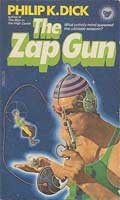
Pyramid Books published the novel in book form as The Zap Gun in January 1967. Jack Gaughan created the cover art for the edition. Among later English-language editions were a Panther edition published in 1975, a Bluejay reissue in 1985, and a Vintage edition in 2002. Reviewing the Vintage edition, Aaron Parrett suggested that the publication of Dick's work by Vintage might indicate growing recognition of his literary complexity and craftsmanship.
Plot
The novel is set in 2004, two years after the governments of the world's two major power blocs secretly end their arms race. To the public, Wes-bloc and Peep-East remain engaged in a continuing Cold War. Under the Plowshare Protocols, both sides announce increasingly powerful weapons while privately ensuring that the designs are not developed for military use. Instead, engineers convert, or "plowshare", them into consumer products, toys, household devices, and other novelties. Only officials within the two governments know that the apparent military competition is largely fictitious.
Lars Powderdry, professionally known as Mr. Lars, is Wes-bloc's principal weapons fashion designer. His Peep-East counterpart is Lilo Topchev. Both enter drug-assisted trance states in which they produce sketches that engineers subsequently interpret as weapon designs. Lars operates a company with offices in New York and Paris, the latter managed by his colleague and mistress, Maren Faine. Although wealthy and publicly celebrated, Lars is dissatisfied with his role and fears that he may eventually enter a trance without producing a design. He is also preoccupied with Lilo, whom he has never met.
Surley G. Febbs, an employee of a savings and loan company in Boise, is selected as one of six "average consumers", or concomodies, assigned to the UN-W Natsec Board. Febbs regards the appointment as an opportunity to expose what he considers government corruption and to acquire political influence. He disputes the decisions of the military and administrative officials on the board and later begins organizing the other concomodies independently.
The Plowshare system becomes a liability when unidentified satellites appear above Earth. Wes-bloc officials initially cannot determine whether they are Peep-East weapons or extraterrestrial objects. New Orleans is enclosed beneath an opaque gray field, and its population disappears from contact; additional populated areas are subsequently taken. The governments eventually learn that the attackers are slavers from the Sirius system. Because neither bloc has maintained functional advanced weapons, the two governments turn to Lars and Lilo in the hope that they can produce a genuine defensive design.
以上文字摘自英文维基百科「The Zap Gun」(有删节,去掉了参考文献等尾部小节),按 CC BY-SA 4.0 使用,作者为维基百科的各位编者。
资料卡
- 原题
- Project Plowshare
- 原作语言
- 美国英语
- 首次出版
- 1967 年
- 作品形式
- 长篇小说
- 体裁
- 科学幻想
- 首版出版社
- 乔夫图书
资料卡来自 Wikidata Q1106283(CC0),众包数据,个别字段可能不全。