书单
百科
这个词条暂时没有中文维基百科条目,下面是英文维基百科的内容(英文原文):
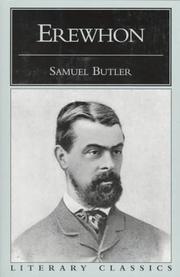
Erewhon, or Over the Range (ERR-eh-hwon) is a utopian novel by English writer Samuel Butler, first published in 1872, set in a fictional country discovered and explored by the protagonist. The book is a satire on Victorian society. Its name is an anagram of the word “nowhere”, with the same meaning as “utopia” (nowhere).
The first few chapters of the novel dealing with the discovery of Erewhon are based on Butler's own experiences in New Zealand; as a young man, he had worked there as a sheep farmer on Mesopotamia Station for four years (1860–1864), exploring parts of the interior of the South Island and writing about it in A First Year in Canterbury Settlement (1863).
The novel is one of the first to explore ideas of artificial intelligence, as influenced by Darwin's recently published On the Origin of Species (1859) and the machines developed out of the Industrial Revolution (late 19th to early 20th centuries). Specifically, it concerns itself, in the three-chapter "Book of the Machines", with the potentially dangerous ideas of machine consciousness and self-replicating machines.
In Erewhon, illness is crime, and crime is illness. As a result, citizens are imprisoned for offenses like physical ailments, misfortune, or ugliness while those who commit conventional crimes like fraud or theft are seen more sympathetically as exhibiting symptoms of moral afflictions and prescribed sessions with a "straightener" (essentially a psychologist) for treatment. The lack of compassion for physical sickness is reflected in the role of physicians in Erewhonian society, which is described as something more akin to that of a judge or law enforcement officer than that of a doctor. This system of law and medicine is a satirical inversion of the pattern in western society where crimes are punished and physical illnesses are treated—immorality is a matter of luck beyond one's control while sickness falls into the purview of one's individual autonomy.
Content
The greater part of the book consists of a description of Erewhon.
The Book of the Machines
Butler developed the three chapters of Erewhon that make up "The Book of the Machines" from a number of articles he had contributed to The Press, which had just begun publication in Christchurch, New Zealand, beginning with "Darwin among the Machines" (1863). Butler was the first to write about the possibility that machines might develop consciousness by natural selection.
In his preface to the second edition Butler wrote: "I regret that reviewers have in some cases been inclined to treat the chapters on Machines as an attempt to reduce Mr. Darwin's theory to an absurdity. Nothing could be further from my intention, and few things would be more distasteful to me than any attempt to laugh at Mr. Darwin."
Characters
Higgs: The narrator, who informs the reader of the nature of Erewhonian society.
Chowbok (Kahabuka): Higgs' guide into the mountains; he is a native, who greatly fears the Erewhonians. He eventually abandons Higgs.
Yram: The daughter of Higgs' jailer, who takes care of him when he first enters Erewhon. Her name is Mary spelled backwards.
Senoj Nosnibor: Higgs' host after he is released from prison; he hopes that Higgs will marry his elder daughter. His name is Robinson Jones backwards.
Zulora: Senoj Nosnibor's elder daughter. Higgs finds her unpleasant, but her father hopes that Higgs will marry her.
Arowhena: Senoj Nosnibor's younger daughter; she falls in love with Higgs and runs away with him.
Mahaina: A woman who claims to suffer from alcoholism but is believed to have a weak temperament.
Ydgrun: The incomprehensible goddess of the Erewhonians. Her name is an anagram of Grundy (from Mrs. Grundy, a character in Thomas Morton's play Speed the Plough).
Reception
In 1873, the reviewer in the Dunedin newspaper the Otago Witness declared that Erewhon was the best English satirical fiction since Gulliver's Travels (1726).
In a 1945 broadcast, George Orwell praised the book and said that when Butler wrote Erewhon, it needed "imagination of a very high order to see that machinery could be dangerous as well as useful". He recommended the novel, though not its sequel, Erewhon Revisited.
Adaptations
In 2014, New Zealand artist Gavin Hipkins released his first feature film, titled Erewhon and based on Butler's book. It premiered at the New Zealand International Film Festival and the Edinburgh Art Festival.
Influence
The French philosopher Gilles Deleuze used ideas from Butler's book at various points in the development of his philosophy of difference. In Difference and Repetition (1968), Deleuze refers to what he calls "Ideas" as "Erewhon". "Ideas are not concepts", he said, they are "a form of eternally positive differential multiplicity, distinguished from the identity of concepts". "Erewhon" refers to the "nomadic distributions" that pertain to simulacra, which "are not universals like the categories, nor are they the hic et nunc or nowhere, the diversity to which categories apply in representation". "Erewhon", in this reading, is "not only a disguised no-where but a rearranged now-here".
In his collaboration with Félix Guattari, Anti-Oedipus (1972), Deleuze draws on Butler's "The Book of the Machines" to "go beyond" the "usual polemic between vitalism and mechanism", as it relates to their concept of "desiring-machines":
以上文字摘自英文维基百科「Erewhon」(有删节,去掉了参考文献等尾部小节),按 CC BY-SA 4.0 使用,作者为维基百科的各位编者。
资料卡
- 原题
- Erewhon
- 原作语言
- 英语
- 首次出版
- 1872 年
- 作品形式
- 长篇小说
- 体裁
- 科学幻想、奇幻、乌托邦小说、失落的世界
- 首版出版社
- Nicholas Trübner
- 续作
- Erewhon Revisited
资料卡来自 Wikidata Q1350048(CC0),众包数据,个别字段可能不全。