书单
百科
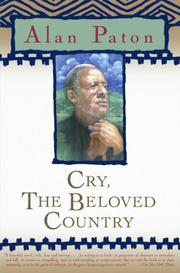
哭吧,亲爱的祖国是南非作家艾伦·佩顿于1948年创作的一部小说。故事背景设定在南非种族隔离实施的前夕,讲述了一位黑人乡村牧师与一位白人农场主在得知凶案消息后的故事。该小说曾被两次改编成电影。
以上文字摘自维基百科「哭吧,亲爱的祖国」(去掉了参考文献等尾部小节),按 CC BY-SA 4.0 使用,作者为维基百科的各位编者。
中文维基百科的条目比较短,下面附上英文维基百科的内容(英文原文):
Cry, the Beloved Country is a 1948 novel by South African writer Alan Paton. Set in the prelude to apartheid in South Africa, it follows a black village priest and a white farmer who must deal with news of a murder.
American publisher Bennett Cerf remarked at that year's meeting of the American Booksellers Association that there had been "only three novels published since the first of the year that were worth reading… Cry, The Beloved Country, The Ides of March, and The Naked and the Dead." It remains one of the best-known works of South African literature.
Two cinema adaptations of the book have been made, the first in 1951 and the second in 1995. The novel was also adapted as a musical called Lost in the Stars (1949), with a book by the American writer Maxwell Anderson and music composed by the German emigre Kurt Weill.
Plot
The story begins in the (fictional) village of Ndotsheni, near the real-life village of Ixopo, where the Christian priest Stephen Kumalo, a Zulu, receives a letter from the priest Theophilus Msimangu in Johannesburg. Msimangu urges Kumalo to come to the city to help his sister Gertrude because she is ill. Kumalo goes to Johannesburg to help her and find his son Absalom, who had gone to the city to look for Gertrude but never came home. It is a long journey to the great city of Johannesburg, and Kumalo sees the wonders of the modern world for the first time.
When he gets to the city, Kumalo learns that Gertrude has taken up a life of prostitution and beer brewing and is now drinking heavily. She agrees to return to the village with her young son. Assured by these developments, Kumalo embarks on the search for Absalom, first seeing his brother John, a carpenter who has become involved in the politics of South Africa. Kumalo and Msimangu follow Absalom's trail, only to learn that Absalom has been in a reformatory and will have a child with a young woman. Shortly thereafter, Kumalo discovers that his son has been arrested for murder. The victim is Arthur Jarvis, a white man who was killed during a burglary. Jarvis was an engineer and an Indigenous rights activist as well as the son of Kumalo's neighbour, James Jarvis.
Jarvis learns of his son's death and comes with his family to Johannesburg. Jarvis and his son had been distant, and now the father begins to know his son through his writings. Through reading his son's essays, Jarvis decides to take up his son's work for South Africa's black population.
Absalom reveals at his trial that he was pressured into committing a burglary by and with his two "friends", who later denied their involvement and threw all the blame on Absalom. Absalom is sentenced to death for the murder of Arthur Jarvis. Before his father returns to Ndotsheni, Absalom marries the girl carrying his child. She joins Kumalo's family. Kumalo returns to his village with his daughter-in-law and nephew, having found that Gertrude ran away the night before their departure.
Back in Ixopo, Kumalo makes a futile visit to the tribe's chief to discuss changes that must be made to help the barren village. Help arrives, however, when James Jarvis becomes involved in the work. He arranges for a dam to be built and hires a native agricultural demonstrator to implement new farming methods.
The novel ends at dawn on the morning of Absalom's execution. The fathers of the two children are devastated that both of their sons have wound up dead.
Characters
Stephen Kumalo: A 60-year-old Christian Zulu priest, the father of Absalom, who attempts to find his family in Johannesburg, and later to reconstruct the disintegrating state of his village. Book three focuses heavily on his relationship with James Jarvis.
Theophilus Msimangu: A priest from Johannesburg who helps Kumalo find his son Absalom and his sister Gertrude.
John Kumalo: Stephen's brother, who denies the tribal validity and becomes a spokesman for the new racial movement in the city; a former carpenter.
以上文字摘自英文维基百科「Cry, the Beloved Country」(有删节,去掉了参考文献等尾部小节),按 CC BY-SA 4.0 使用,作者为维基百科的各位编者。
资料卡
- 原题
- Cry, the Beloved Country
- 原作语言
- 英语
- 首次出版
- 1948 年 2 月
- 作品形式
- 长篇小说
- 体裁
- 历史类虚构作品
- 故事发生地
- 南非
- 获奖
- 安斯非德-禾夫图书奖(1949)
资料卡来自 Wikidata Q2916551(CC0),众包数据,个别字段可能不全。
改编作品
电影2
舞台剧 / 歌剧 / 芭蕾1
名单来自 Wikidata(CC0):只列条目里写明「改编自 / 取材于」这本书的作品,不按名字猜;众包数据,可能不全。