 书单
百科
‘挪威民话集’(挪威语:Norske Folkeeventyr、英语:Norwegian Folktales)是彼得·克里斯滕·阿斯比约恩森和约尔根·穆厄收集挪威的民间故事和传说而成。两人因为此书合称‘阿斯比约恩森和穆厄’(Asbjørnsen and Moe)。
发行
‘挪威民话集’由原集60篇和新选集50篇的合计110篇所构成。1841年,原集出版后,获得好评。1871年,发行新选集。之后的版本,收录多位挪威画家的插画。
收录
以下是部分收录作品,译名参考‘日之东‧月之西:北欧故事集’。
拜访北风的少年(Gutten som gikk til nordenvinden og krevde igjen melet)
拉西和她的教母(Jomfru Maria som gudmor)
白境的三个公主(De tre prinsesser i Hvittenland)
寡妇之子(Enkesønnen)
没有心脏的巨人(Risen som ikke hadde noe hjerte på seg)
日之东‧月之西(Østenfor sol og vestenfor måne)
照顾家的丈夫(Mannen som skulle stelle hjemme)
玻璃丘上的公主(Jomfruen på glassberget)
朵弗费尔的猫(Kjetta på Dovre)
蓝色腰带(Det blå båndet)
蓝山的三个公主(De tre kongsdøtre i berget det blå)
索里亚·莫里亚城堡(Soria Moria slott)
以上文字摘自维基百科「挪威民話集」(去掉了参考文献等尾部小节),按 CC BY-SA 4.0 使用,作者为维基百科的各位编者。
中文维基百科的条目比较短,下面附上英文维基百科的内容(英文原文):
Norwegian Folktales (Norwegian: Norske folkeeventyr) is a collection of Norwegian folktales and legends by Peter Christen Asbjørnsen and Jørgen Moe. It is also known as Asbjørnsen and Moe, after the collectors.
Asbjørnsen and Moe
Asbjørnsen, a teacher, and Moe, a minister, had been friends for about 15 years when in 1841 they published the first volume of folktales – the collection of which had been an interest of both for some years. The work's popularity is partly attributable to Norway's newly won partial independence, and the wave of nationalism that swept the country in the 19th century; and the Norwegian written language they contributed to developing (i.e., what would become Bokmål). The language of their publication of the fairy tales struck a balance in that, while it did not preserve their original dialect form in its entirety, it did import certain non-Danish features from it (dialect words and certain syntactic constructions).
Asbjørnsen and Moe were inspired by the German folktale collectors, the Brothers Grimm, not merely to emulate their methodology, but drawing encouragement by it, their endeavor was a work of national importance, especially as the Grimms openly gave high praise for the Norske folkeeventyr. Asbjørnsen and Moe applied the principles espoused by the Grimms, for instance, using a simple linguistic style in place of dialects, while maintaining the original form of the stories. Moreover, Asbjørnsen and Moe did not publish collected folktales in the raw, but created "retold" versions, seeking to reconstruct the lost Urform (original form) of the tales—although the alterations performed were not as drastic as the Grimms sometimes allowed license for themselves. The Norwegian pair also collected tales from the field themselves, in contrast to the Grimms.
Publications
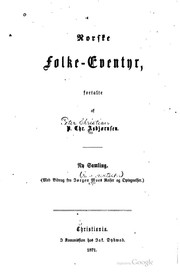
The original series, entitled Norske Folkeeventyr went into publication piecemeal. It first appeared a slim pamphlet (1841) offering a selection of a few tales, without a title page, the editor's names or table of contents. This was sufficiently well-received, and championed by P. A. Munch in a German newspaper. It led to the appearance of a reprint of the first volume in 1843 and the second volume in 1844 as proper hardcovers. The second edition appeared in 1852. Another series dubbed the "New Collection" appeared later (Norske Folke-Eventyr. Ny Samling 1871). The tales are numbered, the original collection containing 58 tales, increased to 60 tales in later editions. The new collection held 50 tales.
Asbjørnsen as a solo project collected and published Norske Huldre-Eventyr og Folkesagn I-II (1845–48), which also was expanded by a "second collection," (Norske huldre-eventyr og folkesagn: anden samling 1866).
Illustrators
The first fully illustrated edition of the book was the 1879 edition of Asbjørnsen's Norske folke- og huldre-eventyr, which featured the artworks of several artists: Peter Nicolai Arbo (1831−1892), Hans Gude (1825−1903), Vincent Stoltenberg Lerche, Eilif Peterssen (1852−1928), August Schneider (1842−1873), Otto Sinding (1842−1909), Adolph Tidemand (1814−1876), and Erik Werenskiold (1855−1938).
In later editions, Werenskiold and Theodor Kittelsen became prominent illustrators. Kittelsen was an unknown artist when he began collaborating on the project on the recommendation of his friend Werenskiold.
Translation into English
The tales were first translated into English by Sir George Webbe Dasent. He translated all but a few of the tales from the two series of Norske Folkeeventyr. Dasent's Popular Tales from the Norse (1859), contains all 58 tales from the initial edition of the original collection. Dasent's Tales from the Fjeld: A Second Series of Popular Tales (1874) covers the two tales added to later editions of the original collection and 45 of the tales from the new collection.
以上文字摘自英文维基百科「Norwegian Folktales」(有删节,去掉了参考文献等尾部小节),按 CC BY-SA 4.0 使用,作者为维基百科的各位编者。
资料卡
- 原题
- Norske Folkeeventyr
- 原作语言
- 书面挪威语
- 首次出版
- 1841 年
- 作品形式
- 童话集
资料卡来自 Wikidata Q2026385(CC0),众包数据,个别字段可能不全。