书单
百科
这个词条暂时没有中文维基百科条目,下面是英文维基百科的内容(英文原文):
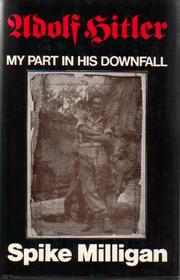
Adolf Hitler: My Part in His Downfall, published in 1971, is the first volume of Spike Milligan's war memoirs. The book spans the period from Britain's declaration of war on Germany to when Milligan lands in Algeria as a part of the Allied liberation of Africa.
The preface anticipates the book will be part of a trilogy; years later, the cover of the fourth volume said: "Don't be fooled this is the last, volume four of the war memoirs." Ultimately, however, Milligan published seven volumes covering his war service, his first nervous breakdown and reallocation to rear-echelon duties, his demob and early years trying to break into the entertainment industry. In Mussolini: His Part in My Downfall, having been stung by a critic who called the biographies unreliable, Milligan wrote, "I wish the reader to know that he is not reading a tissue of lies and fancies, it all really happened."
The presentation is an unusual format freely mixing narrative anecdotes, contemporary photography, excerpts from diaries, letters, rough sketches and performance programs, along with comic sketches and absurd fake memoranda from ranking Nazi officials; the hard facts are usually apparent. Milligan says in the preface: "All the salient facts are true"; at the end of the preface: "There were the deaths of some of my friends, and therefore, no matter how funny I tried to make this book, that will always be at the back of my mind: but, were they alive today, they would have been the first to join in the laughter, and that laughter was, I'm sure, the key to victory."
The book was made into a film with the same title and adapted into a stage play.
Summary
Prologue
The prologue consists of only two sentences, which in itself represents the word-play humour that was Milligan's hallmark: "After Puckoon I swore I would never write another novel. This is it."[b]
Part 1
Milligan is at home with his family. His mother is digging the air-raid shelter when Neville Chamberlain announces that Britain is at war with Germany. The family response is for Spike, his father and brother to produce boyish drawings of war machines (the drawings are included in the book), which are taken to the War Office.
Milligan receives a letter marked O.H.M.S., which his uncle advises him not to open. After some weeks similar letters arrive marked "Urgent". Eventually he opens one containing a "cunningly worded invitation to partake in World War II". About then, in an attempt to impress girls at a gym, he slips a disc, whereupon he's hospitalised to determine whether he's faking. After three months of avoiding call-up, he is given "a train ticket and a picture of Hitler reading "This is your enemy". He searches the train, but can't find him.
"I got off at Bexhill-on-Sea. It wasn't easy – the train didn't stop there".
Part 2
Part 2 lasts 13 pages, much of it illustrations by Milligan or photographs. He begins his months in military training at Bexhill-on-Sea. It starts with Milligan joining his regiment (56th Heavy Regiment Royal Artillery) late and immediately being singled out as a troublemaker. He learns disrespect for certain officers within a few sentences and commences sniping:
"I suppose," said Suitcase, "you know you are three months late arriving?"
"I'll make up for it sir, I'll fight nights as well!"
Milligan refers to his first commanding officer as "Leather Suitcase" for the numerous leather patches on his uniform. Suitcase is an officious peacetime officer with no field experience. He is removed when General Montgomery takes over. The regiment is also blessed with soldiers who are no use to anybody, disruptive or even mentally disturbed. These men are sometimes "posted", which is described in a footnote as "the art of being shifted sideways". At any given time, according to Milligan, hundreds of men were in transit between regiments that didn't want them. Milligan then facetiously describes the last of them as being found "naked save for a vest one sock" sitting on the back of a lorry, "waiting to be posted".
Milligan talks to soldiers returning from Dunkirk and sees his first German plane. His regiment is equipped with the obsolete BL 9.2-inch howitzer. Gun drill includes the crews shouting "bang" in unison as they have no shells to practice with. A shell from World War I is eventually found and they make strenuous attempts to fire it for practice. It's a dud. A year passes, Milligan trains, the summer months are pleasant. One of the gunners, however, loses a hand when a shell he is pushing into the howitzer's breech explodes.
Part 3
Part 3 begins a year previously, and launches into a favourite Milligan literary aside—a long discussion of setting up musical shows, including names of songs, instruments and players. It is while playing jazz that he meets his lifelong friend, self-taught pianist Harry Edgington, a man "with moral scruples that would have pleased Jesus". (In the biographies, Milligan variously portrays himself as licentious or unusually chaste.) The group of pick-up military musicians practices for a month, then are asked to give their first gig in Bexhill Old Town Church Hall. (Milligan's military career shifts between his duties as a gunner and musical performances.) Milligan notes that until 1940 they were entertaining nightly, which he later saw as his first steps into show business. He is left off long enough to go to a BBC musician contest, where as a trumpet player, he wins a recording session with an established artist. He cuts his first records, then returns to barracks.
以上文字摘自英文维基百科「Adolf Hitler: My Part in His Downfall」(有删节,去掉了参考文献等尾部小节),按 CC BY-SA 4.0 使用,作者为维基百科的各位编者。
资料卡
- 原题
- Adolf Hitler: My Part in His Downfall
- 原作语言
- 英语
- 首次出版
- 1971 年
- 作品形式
- 长篇小说
- 体裁
- 自传
- 首版出版社
- Michael Joseph
- 续作
- "Rommel?" "Gunner Who?"
资料卡来自 Wikidata Q4684102(CC0),众包数据,个别字段可能不全。