书单
百科
这个词条暂时没有中文维基百科条目,下面是英文维基百科的内容(英文原文):
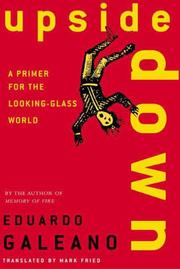
Upside Down: A Primer for the Looking-Glass World (Spanish: Patas Arriba: la Escuela del Mundo al Revés), originally published in Spanish in 1998, was written by Eduardo Galeano, a Uruguayan author who was greatly impacted by the political turmoil during the 20th century military regimes in Latin America. Events such as the Uruguayan military coup forced Galeano into exile in Spain and Argentina; these exiles, in particular, may have been formative in Galeano's life and writing. The ruminations of this book were formed as a result of Galeano's desire to remember the past traumas and as well as to learn from them. Within this piece of nonfiction, he explores themes such as modern education systems, racism, sexism, poverty, economics, work, and societal fear. The pretense of the prose tends to be preoccupied with learning to rethink the contradictions of society; in a moment when outrageous circumstances are normalized, it is time to reconsider the understandings many people hold, which, in turn, informs the way such people view things. Though focusing on Latin America, Galeano uses what he has learned from the political and social environment within Latin America to understand injustices and social dynamics throughout the rest of the world.
Form
In Upside Down, Galeano makes a set of rhetorical and visual choices that expose the intentions of his book. Beginning with the title, Upside Down: A Primer for the Looking-Glass World, Galeano uses the term "primer" to convey the educational goals of the book. Later on he uses the term "practicum" to reinforce such goals. Primer, in this case, both indicates Galeano’s wish for this to be the initial textbook that engenders a new structure of thought and also suggests a secondary meaning; he views Upside Down as a text that provides a clear foundation. Galeano's prose is accessible to intellectuals as well as non intellectuals; many examples are developed in very clear and simple terms. His desire to change his readers' manner of thinking is shown through the accessibility of this non-fiction piece. Furthermore, small drawings, such as the one seen to the left, occupy the pages of this text. The text and image is reminiscent of introductory textbooks and picture books. Overall, Galeano's choices seem to always enhance accessibility.
Summary
Upside Down presents the relationship between developed (or “first world”) and developing (or “third world”) nations, illuminating the influences of the colonizer over the colonized. Seeing life as "upside down" becomes the central metaphor for looking at experiences throughout the book. Galeano’s epigraph clues the reader into this by farcically posturing Al Capone, as an authority on honor, law, and virtue. It is frightening that Capone delivers a truthful message about the realistic and corrupt state of affairs, given the business he works in. Upending experience calls into question structures we imagine as unchangeable and factual. Galeano suggests that we can start to understand our perceptions of power as based from media interpretations when these "facts" are turned upside down again and forced to stand on their own, inherently dropping all media constructed falsities. Common views of power and hierarchy within societies, institutions, and media begin to look less believable when held against the raw numbers Galeano presents to his readers. Galeano also challenges the First World, eurocentric readers with the question of why Europe and America are always presented on the top of the world, and why can't Latin America and Australia and Africa be seen as the top of the world? The method of questioning also forces his readers to critically analyze themselves and their roles in these power dynamics.
Education
Galeano begins his analysis with the students, and eventually looks at the role of teachers in the classroom. Finally he moves to the employment industry, analyzing the lessons learned from commercialism and from the general society. He divides the students into social class based on familial economic standings and sees the futures of students based on these economic standings as being pre-set. Poor kids are disrespected for being poor, rich kids are respected for being rich, and rich and poor kids end up in the same position as their parents. Further distinguishing between the social classes, he explains that rich children in Latin America never experience the city they live in; they live in a sheltered, private, improved version of it. Galeano claims that these children see their own societies "as a threat," and therefore are "stripped of cultural identity". Poor children, on the other hand, are "dodging real bullets" and "little slaves in the family economy of in the informal sector of the global economy". In Latin American society, poor children are seen as potential disasters after they are victimized in child labor, the sex trade and sweat shop labor. Galeano demonstrates that the current system of "education" locks poor children in their social space in ways that often cause additional social grief. Galeano shares the personal story of a street kid who looks to drugs to rid himself of all the problems he faces in his daily life of poverty. Meanwhile, the children that lie somewhere between rich and poor taught the "fear of living, fear of falling, fear of losing your job, your car, your home, your possessions, fear of never having what you ought to have in order to be". Teachers, after the redistribution of jobs so that jobs are now almost all temporary, have had to accept that teaching "does not pay". Galeano points out that it is counterintuitive to be financially unappreciative of those who are greatly involved in forming the next generation of workers and citizens.
以上文字摘自英文维基百科「Upside Down (book)」(有删节,去掉了参考文献等尾部小节),按 CC BY-SA 4.0 使用,作者为维基百科的各位编者。
资料卡
- 原题
- Upside Down
- 首次出版
- 2001 年
资料卡来自 Wikidata Q7899274(CC0),众包数据,个别字段可能不全。