书单
百科
这个词条暂时没有中文维基百科条目,下面是英文维基百科的内容(英文原文):
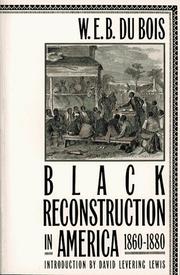
Black Reconstruction in America: An Essay Toward a History of the Part Which Black Folk Played in the Attempt to Reconstruct Democracy in America, 1860–1880 is a history of the Reconstruction era by W. E. B. Du Bois, first published in 1935. The book challenged the standard academic view of Reconstruction at the time, the Dunning School, which contended that the period was a failure and downplayed the contributions of African Americans. Du Bois instead emphasized the agency of Black people and freed slaves during the Civil War and Reconstruction and framed the period as one that held promise for a worker-ruled democracy to replace a slavery-based plantation economy.
Context and inception
Du Bois' first published writing on Reconstruction was a 1901 Atlantic Monthly essay entitled "The Freedmen's Bureau", which was reprinted as the essay "Of the Dawn of Freedom" in his 1903 book The Souls of Black Folk. He also wrote about Reconstruction in his 1924 book The Gift of Black Folk. He wrote a more extensive essay on the topic entitled "Reconstruction and Its Benefits", which was first delivered to the American Historical Association in December 1909 in New York City. Albert Bushnell Hart, one of his former professors at Harvard University, sent him money to attend the conference. William Archibald Dunning, leader of what was called the Dunning School that developed at Columbia University, heard Du Bois' presentation and praised his paper, according to Du Bois. The essay was published in the July 1910 issue of The American Historical Review, but had little influence at the time.
The academic consensus at this time portrayed black enfranchisement and Reconstruction governments in the south as a failure. A view had collected around James Pike's work, The Prostrate State (1878), written shortly after Reconstruction ended. He contended there were no benefits from Reconstruction. Woodrow Wilson's Division and Reunion, 1829–1889 (1893), and James Ford Rhodes' History of the United States from the Compromise of 1850 (1906) denigrated African-American contributions during that period, reflecting attitudes of white supremacy in a period when most blacks and many poor whites had been disenfranchised across the South. James Wilford Garner's Reconstruction in Mississippi (1901), Walter L. Fleming's Civil War and Reconstruction in Alabama (1905), Thomas Staples' Reconstruction in Arkansas, 1862–1874 (1923), and Charles William Ramsdell's Reconstruction in Texas (1910) were works by Dunning followers, most of whom had positions in history at Southern universities.
After the publication of Claude Bowers' The Tragic Era: The Revolution after Lincoln, which promoted the Dunning school view, in 1929, Anna Julia Cooper wrote to Du Bois and asked him to write a response. In 1931, Du Bois received funding to the Julius Rosenwald Fund funding for two books, including one on Reconstruction. In 1931, he wrote to Alfred Harcourt—whose publishing firm Harcourt, Brace and Howe would later publish the book—outlining the theses of what would become Black Reconstruction.
Summary
After three short chapters profiling the black worker, the white worker, and the planter, Du Bois argues in the fourth chapter that the decision gradually taken by slaves on the Southern plantations to stop working during the war was an example of a potential general strike force of four million slaves the Southern elite had not reckoned with. The institution of slavery simply had to soften: "In a certain sense, after the first few months everybody knew that slavery was done with; that no matter who won, the condition of the slave could never be the same after this disaster of war."
Du Bois' research shows that the post-emancipation South did not degenerate into economic or political chaos. State by state in subsequent chapters, he notes the efforts of the elite planter class to retain control and recover property (land, in particular) lost during the war. This, in the ever-present context of violence committed by paramilitary groups, often from the former poor-white overseer class, all throughout the South. These groups often used terror to repress black organization and suffrage, frightened by the immense power that 4 million voters would have on the shape of the future.
He documents the creation of public health departments to promote public health and sanitation, and to combat the spread of epidemics during the Reconstruction period. Against the claim that the Radical Republicans had done a poor job at the constitutional conventions and during the first decade of Reconstruction, Du Bois observes that after the Democrats regained power in 1876, they did not change the Reconstruction constitutions for nearly a quarter century. When the Democrats did pass laws to impose racial segregation and Jim Crow, they maintained some support of public education, public health and welfare laws, along with the constitutional principles that benefited the citizens as a whole.
Du Bois noted that the Southern working class, i.e. black freedmen and poor whites, were divided after the Civil War along the lines of race, and did not unite against the white propertied class, i.e. the former planters. He believed this failure enabled the white Democrats to regain control of state legislatures, pass Jim Crow laws, and disfranchise most blacks and many poor whites in the late 19th and early 20th centuries.
Du Bois' extensive use of data and primary source material on the postwar political economy of the former Confederate States is notable, as is the literary style of this 750-page essay. He notes major achievements, such as establishing public education in the South for the first time, the founding of charitable institutions to care for all citizens, the extension of the vote to the landless whites, and investment in public infrastructure.
以上文字摘自英文维基百科「Black Reconstruction in America」(有删节,去掉了参考文献等尾部小节),按 CC BY-SA 4.0 使用,作者为维基百科的各位编者。
资料卡
- 原作语言
- 英语
- 主题
- 美国重建时期
资料卡来自 Wikidata Q4921540(CC0),众包数据,个别字段可能不全。