书单
百科
这个词条暂时没有中文维基百科条目,下面是英文维基百科的内容(英文原文):
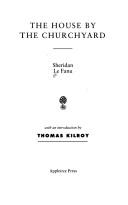
The House by the Churchyard is an 1863 novel by the Irish writer Sheridan Le Fanu that combines elements of the mystery novel and the historical novel. Le Fanu uses the Gothic fiction plot to explore various themes related to death, suspense, mystery, the supernatural, and the darker aspects of human actions against the backdrop of 18th-century Irish village life. The work is one of Le Fanu's most popular novels, and was first published in London by William Tinsley.
The story revolves around a series of interconnected crimes, disappearances and murders, both in the past and the present, that disrupt the seemingly peaceful Irish rural life. A newly unearthed human skull with unusual injuries sparks both intrigue and investigation, bringing in supporting characters like the mysterious Barnaby Sturk and the young medical student Charles Wilder. The protagonist is Mervyn, whose father was unjustly convicted of murder, and he returns to Chapelizod seeking to clear his family's name and uncover the truth behind the unsolved crimes. The novel is also noted for its vivid and detailed descriptions of the Irish countryside and its villages, creating a haunting setting for the plot. The setting of the novel involves an actual real-life building, located in Chapelizod village. Although it has undergone many rounds of renovations, the overall appearance of the building remains similar to what it was during the late 19th century, when the novel was written.
The work inspired several later Irish writers, including James Joyce, M. R. James, and Bram Stoker, who drew upon its Gothic horror and suspense features for their own novels. It has been considered by many critics as a precursor to the psychological horror genre, and although it is credited with influencing the genre significantly, there have been no adaptations of the novel to date.
Plot summary
The novel begins with a prologue in the voice of an old man, Charles de Cresseron, that is set in Chapelizod, Ireland, roughly a century after the events of the novel proper. This prologue details how, during an interment at the churchyard of the title, a skull is accidentally unearthed, which bears the marks of two crushing blows to the head and – even more disconcertingly – a small hole from a trepanning. The novel itself is Cresseron's reconstruction of the history related to this grisly item (though by and large his narratorial voice drops out and the novel is told from a conventional omniscient narrator's point of view).
The first chapter of the novel proper moves back to 1767, the period of the novel, and begins with another mysterious occurrence in the churchyard: the secretive burial of a coffin, with the occupant simply identified on the brass plaque as "R.D." But after this ominous opening the book turns (in its first half) to the careful and largely light-hearted elaboration of the social life and intrigues among the denizens of Chapelizod, from the powerful Lord Castlemallard to the soldiers in the local barracks under General Chattesworth, to the good Doctor Walsingham and his daughter Lily, to the gluttonous local Catholic priest Father Roach. The opening section of the novel is largely taken up by a farcical duel between two characters, Nutter and O'Flaherty, which arises from drunken misunderstanding and eventually is defused without any harm done. Le Fanu introduces hints of unease, though, with the advent of the mysterious Mr Mervyn, who takes up residence in the Tiled House, a building widely rumoured to be haunted. (At this point, Le Fanu interpolates a ghost story, "An Authentic Narrative of the Ghost of a Hand", which has often been separately anthologized.) Mervyn courts the daughter of the General, Gertrude Chattesworth, but has a rival in the scheming Mr Dangerfield, the trusted manager of the English estates of Lord Castlemallard who is visiting Chapelizod and who also has his eye on Gertrude. Dangerfield destroys the romance between Mervyn and Gertrude by setting into circulation vicious rumours about him and his family. Mervyn is in fact the son and heir of the late Lord Dunoran, who was found guilty of murdering a man named Beauclerc to whom he had lost a considerable sum at cards; Dunoran then committed suicide in his prison cell. (It was his coffin that was buried at the beginning of the book – the secrecy required because of the dubiousness of burying a suicide on consecrated ground.)
The centre of the novel is the dark web of intrigue surrounding Doctor Sturk, the military doctor (who is on the brink of bankruptcy) and Charles Nutter, the local agent for Lord Castlemallard, whom Sturk both hates and envies. Sturk is troubled by vague recollections about Dangerfield, and gradually realizes that he is in fact the wily and dangerous Charles Archer, who actually committed the murder of Beauclerc. (The only other person who knows about the identity of Charles Archer is Mr Irons, the church clerk, who was originally his accomplice.) Foolishly, Sturk tries to blackmail Dangerfield, and is later discovered in Phoenix Park with his head clubbed in. Sturk survives the attack but is left in a coma.
以上文字摘自英文维基百科「The House by the Churchyard」(有删节,去掉了参考文献等尾部小节),按 CC BY-SA 4.0 使用,作者为维基百科的各位编者。
资料卡
- 原题
- The House by the Churchyard
- 原作语言
- 英语
- 首次出版
- 1863 年
- 作品形式
- 长篇小说
- 首版出版社
- William Tinsley
- 故事发生地
- 都柏林
资料卡来自 Wikidata Q4165605(CC0),众包数据,个别字段可能不全。