书单
百科
这个词条暂时没有中文维基百科条目,下面是英文维基百科的内容(英文原文):
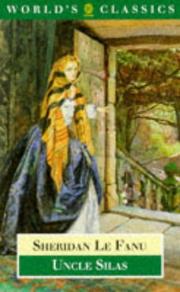
Uncle Silas, subtitled "A Tale of Bartram Haugh", is an 1864 Victorian Gothic mystery-thriller novel by the Irish writer Sheridan Le Fanu. The novel is a first-person narrative told from the viewpoint of one of the main characters. Despite Le Fanu resisting its classification as such, the novel has also been hailed as a work of sensation fiction by contemporary reviewers and modern critics alike. It is an early example of the locked-room mystery subgenre, rather than a novel of the supernatural (despite a few creepily ambiguous touches), but does show a strong interest in the occult and in the ideas of Emanuel Swedenborg, a Swedish scientist, philosopher and Christian mystic.
Like many of Le Fanu's novels, Uncle Silas grew out of an earlier short story, in this case "A Passage in the Secret History of an Irish Countess" (1839), which he also published as "The Murdered Cousin" in the collection Ghost Stories and Tales of Mystery (1851). While this earlier story was set in Ireland, the novel's action takes place in Derbyshire; the author Elizabeth Bowen was the first to identify a distinctly Irish subtext to the novel, however, in spite of its English setting. It was first serialized in the Dublin University Magazine in 1864, under the title Maud Ruthyn and Uncle Silas, and appeared in December of the same year as a three-volume novel from the London publisher Richard Bentley. Several changes were made from the serialization to the volume edition, such as resolving the inconsistencies of names.
Uncle Silas is known for its psychological suspense, exploration of various themes such as betrayal and inheritance, and its depiction of a prominent female protagonist. The novel's setting, particularly the contrast between its main characters, plays a significant role in the narrative. As one of Le Fanu's best-known works, the novel has been adapted numerous times for films, television series, books, radio, and other audio recordings.
Plot summary
The novel is a first-person narrative told from the point of view of the adolescent girl Maud Ruthyn, an heiress living with her wealthy, sombre, reclusive father Austin Ruthyn in their mansion at Knowl. Through her father and her worldly, cheerful cousin, Lady Monica Knollys, she gradually learns more regarding her uncle, Silas Ruthyn, a black sheep of the family whom she has never met; once an infamous rake and gambler, he is now apparently a fervently reformed Christian. His reputation has been tainted by the suspicious suicide of a man to whom Silas owed an enormous gambling debt, which took place within a locked, apparently impenetrable room in Silas's mansion at Bartram-Haugh.
In the first part of the novel, Maud's father hires a French governess, Madame de la Rougierre, as a companion for her. Madame terrifies Maud and appears to have designs on her: during two of their walks together, Maud is brought into suspicious contact with strangers that seem to be known to Madame. (In a cutaway scene that breaks the first-person narrative, we learn that she is in league with Silas's good-for-nothing son Dudley.) The governess is eventually dismissed when she is discovered by Maud in the act of searching her father's locked desk.
Maud is asked in obscure terms by her father, a Swedenborgian, if she is willing to undergo some kind of "ordeal" to clear the name of her uncle, and of the family more generally; shortly after she assents, her father dies from a ruptured aneurysm. At the reading of his will, it emerges that he had added a codicil to it so that Maud will live with Silas, who becomes her guardian until she comes of age. However, the will allows that, if she were to die whilst still a minor, the estate would then pass to Silas. Lady Knollys, together with Austin's executor and fellow Swedenborgian, Dr. Bryerly, attempts in vain to overturn the codicil, realizing its dangerous implications for the young heiress; despite their efforts, Maud consents willingly to spending the next three and a half years at Bartram-Haugh.
Maud initially finds life at Bartram-Haugh strange but not unpleasant, despite ominous signs such as the uniformly unfriendly servants and Silas's malevolent factotum, the one-legged Dickon Hawkes. Silas himself frightens Maud but is nonetheless seemingly kind to her, in contrast to his treatment of his own children, the loutish Dudley and the uneducated Millicent ('Milly'). Although Maud initially deprecates Millicent's rustic manners they become best friends, and each other's only source of companionship at the estate. During her stay, Maud is subject to various attempts by her cousin Dudley to court her, but she rejects him thoroughly on each occasion. Silas is periodically subject to mysterious catatonic fits, attributed to his massive consumption of laudanum.
Various ominous happenings begin to take place at Bartram-Haugh, and it becomes increasingly difficult for Maud and Millicent to find any way out of the estate. Meanwhile, Dudley's courtship culminates in a marriage proposal to Maud; when she complains to Silas about it, he attempts to coax her into accepting. She is relieved when it is discovered that Dudley is already married, and after being disowned by his father, he and his wife leave to set sail to Australia. Silas decides that Millicent should attend a boarding school in France, and sends her away with the promise that Maud is to join her after three months.
以上文字摘自英文维基百科「Uncle Silas」(有删节,去掉了参考文献等尾部小节),按 CC BY-SA 4.0 使用,作者为维基百科的各位编者。
资料卡
- 原题
- Uncle Silas
- 原作语言
- 英语
- 首次出版
- 1864 年
- 体裁
- 哥特小说
- 首版出版社
- Dublin University Magazine、理查德·班特利
资料卡来自 Wikidata Q3835925(CC0),众包数据,个别字段可能不全。
改编作品
电影1
名单来自 Wikidata(CC0):只列条目里写明「改编自 / 取材于」这本书的作品,不按名字猜;众包数据,可能不全。