书单
百科
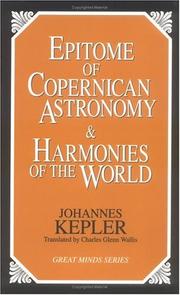
世界的和谐(拉丁语:Harmonices Mundi,英语:The Harmony of the Worlds)是德国天文学家约翰内斯·开普勒在1619年出版的书。该书主要介绍几何与物理世界的和谐和全等。最后一章提出开普勒第三定律。
内容
本书共分成五个部分。第一部分讲述正多边形。第二部分讲几何全等。第三部分讲述音乐和声的原理。第四部分则是相位。第五部分是行星运动的和谐。
虽然中世纪哲学家以球体音乐来隐喻,开普勒发现了行星运动的物理和谐性。他发现行星在轨道运动时,在最高和最低角速度之间有近似和谐的比例。例如:地球相对于太阳的角速度在近日点和远日点之间以一个半音改变(16:15),而金星则是25:24(升音)。
在非常罕见的间隔所有的行星将一起唱“完美和谐”:开普勒提出,这可能发生在历史上只有一次,也许在行星形成的时候。
开普勒还发现,只有一个的行星最高和最低轨道速度的比例在周边的行星轨道近似的音乐和声幅度内,误差小于一个升音(25:24的间隔)。在火星和木星产生一个例外的规则,形成了不和谐的比例18:19。事实上,导致不和谐的原因可能是一个事实,即小行星带分隔两个行星轨道,小行星带在开普勒逝世170年后发现于1801年。
开普勒定律
开普勒的上一本书新天文学提出开普勒定律的前两个定律。第三个定律在这本书的第五章才被提出。
以上文字摘自维基百科「世界的和諧」(去掉了参考文献等尾部小节),按 CC BY-SA 4.0 使用,作者为维基百科的各位编者。
中文维基百科的条目比较短,下面附上英文维基百科的内容(英文原文):
Harmonice Mundi (Latin: The Harmony of the World, 1619) is a book by Johannes Kepler. In the work, written entirely in Latin, Kepler discusses harmony and congruence in geometrical forms and physical phenomena. The final section of the work relates his discovery of the so-called third law of planetary motion.
The full title is Harmonices mundi libri V (The Five Books of The Harmony of the World), which is commonly but ungrammatically shortened to Harmonices mundi.
Background and history
Kepler began working on Harmonice Mundi around 1599, which was the year Kepler sent a letter to Michael Maestlin detailing the mathematical data and proofs that he intended to use for his upcoming text, which he originally planned to name De harmonia mundi. Kepler was aware that the content of Harmonice Mundi closely resembled that of the subject matter for Ptolemy's Harmonica, but was not concerned. The new astronomy Kepler would use (most notably the adoption of elliptic orbits in the Copernican system) allowed him to explore new theorems. Another important development that allowed Kepler to establish his celestial-harmonic relationships was the abandonment of the Pythagorean tuning as the basis for musical consonance and the adoption of geometrically supported musical ratios; this would eventually be what allowed Kepler to relate musical consonance and the angular velocities of the planets. Thus, Kepler could reason that his relationships gave evidence for God acting as a grand geometer, rather than a Pythagorean numerologist.
The concept of musical harmonies intrinsically existing within the spacing of the planets existed in medieval philosophy prior to Kepler. Musica universalis was a traditional philosophical metaphor that was taught in the quadrivium, and was often called the "music of the spheres." Kepler was intrigued by this idea while he sought explanation for a rational arrangement of the heavenly bodies. When Kepler uses the term "harmony" it is not strictly referring to the musical definition, but rather a broader definition encompassing congruence in Nature and the workings of both the celestial and terrestrial bodies. He notes musical harmony as being a product of man, derived from angles, in contrast to a harmony that he refers to as being a phenomenon that interacts with the human soul. In turn, this allowed Kepler to claim the Earth has a soul because it is subjected to astrological harmony.
While writing the book, Kepler had to defend his mother in court after she had been accused of witchcraft.
Content
Kepler divides The Harmony of the World into five long chapters: the first is on regular polygons; the second is on the congruence of figures; the third is on the origin of harmonic proportions in music; the fourth is on harmonic configurations in astrology; the fifth is on the harmony of the motions of the planets.
Chapter 1 and 2
Chapters 1 and 2 of The Harmony of the World contain most of Kepler's contributions concerning polyhedra. He is primarily interested with how polygons, which he defines as either regular or semiregular, can come to be fixed together around a central point on a plane to form congruence. His primary objective was to be able to rank polygons based on a measure of sociability, or rather, their ability to form partial congruence when combined with other polyhedra. He returns to this concept later in Harmonice Mundi with relation to astronomical explanations. In the second chapter is the earliest mathematical understanding of two types of regular star polyhedra, the small and great stellated dodecahedron; they would later be called Kepler's solids or Kepler Polyhedra and, together with two regular polyhedra discovered by Louis Poinsot, as the Kepler–Poinsot polyhedra. He describes polyhedra in terms of their faces, which is similar to the model used in Plato's Timaeus to describe the formation of Platonic solids in terms of basic triangles. The book features illustrations of solids and tiling patterns, some of which are related to the golden ratio.
以上文字摘自英文维基百科「Harmonice Mundi」(有删节,去掉了参考文献等尾部小节),按 CC BY-SA 4.0 使用,作者为维基百科的各位编者。
资料卡
- 原作语言
- 拉丁语
- 首次出版
- 1619 年
- 首版出版社
- 林茨
- 主题
- 开普勒定律
资料卡来自 Wikidata Q1066757(CC0),众包数据,个别字段可能不全。
改编作品
舞台剧 / 歌剧 / 芭蕾1
- 《世界大同交响曲》Die Harmonie der Welt
名单来自 Wikidata(CC0):只列条目里写明「改编自 / 取材于」这本书的作品,不按名字猜;众包数据,可能不全。