书单
百科
这个词条暂时没有中文维基百科条目,下面是英文维基百科的内容(英文原文):
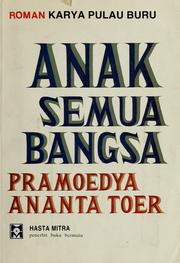
Child of All Nations is the second book in Pramoedya Ananta Toer's epic quartet called Buru Quartet, first published by Hasta Mitra in 1980. Child of All Nations continues the story of the lives of the main character, Minke, and his mother in law, Nyai Ontosoroh. By describing the lives of these two people who live in the Dutch controlled islands of Java, Pramoedya is able to discuss many aspects of life in a colonized nation. Child of All Nations explores the social hierarchy in a colonized nation by giving glimpses of how the oppressed colonized peoples, such as the Javanese farmers, are required to be submissive to their occupiers, the Dutch. That wealthy, educated Javanese like Minke and Nyai were still considered inferior to the Dutch due to their Native birth status and frequently simply the color of their skin. The main theme of the novel is, as the title suggests, that the world is becoming more integrated as revealed in the life of the main character Minke, the self-proclaimed "child of all nations" 1. Minke speaks French, Dutch, Malay, and both high and low Javanese. He writes for a newspaper published in Dutch and has to come to terms with being a 'native' in a European controlled world. His worldview is jaded by the fact that he is wealthy and educated, and therefore closer to the Dutch than other Javanese; however, Minke comes to realize the ethical implications of the injustices being done to his people. His life is caught between two worlds, which the novel follows as he tries to understand who he really is, his role in the Dutch-occupied society, and his duty to his people.
Plot summary
The story continues where This Earth of Mankind leaves off, shortly after Annelies has departed by ship to the Netherlands with Panji Darman secretly in tow. Having promised to watch over Annelies, Panji discovers her room on the ship, only to be recruited by the ship's crew in taking care of the severely ailing young woman. Panji continues to accompany her after arriving in the Netherlands where she dies after rapidly deteriorating. He relays this information back to Nyai and Minke through multiple letters.
From this point, Minke attempts to continue on with his life by writing for Maarten Nijman and the Soerabaiaasch Nieuws, however he is challenged by his good friend Jean Marais, as well as Kommer later on, to write in Javanese or Malay. They argue that in doing so, he would be helping his people in their struggle to overcome the oppression laid down by the Dutch occupying their nation. At first, Minke refuses on the grounds that it would tarnish his rising, reputable position in his influential field. His opinion quickly changes after recording an interview between Nijman and a member of the Chinese Young Generation, Khouw Ah Soe. After being a part of the unique experience, Minke feels quite proud, as well as curious of Soe's position and beliefs. Soon after, he discovers the article he wrote was completely ignored, only to be replaced by Nijman's self-report of Soe being a Chinese radical, opposing old Chinese traditions, and generally being a trouble-maker. Minke feels hurt from the encounter, and decides to take Kommer up on his offer to visit the Sidoarjo region and discover who his people really are.
Character list
Minke – Main protagonist of the novel
Minke is Javanese, and one of the few natives with a formal education—even more uncommon, a Dutch education. He is first introduced as a widower, mourning the suspicious death of his beautiful Indo-Dutch wife, Annelies. At first Minke is naive, unpatriotic, and even arrogant in regards to his own people. He is also an aspiring writer who works for a Dutch newspaper. However, after his boss alters his writing to condemn a Chinese activist (Toer 74-75), Minke begins to understand the corruption and power of the Dutch colonists. Urged by his mother-in law, his friend Jean, and another writer named Kommer, Minke sets out on a journey to understand his own nation, and reveal the truth about the oppression of his people.
Nyai Ontosoroh – Mother-in-law of Minke, Annelies’ mother, and business owner
Nyai (usually referred to as "Mama" by Minke) is very perceptive, hard-working, and resolute. She was sold to a Dutch man as a concubine when she was younger, but persevered and now runs a successful business. She has strong opinions concerning the Dutch and the colonization of the Indies. Though she is Minke's mother-in-law, she treats him more like her own son. Throughout the novel she can be seen lecturing Minke on different subjects, especially when it comes to the Dutch colonists and how the Native people are being treated. She tries to show him a perspective he would not have known in his Dutch schooling. Despite her strength, the death of her daughter and departure of her disgraced son Robert have left her feeling lonely and dependent on Minke as her only remaining family. Throughout the book she worries of losing her business, and more importantly, losing Minke. Nyai has perhaps more influence on Minke than any other character. Not only does she continuously give him advice and her opinions, but she is also a living example of the oppression of the Javanese.
Jean Marais – Friend of Minke and Nyai, works as a painter, Frenchman
Minke is close friends with Jean, and Jean’s daughter. He confronts Minke about possibly writing in Malay to increase the newspaper’s Asian readership, but is met with Minke’s defenses, resulting in tension in their relationship.
Kommer - Friend of Jean Marais, a Dutch-Indonesian Mixed-blood Journalist.
以上文字摘自英文维基百科「Child of All Nations」(有删节,去掉了参考文献等尾部小节),按 CC BY-SA 4.0 使用,作者为维基百科的各位编者。
资料卡
- 原题
- Anak Semua Bangsa
- 原作语言
- 印尼语
- 首次出版
- 1980 年
- 作品形式
- 长篇小说
- 首版出版社
- 企鹅出版集团
- 所属系列
- Buru Quartet
- 前作
- 人世间
- 续作
- 足迹、Rumah Kaca
- 故事发生地
- 印度尼西亚
资料卡来自 Wikidata Q5097881(CC0),众包数据,个别字段可能不全。