书单
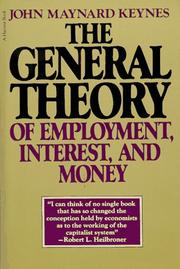
就业、利息和货币通论 (1936)
百科
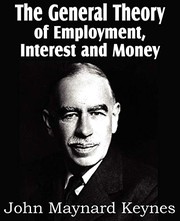
《就业、利息和货币通论》(英语:The General Theory of Employment, Interest, and Money)是英国的经济学者凯恩斯于1936年出版的重要著作,简称《通论》。
简述
该书的出版在经济学上来说是开创性的,也是随后宏观经济学得以发展的主要思想源泉。凯恩斯的思想后来形成了资本主义改良性质的主要思想体系,即凯恩斯主义,及其流派,凯恩斯学派。其追随者也随后被称为是凯恩斯主义者。
中文版本
[英]约翰·梅纳德·凯恩斯著,高鸿业重译《就业、利息和货币通论》(汉译世界学术名著丛书)商务印书馆,1999。
以上文字摘自维基百科「就业、利息和货币通论」(去掉了参考文献等尾部小节),按 CC BY-SA 4.0 使用,作者为维基百科的各位编者。
中文维基百科的条目比较短,下面附上英文维基百科的内容(英文原文):
The General Theory of Employment, Interest and Money is a book by English economist John Maynard Keynes published in February 1936. It caused a profound shift in economic thought, giving macroeconomics a central place in economic theory and contributing much of its terminology – the "Keynesian Revolution". It had equally powerful consequences in economic policy, being interpreted as providing theoretical support for government spending in general, and for budgetary deficits, monetary intervention and counter-cyclical policies in particular. It is pervaded with an air of mistrust for the rationality of free-market decision-making.
Keynes denied that an economy would automatically adapt to provide full employment even in equilibrium, and believed that the volatile and ungovernable psychology of markets would lead to periodic booms and crises. The General Theory is a sustained attack on the classical economics orthodoxy of its time. It introduced the concepts of the consumption function, the principle of effective demand and liquidity preference, and gave new prominence to the multiplier and the marginal efficiency of capital.
Keynes's aims in the General Theory
The central argument of The General Theory is that the level of employment is determined not by the price of labour, as in classical economics, but by the level of aggregate demand. If the total demand for goods at full employment is less than the total output, then the economy has to contract until equality is achieved. Keynes thus denied that full employment was the natural result of competitive markets in equilibrium.
In this he challenged the conventional ('classical') economic wisdom of his day. In a letter to his friend George Bernard Shaw on New Year's Day, 1935, he wrote:
I believe myself to be writing a book on economic theory which will largely revolutionize – not I suppose, at once but in the course of the next ten years – the way the world thinks about its economic problems. I can't expect you, or anyone else, to believe this at the present stage. But for myself I don't merely hope what I say, – in my own mind, I'm quite sure.
The first chapter of The General Theory (only half a page long) has a similarly radical tone:
I have called this book the General Theory of Employment, Interest and Money, placing the emphasis on the prefix general. The object of such a title is to contrast the character of my arguments and conclusions with those of the classical theory of the subject, upon which I was brought up and which dominates the economic thought, both practical and theoretical, of the governing and academic classes of this generation, as it has for a hundred years past. I shall argue that the postulates of the classical theory are applicable to a special case only and not to the general case, the situation which it assumes being a limiting point of the possible positions of equilibrium. Moreover, the characteristics of the special case assumed by the classical theory happen not to be those of the economic society in which we actually live, with the result that its teaching is misleading and disastrous if we attempt to apply it to the facts of experience.
Summary of the General Theory
Keynes's main theory (including its dynamic elements) is presented in Chapters 2–15, 18, and 22, which are summarised here. A shorter account will be found in the article on Keynesian economics. The remaining chapters of Keynes's book contain amplifications of various sorts and are described later in this article.
Book I: Introduction
The first book of The General Theory of Employment, Interest and Money is a repudiation of Say's law. The classical view for which Keynes made Say a mouthpiece held that the value of wages was equal to the value of the goods produced, and that the wages were inevitably put back into the economy sustaining demand at the level of current production. Hence, starting from full employment, there cannot be a glut of industrial output leading to a loss of jobs. As Keynes put it on p. 18, "supply creates its own demand".
以上文字摘自英文维基百科「The General Theory of Employment, Interest and Money」(有删节,去掉了参考文献等尾部小节),按 CC BY-SA 4.0 使用,作者为维基百科的各位编者。
资料卡
- 原题
- The General Theory of Employment, Interest and Money
- 原作语言
- 英语
- 首次出版
- 1936 年
- 体裁
- 非虚构作品
- 页数
- 472
- 主题
- 宏观经济学
资料卡来自 Wikidata Q1047156(CC0),众包数据,个别字段可能不全。