书单
百科
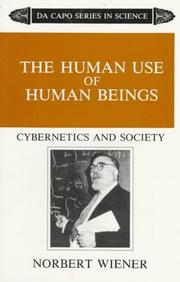
《人有人的用处》(英语:The Human Use of Human Beings)是一本由美国国数学家与哲学家诺伯特·维纳创作的专著,1950年首次出版,1954年再版,涉及控制论与自动化。
以上文字摘自维基百科「人有人的用处」(去掉了参考文献等尾部小节),按 CC BY-SA 4.0 使用,作者为维基百科的各位编者。
中文维基百科的条目比较短,下面附上英文维基百科的内容(英文原文):
The Human Use of Human Beings is a book by Norbert Wiener, the founding thinker of cybernetics theory and an influential advocate of automation; it was first published in 1950 and revised in 1954. The text argues for the benefits of automation to society; it analyzes the meaning of productive communication and discusses ways for humans and machines to cooperate, with the potential to amplify human power and release people from the repetitive drudgery of manual labor, in favor of more creative pursuits in knowledge work and the arts. The risk that such changes might harm society (through dehumanization or subordination of our species) is explored, and suggestions are offered on how to avoid such risk.
What is cybernetics?
The word cybernetics refers to the theory of message transmission among people and machines. The thesis of the book is that:
society can only be understood through a study of the messages and the communication facilities which belong to it; and that in the future development of these messages and communication facilities, messages between man and machines, between machines and man, and between machine and machine, are destined to play an ever-increasing part. (p. 16)
Communication methods have entered a new realm, involving new technologies. Whether a transmission is between people, or between people and machines, the process is similar in that information is sent by one party and received by another, which can send a response. This is a type of feedback. People, animals, and plants all have the ability to take certain actions in response to their environments; in the same way, machines have feedback systems in order for their performances to be altered or evaluated in accordance with results. In the context of human/machine society, Wiener offers a definition of the message as:
"a sequence of events in time which, though in itself has a certain contingency, strives to hold back nature's tendency toward disorder by adjusting its parts to various purposive ends" (p. 27).
Entropy and negentropy
The physical world has a "tendency toward disorder." Entropy (although a broad concept used in somewhat different ways across disciplines) roughly describes the way that isolated systems naturally become less and less organized with the passage of time; popularly understood as meaning a gradual decline into a state of chaos, the concept more accurately refers to the diffusion of energy toward a state of equilibrium, following the second law of thermodynamics.
Wiener believed that communication of information is essentially negentropic – it resists entropy – because it relies on organizational structures. There are two kinds of possible disorganizational forces, passive and active:"Nature offers resistance to decoding, but it does not show ingenuity in finding new and undecipherable methods for jamming our communication with the outer world" (pp. 35–36).Nature's passive resistance is in contrast to active resistance, like that of a chess opponent. This is similar to Einstein's view, expressed in his famous comment: "The Lord is subtle but he is not vicious".
Potential for learning
An increase of information, whether communicated by a living being or a machine, will increase organization. The feedback systems of an organism and those of a machine (informational organization in machines does not necessarily constitute "vitality" or a "soul") function in a similar way, allowing either to make assessments and act on the actual effectiveness of previous actions; when such feedback modifies not just a discrete action but an entire set of behaviors, Wiener calls this learning.
以上文字摘自英文维基百科「The Human Use of Human Beings」(有删节,去掉了参考文献等尾部小节),按 CC BY-SA 4.0 使用,作者为维基百科的各位编者。
资料卡
- 原题
- The Human Use of Human Beings
- 原作语言
- 英语
- 首次出版
- 1950 年
- 主题
- 控制论
资料卡来自 Wikidata Q7740888(CC0),众包数据,个别字段可能不全。