书单
百科
这个词条暂时没有中文维基百科条目,下面是英文维基百科的内容(英文原文):
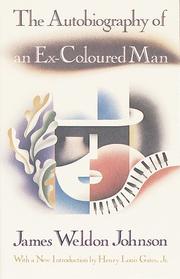
The Autobiography of an Ex-Colored Man (1912/1927) by James Weldon Johnson is the fictional account of a young biracial man, referred to only as the "Ex-Colored Man", living in post-Reconstruction era America in the late nineteenth and early twentieth centuries. He lives through a variety of experiences, including witnessing a lynching, that convince him to "pass" as white to secure his safety and advancement, but he feels as if he has given up his dream of "glorifying" the black race by composing ragtime music.
History
Johnson originally published The Autobiography of an Ex-Colored Man anonymously in 1912, via the small Boston publisher Sherman, French, & Company. He decided to publish it anonymously because he was uncertain how the potentially controversial book would affect his diplomatic career. He wrote openly about issues of race and discrimination that were not common then in literature. The book's initial public reception was poor. It was republished in 1927, with some minor changes of phraseology, by Alfred A. Knopf, an influential firm that published many Harlem Renaissance writers, and Johnson was credited as the author.
Despite the title, the book is a novel. It is drawn from the lives of people Johnson knew and from events in his life. Johnson's text is an example of a roman à clef.
Plot summary
The novel begins with a frame tale in which the unnamed narrator describes the narrative that follows as "the great secret of my life." The narrator notes that he is taking a substantial risk by composing the narrative, but that it is one he feels compelled to record, regardless. The narrator also chooses to withhold the name of the small Georgia town where his narrative begins, as there are still living residents of the town who might be able to connect him to the narrative.
Throughout the novel, the adult narrator from the frame interjects into the text to offer reflective commentary into the events of the narrative.
Early life
Born shortly after the Civil War in a small Georgia town, the narrator's African-American mother protected him as a child and teenager. The narrator's father, a wealthy white member of the Southern aristocracy, is absent throughout the narrator's childhood but, nevertheless, continues to provide financial support for the narrator and his mother. Because of that financial support, she had the means to raise her son in an environment more middle-class than many black people could enjoy at the time.
The narrator describes learning to love music at a young age as well as attending an integrated school. It is while attending this school that the narrator first realizes he is African-American and thus subject to ridicule and mistreatment for his racial heritage. This "discovery" occurs when he is publicly corrected by his teacher and the headmaster when he stands when "the white scholars" (schoolchildren) are asked to stand. Returning home from school, the distraught narrator confronts his mother, asking her if he is a "nigger." His mother reassures him, however, noting that while she is not white, "your father is one of the greatest men in the country—the best blood of the South is in you." The narrator notes that this event became a racial awakening and loss of innocence that caused him to suddenly begin searching for—and finding—faults in himself and his mother, setting the stage for his eventual decision (though far in the future) to "pass" as a white man.
While in school, the narrator also grows to admire and befriends "Shiny," an unmistakably African-American boy, who is described as one of the brightest and best-spoken children in the class.
After the narrator's mother dies, he becomes a poor orphan and subject to harsh conditions.
He adapted very well to life with lower-class black people and was able to move easily among the classes of black society. During this carefree period, he taught music and attended church, where he came in contact with upper-class black people. Living in an all black community, he discovers and describes three classes of black people: the desperate, the domestics, and the independent workmen or professionals.
The Ex-Colored Man believed the desperate class consists of lower-class black people who loathe the whites. The domestic worker class comprises black people who work as servants to whites. And the artisans, skilled workers, and black professionals class included black people who had little interaction with the whites. Many white readers, who viewed all black people as a stereotype of a single class, were unfamiliar with class distinctions described among black people.
Time with the Rich White Gentleman
While playing ragtime at a late night hotspot in New York, the Ex-Colored Man caught the attention of a wealthy white gentleman. The gentleman's liking for ragtime develops as liking for the Ex-Colored Man himself. The white gentleman hired him to play ragtime piano for guests at parties. Soon the Ex-Colored Man spent most of his time working for the white gentleman, who paid him to play ragtime music for hours at a time. He would play until the white gentleman would say "that will do." The Ex-Colored man would tire after the long hours but would continue playing as he saw the joy and serenity he brought the white gentleman.
以上文字摘自英文维基百科「The Autobiography of an Ex-Colored Man」(有删节,去掉了参考文献等尾部小节),按 CC BY-SA 4.0 使用,作者为维基百科的各位编者。
资料卡
- 原题
- The Autobiography of an Ex-Colored Man
- 原作语言
- 英语
- 作品形式
- 长篇小说
- 体裁
- 非洲裔美国人文学
- 故事发生地
- 纽约
资料卡来自 Wikidata Q7714967(CC0),众包数据,个别字段可能不全。