书单
百科
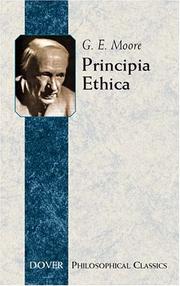
《伦理学原理》(Principia Ethica)是一本后设伦理学书籍,由乔治·爱德华·摩尔于1903年完成。摩尔于此书主张“善”是不可定义,并认为自然主义有谬误。《伦理学原理》被认为对伦理学产生了深远影响。
内容
摩尔坚持认为“善”是不可定义,并且认为自然主义有谬误。他坚持价值观是客观和多样,但认为价值观的知识不能来自认识事实,而只能源于对诸如美、快乐、友谊和知识等事态的良善的直觉。在摩尔看来,正确的行为是产生最好的行为。
以上文字摘自维基百科「倫理學原理」(去掉了参考文献等尾部小节),按 CC BY-SA 4.0 使用,作者为维基百科的各位编者。
中文维基百科的条目比较短,下面附上英文维基百科的内容(英文原文):
Principia Ethica is a book written in 1903 by British philosopher G. E. Moore. Moore questions a fundamental pillar of ethics, specifically what the definition of "good" is. He concludes that "good" is indefinable because any attempts to do so commit the naturalistic fallacy. Principia Ethica was influential, with Moore's arguments being considered ground-breaking advances in the field of moral philosophy.
Publication history
Principia Ethica was first published in October 1903 by Cambridge University Press. It was reprinted in 1922 and 1929. An Italian translation by Gianni Vattimo, with a preface by Nicola Abbagnano, was published by Bompiani in 1964.
Summary
Moore suggests that ethics is about three basic questions: (1) "What is good?" (which is noted as the most important of the three), (2) "What things are good or bad in themselves?", and (3) "What is good as a means?".
What is good?
The first question is concerned with the nature and definition of the term "good". Moore insists that this term is simple and indefinable. But two forms of goodness have to be distinguished: things that are good in themselves or intrinsically good and things that are good as causal means to other things. Our knowledge of value in itself comes from self-evident intuitions and is not inferred from other things, unlike our knowledge of goodness as a means or of duties. Among the things that are good in themselves, there is an important difference between the value of a whole and the values of its parts. It is often assumed that the value of a whole just consists in the sum of the values of its parts. Moore rejects this view and insists that it fails for certain types of wholes: "organic unities" or "organic wholes". Cases of retributive justice are examples of organic wholes. Such cases are wholes comprising two negative things, a morally vicious person and pain inflicted on this person as punishment. But the value on the whole is less negative (or maybe even positive) than the sum of the values of the two parts. Again we have to depend on our intuitions to determine how the intrinsic value of a whole differs from the sum of the values of its parts.
What things are good or bad in themselves?
The second question of ethics asks about what kinds of things are good in themselves. Moore discusses various traditional answers to this question, especially naturalism, which he contrasts with his own approach. The main problem with naturalism in ethics is its tendency to identify value with natural properties, like pleasure in hedonism or being more evolved in "Evolutionistic Ethics". He accuses such positions of committing the naturalistic fallacy in trying to define the term "good", an unanalysable term according to Moore, in terms of natural properties. If such definitions were true, then they would be uninformative tautologies, "'Pleasure is good' would be equivalent to 'pleasure is pleasure.'" But Moore argues, it is not a tautology but an open question whether such sentences are true. This is why the definition above and naturalism with it fails.
Moore agrees with hedonism that pleasure is good in itself, but it is not the only intrinsically valuable thing. Another important good that is valuable in itself is beauty, for example, the beauty of mountains, rivers and sunsets. Moore proposes a thought experiment, the "method of isolation", as a test to determine whether something has intrinsic value. The test is meant to remove any considerations of the thing being good as a means by isolating the intrinsic values. The method consists in imagining a world that contains only the thing in question, for example, a world composed only of a beautiful landscape. Moore argues that such a world would be better than an ugly world, even though no one is there to enjoy it in either case, which is to show that pleasure is not the only thing good in itself.
以上文字摘自英文维基百科「Principia Ethica」(有删节,去掉了参考文献等尾部小节),按 CC BY-SA 4.0 使用,作者为维基百科的各位编者。
资料卡
- 原题
- Principia Ethica
- 原作语言
- 英语
- 首次出版
- 1903 年
资料卡来自 Wikidata Q2344885(CC0),众包数据,个别字段可能不全。
更多资料与书评
在哪读
相似的书
 豆瓣 #126
 豆瓣 #15
 豆瓣 #102
 豆瓣 #178
 豆瓣 #169
 豆瓣 #174