书单
百科
这个词条暂时没有中文维基百科条目,下面是英文维基百科的内容(英文原文):
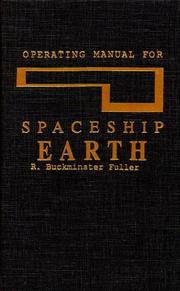
Operating Manual For Spaceship Earth is a short book by R. Buckminster Fuller, first published in 1969, following an address with a similar title given to the 50th annual convention of the American Planners Association in the Shoreham Hotel, Washington D.C., on 16 October 1967.
The book relates Earth to a spaceship flying through space. Noting the lack of any user manual to help Earthians steward this ship, Fuller offers some reflections, prognostications, and guidance, based on contemporary concepts of linked relationships, that may help in the understanding, management, sustainment, and creation of a plan to preserve spaceship earth for the future of humanity. The spaceship has a finite amount of resources and cannot be resupplied.
Chapters
Comprehensive propensities
Origins of specialization
Comprehensively commanded automation
Spaceship Earth
General systems theory
Synergy
Integral functions
The regenerative landscape
Main themes
History
Fuller describes two epochs within modern and contemporary history.
The first epoch was one run by "Great Pirates" or "great outlaws." The source of their power is that they are the only masters of global information in a time where people are focused locally. They were aware that resources weren't evenly distributed around the world, so that items which are abundant in one area are scarce in another. This gives rise to trade which the Great Pirates exploit for their own advantage. They established sea-trade routes to connect previously isolated populations throughout the globe. As these people took to the sea they left the local, regional laws of their original communities and entered a transitional space where they invented their own laws based on their interests in retaining special access to the Earth's dispersed resources and to gaining power through trade. The Great Pirates had a special ability to comprehend and activate a wide range of skills and knowledges required to generalize, translate, navigate, and integrate existing systems.
Fuller posits that these Great Pirates established governments in various areas and supported leaders who will defend their trade routes. By providing the leaders with special access to global resources, the Great Pirates controlled regional politicians, military, and leaders; these puppet leaders served the role of facilitating the Great Pirates' work, and in exchange for providing the Great Pirates with special privileges the Great Pirates would reward them with a cut of their profits. This historical era found a vast increase in the circulation and advancements of tools, goods, and services.
Power struggles for waterways ensue, requiring people such as Leonardo da Vinci and Michelangelo to design better defenses for the Great Pirates. As engineers become involved with the Great Pirates many new concepts appear, but the main one was of the Navy. As the size of the people in the Great Pirates' employment grow, training becomes a necessity, and the beginnings of schools and colleges ensue. Monarchs are encouraged to develop civil service systems to provide secure but specialized employment for their brightest subjects, which prevents them from competing with the Great Pirates in their lucrative global trading. Thus the Great Pirates guarded the advantages that their unique global perspective revealed.
This previous epoch set in place the current system of political organization rooted in the concept of sovereign nations which control the planet's natural resources and distribution networks. Fuller describes this as an outdated and illogical structure. This structure is based on colonization, imposing servility on anyone born outside of the borders of the privileged nations, and installing "identity classification" based on race, birth-nation, and citizenship as a status quo, and encouraging competitive ideologies based on politics, science, and religion.
Fuller describes that these separate sovereign nations with their competitive identities led to World War I and continued through World War II. World War I emerged from the struggle between the 'out-pirates' (electronic and chemical warfare) and the 'in-pirates' (electromagnetics). This change from the visible to the invisible forced the Great Pirates to rely on experts, which causes the end of the Great Pirates (who previously had been the only ones that were truly multi-disciplined). The public is unaware that Great Pirates had been ruling the earth, and the role falls back to kings and politicians, though the frameworks of trade, rating and accounting remain. Fuller declares that the Great Pirates society became extinct as a result of advances in industrial production and technology. Yet the systems that they had created were not altered. National leaders assumed the role of the Great Pirates, without having the necessary skills and experiences of a generalized world view. By default they reinforced the outdated systems of sovereignty.
In the current era, Fuller predicts that "planners, architects, and engineers take the initiative".
以上文字摘自英文维基百科「Operating Manual for Spaceship Earth」(有删节,去掉了参考文献等尾部小节),按 CC BY-SA 4.0 使用,作者为维基百科的各位编者。
资料卡
- 原题
- Operating Manual for Spaceship Earth
- 原作语言
- 英语
- 首次出版
- 1968 年
- 体裁
- 科学幻想
- 主题
- 恒星际旅行、地球
资料卡来自 Wikidata Q7096686(CC0),众包数据,个别字段可能不全。