 书单
百科
这个词条暂时没有中文维基百科条目,下面是英文维基百科的内容(英文原文):
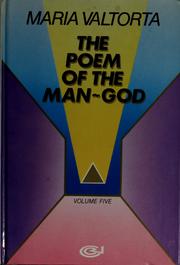
The Poem of the Man-God (Italian title: Il Poema dell'Uomo-Dio) is a work on the life of Jesus Christ written by Maria Valtorta. The current editions of the work bear the title The Gospel as Revealed to Me.
The work was first published in Italian in 1956 and has since been translated into many languages. It is based on about 10,000 of the over 15,000 handwritten pages produced by Maria Valtorta in her notebooks. The large majority of the work was written in about three years between January 1944 and April 1947. During these years she reported visions of Jesus and Mary, in addition to personal conversations and dictations from Jesus.
The work was placed on the (now abolished) Index Librorum Prohibitorum in 1959, and has remained controversial since its publication. Various scholars, historians and Biblical experts continue to both support and criticize the work to this day.
Writing and publication
The handwritten notebooks
After writing her autobiography based on the advice of her priest, Father Romualdo Migliorini, O.S.M., in 1943 the bedridden Valtorta began handwriting a series of what she claimed were messages from Jesus. These were later typed by her priest and arranged chronologically to produce the work.
Although Valtorta wrote about 15,000 pages during the years 1943–1947, only 10,000 of these (mostly written from 1944 to 1947) were used in her main book which was at first called The Poem of the Man-God. The additional pages were later published as The Notebooks. The Poem contains over 650 reported episodes in the life of Jesus and the Virgin Mary.
The papal audience
Father Corrado Berti, O.S.M., professor at Marianum Pontifical Faculty of Theology at Rome, sent a preprint copy of the Poem to Pope Pius XII in 1947. Then on 26 February 1948, Pope Pius XII received Fr. Berti, Fr. Miglorini, and their prior Fr. Andrea Chechin in private audience which was reported in L'Osservatore Romano the next day. Fr. Berti reported that in the meeting Pius XII stated:
Publish this work as it is. There is no need to give an opinion about its origin, whether it be extraordinary or not. Who reads it will understand. One hears of many visions and revelations. I will not say they are all authentic; but there are some of which it could be said they are.
However, in 1949 the Holy Office summoned Fr. Berti and ordered him not to publish the work.
The imprimatur question
Cardinal Edouard Gagnon wrote that the statement by Pius XII at the meeting with the three priests was "the type of imprimatur granted by the Holy Father before witnesses," and that it was in complete conformity with the demands of canon law. Fr. Melançon, C.S.C., said that Gagnon's doctoral thesis in canon law gave him the qualifications to make such a determination. In contrast, Fr. Anthony Pillari said that the only valid imprimatur for the work was issued in 1993 for the Malayalam translation and does not carry over to other languages. Similarly, Rene Laurentin et al. maintain that Pius XII never took an official position beyond his original statement in the February 1948 private audience.
Pillari noted that, in 1952, ten scholars (including Archbishop Alfonso Carinci) who supported Valtorta petitioned Pius XII to take some steps to allow the publication of the work, given the opposition from the Holy Office, but Pius XII took no action. Pillari said that after the significant change brought by the 1983 Code of Canon Law (CIC/17 c. 1385), the issue of Valtorta's work having or not having an imprimatur is currently irrelevant. He pointed to the article "The End of The Imprimatur" by J. Coriden, which said that the 1983 change significantly narrowed the scope of the works needing an imprimatur, to the extent that most theological and religious writings are now exempt from the requirement to have one, except in a few cases such as specific books used for teaching theology.
Publication
According to Paul Collins, Maria Valtorta was at first reluctant to have her notebooks published but, on the advice of her priest, in 1947 she agreed to their publication. However, the initial four volume edition of the work was published without an author name.
In 1952, the two priests Migliorini and Berti found a publisher for the work, and in October of that year Maria Valtorta signed a contract with Michele Pisani, whose publishing firm was based in Frosinone, southeast of Rome. The first edition of the work was published in 1956 in Italian. Later, the firm was managed by Emilio Pisani, the son of Michele Pisani. In 2014, Emilio Pisani stated that he had spent about 50 years with the work and that by then translations into 15 languages had been published and translations into around another 15 languages were in progress. Asked by Il Giornale about the number of copies sold, Pisani responded that he did not have an exact number at hand, but there were millions of copies.
Ecclesiastical reaction
Index of Forbidden Books
On 16 December 1959, the Holy Office placed the 4-volume work (the first volume entitled The Poem of Jesus, and the remaining 3 volumes titled The Poem of the Man-God) on the Index Librorum Prohibitorum. The decree was published in L'Osservatore Romano on 6 January 1960, accompanied by a front-page, anonymously written article under the heading "A Badly Fictionalized Life of Jesus". Fr. Anthony Pillari noted that the L'Osservatore Romano article stated that the work was placed on the Index because it went against rule 1385 of the Code of Canon Law which required an imprimatur prior to publication.
On 1 December 1961, an official statement by the Holy Office published in L'Osservatore Romano stated that the second edition of the Poem published in ten volumes effectively contained the same material as the previous edition and remained subject to the same prohibitions.
On 15 June 1966, the Sacred Congregation for the Doctrine of the Faith abolished the Index and all formal sanctions against reading books placed on the Index ended. The decree was published in L'Osservatore Romano by Cardinal Alfredo Ottaviani.
以上文字摘自英文维基百科「The Poem of the Man-God」(有删节,去掉了参考文献等尾部小节),按 CC BY-SA 4.0 使用,作者为维基百科的各位编者。
资料卡
- 原题
- Il Poema dell’Uomo Dio
- 原作语言
- 意大利语
- 首次出版
- 1956 年
- 体裁
- 基督教诗歌
- 首版出版社
- Centro Editoriale Valtortiano
资料卡来自 Wikidata Q5232904(CC0),众包数据,个别字段可能不全。