 书单
百科
这个词条暂时没有中文维基百科条目,下面是英文维基百科的内容(英文原文):
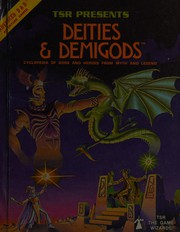
Deities & Demigods (abbreviated DDG), alternatively known as Legends & Lore (abbreviated L&L or LL), is a reference book for the Dungeons & Dragons fantasy role-playing game (D&D). The book provides descriptions and game statistics of gods and legendary creatures from various sources in mythology and fiction, and allows dungeon masters to incorporate aspects of religions and mythos into their D&D campaigns.
The first Deities & Demigods was published in 1980 by TSR, Inc. while another book called Deities and Demigods was published in 2002 by Wizards of the Coast, which acquired the D&D brand with their purchase of TSR in 1998.
The original 1980 edition was the first print appearance of various fictional non-human deities, such as Corellon Larethian, Moradin, Gruumsh, and others, many of which have become standard features of the D&D game and its derivatives. These deities were the creation of Jim Ward. Later printings of Deities & Demigods, beginning in 1981, removed some material present in the 1980 printings.
Printings
1st Edition Advanced Dungeons & Dragons
TSR published the first version of Deities & Demigods in 1980 as a 144-page hardcover for the first edition Advanced Dungeons & Dragons rules. This edition, by James M. Ward and Robert J. Kuntz, served to update the material they had earlier included in 1976's Supplement IV: Gods, Demi-Gods & Heroes for the original D&D ruleset. The book presents the game statistics and background information for gods and legendary heroes and creatures taken from various mythologies. The original edition included 12 pantheons of gods taken from both myth and folklore, as well as gods for various nonhuman races, and four groups taken from fictional works: the Arthurian heroes, the Nehwon mythos from Fritz Leiber, the Melnibonéan mythos from Michael Moorcock, and the Cthulhu Mythos from H. P. Lovecraft. These statistics are presented in a fashion similar to that of the Monster Manual, and illustrations accompany the statistics, as well as a short description that details what circumstances might cause the god to personally appear and what actions the god might take in such an instance, and what responsibilities and penchants that god may have. The book also details the mythoi of these religions, as well as what behaviors are expected of clerics, and describes the known planes of existence and how characters may find themselves in the afterlife. Interior illustrations were submitted by Jeff Dee, Eymoth (Kenneth Rahman), Jennell Jaquays, Dave S. LaForce, Jeff Lanners, Erol Otus, Darlene Pekul, Jim Roslof, David C. Sutherland III, and D. A. Trampier.
The original Deities & Demigods includes a nine-page chart for clerics, as well as an entire chapter about the various planes of existence.
For the first 1980 printing, TSR obtained permission from Michael Moorcock for inclusion of Melnibonéan material (from his Elric series of books), and from Arkham House, which claimed to hold the copyrights on a number of works by H. P. Lovecraft, for inclusion of characters from the Cthulhu Mythos. However, Arkham House had already licensed the Cthulhu property to the game company Chaosium. Furthermore, Chaosium had also licensed the Melnibonéan copyright from Moorcock. When Chaosium threatened legal action, the first printing was halted and the two companies agreed on a compromise: TSR could continue to use the material but must provide a credit to Chaosium to do so. TSR added the credit for the second printing of the book.
The Cthulhu and Melnibonéan sections were removed from the 1981 edition, making it a 128-page hardcover (which resulted in the original edition having a high collector's value). TSR felt its material should not contain such an overt reference to one of its competitors and removed the two pantheons altogether, thus negating the need for the credit. For this reason, the first and second printings have generally been in greater demand by D&D fans and collectors. The credit to Chaosium and incorrect page and pantheon counts were still included in some of the subsequent printings.
For the 1985 printing, the book was repackaged and its name was changed to Legends & Lore. This sixth printing featured the name change to avoid potential conflicts with fundamentalist Christian groups such as Patricia Pulling's BADD. Despite the name change and new cover artwork (by Jeff Easley), the interior material was nearly identical to the fifth printing.
In 1999, a paperback reprint of the first edition was released.
2nd Edition Advanced Dungeons & Dragons
When the second edition of the Advanced Dungeons & Dragons game was released, a new Legends & Lore was written for it. Cover art is by Jeff Easley, with interior illustrations by George Barr, Terry Dykstra, Erol Otus, Erik Olsen, Jean Elizabeth Martin, Jeff Easley, Carol Heyer, Roger Loveless, John and Laura Lakey, and Keith Parkinson. Legends & Lore was expanded, completely revised from the 1st Edition AD&D volume, and rewritten for the 2nd Edition rules. This edition had pared-down content in comparison to the original; the sections on Babylonian, Finnish, Sumerian and non-humanoid deities were wholly excised. The Central American mythos was renamed the Aztec mythos while the Nehwon mythos was retained. A separate sourcebook, Monster Mythology, later covered the non-human deities in much greater detail than any previous source, introducing several new deities in the process. Furthermore, the late 2nd Edition Planescape book, On Hallowed Ground, gave a virtually comprehensive look at the various pantheons present in the D&D shared universe up to that point, and a level of detail not since exceeded.
以上文字摘自英文维基百科「Deities & Demigods」(有删节,去掉了参考文献等尾部小节),按 CC BY-SA 4.0 使用,作者为维基百科的各位编者。
资料卡
- 原作语言
- 英语
- 首次出版
- 1980 年
- 体裁
- Tactical role-playing game
- 首版出版社
- TSR
资料卡来自 Wikidata Q5252594(CC0),众包数据,个别字段可能不全。