书单
百科
这个词条暂时没有中文维基百科条目,下面是英文维基百科的内容(英文原文):
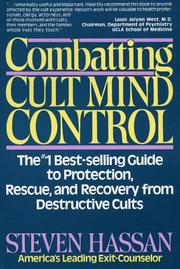
Combating Cult Mind Control is a nonfiction book by Steven Hassan, first published in 1988. The book presents itself as a guide to resisting the mind control practices of destructive cults, and focuses on the research of Margaret Singer and Robert Lifton as well as the cognitive dissonance theory of Leon Festinger. Hassan published a revised edition in 2015 which updated information on organizations that he alleges practice mind control and use social media to increase their influence.
Summary
In the preface, Hassan directly addresses readers who know someone in a cult or may be in a cult themselves. He stresses that everyone needs to decide for themselves whether they are in a destructive cult and that if their group is not a mind control cult, it will stand up to criticism and examination.
In the introduction, Hassan expresses discomfort with the term "deprogramming" because, though still widely considered positive by the public, it evokes images of kidnapping cult members against their will, which he no longer supports except in extreme cases. Hassan views another term, "exit counseling," has its own pros and cons. While it is more voluntary, cults also warn their members against exit counseling, and the "exit" can turn off cult members who do not think they are ready to leave the destructive cult yet. In the United Kingdom, exit counseling can refer to someone who aids in end of life care, another point of confusion. Though he is uncomfortable with both terms, Hassan admits he does not have a better replacement and uses both throughout the book.
Changes in later editions
In the 2018 30th Anniversary Edition, Hassan changed many instances of mind control to "undue influence." Though this emerged as a legal term, he finds it more helpful because efforts to change the minds of cult members are often not fully effective and much more easily thought of as a type of pressure or influence that makes individuals more likely to agree with cult doctrine than disagree.
Additionally, Hassan adds stories of Mormon and Scientology ex-members, which previous editions had strayed away from for fear of litigation. He notes that, because previous editions did not describe Mormonism or Scientology as destructive cults, the book was not banned by those groups and many members were able to read it.
The 30th anniversary edition begins with Hassan describing his own membership in the Unification Church and eventually deprogramming.
Cult structure
Hassan categorizes cults into four groups: religious, political, psychotherapy/educational, and commercial. Most cults have five types of members, depending on their commitment to the cult: top leaders, sub leaders, core members, rank and file members, and fringe members.
Hassan defines mind control as "a system that disrupts an individual's healthy identity development." Identities are composed of beliefs, behavior, thoughts, and patterns of emotions. When cults indoctrinate a member, they replace this authentic identity with an artificial one. According to Hassan, while this can happen quickly, it generally takes days or weeks and can occur even if, at first, the individual fakes the cult identity in order to fit in, without actually believing in cult doctrine.
According to Hassan, modern cults use mind control techniques like neuro-linguistic programming (NLP) and hypnosis to recruit members. Their recruitment techniques continue to improve over time and they now no longer target mostly college. Hassan does not use mind control and brainwashing as synonyms. Instead, he uses brainwashing as a specific type of destructive mind control.
Hassan's four components of mind control are: behavior, information, thought, and emotion. According to his BITE model, if a destructive cult can effectively control one or more components, the others will tend to follow. For instance, restricting information can lead to control of thoughts, which can in turn lead to changed and controlled behaviors and emotions. His BITE model is based on Leon Festinger's cognitive dissonance theory, though Hassan added information as a fourth realm of control.
Hassan claims there are three steps to gaining control of someone's mind: unfreezing, changing, and refreezing. Unfreezing means "breaking a person down," changing is when indoctrination is introduced, and refreezing means building someone's new artificial cult identity. According to Hassan, the most important part of refreezing is the denigration of the past self. Cult members must not want to return to their old lives and old identity. This may include giving up on their old hobbies, friends and family, often in a public setting, and confessing their sins to the group. Members may have distorted memories during this phase. Cults often pair new recruits with more seasoned members, instructing the new ones to imitate the older ones in all things. In this phase, cults may use outside cues like a new name, clothes, or language to cement the new identity. New members are also quickly converted into recruiters, as convincing people to believe something actually cements one's own belief in the same thing.
以上文字摘自英文维基百科「Combating Cult Mind Control」(有删节,去掉了参考文献等尾部小节),按 CC BY-SA 4.0 使用,作者为维基百科的各位编者。
资料卡
- 原题
- Combatting Cult Mind Control
- 原作语言
- 英语
- 首次出版
- 1988 年
- 体裁
- 非虚构作品
- 首版出版社
- Park Street Press
- 续作
- Releasing the Bonds
- 主题
- 邪教
资料卡来自 Wikidata Q5150743(CC0),众包数据,个别字段可能不全。