书单
百科
这个词条暂时没有中文维基百科条目,下面是英文维基百科的内容(英文原文):
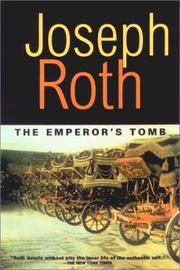
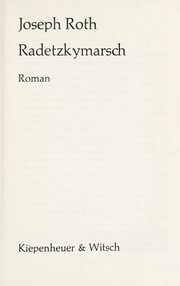
Radetzky March (German: Radetzkymarsch) is a 1932 family saga novel by Joseph Roth chronicling the decline and fall of the Habsburg Monarchy via the story of the Trotta family. Radetzkymarsch is an early example of a story that features the recurring participation of a historical figure, in this case the Emperor Franz Joseph I of Austria (1830–1916). Roth continues his account of the Trotta family to the time of the Anschluss in his The Emperor's Tomb (Kapuzinergruft, 1938). The novel, which covers the period from 1859 to 1916, has been published in English translations by Geoffrey Dunlop in 1933, Joachim Neugroschel in 1995 and Michael Hofmann in 2003.
Plot
Radetzky March relates the stories of three generations of the Trotta family, professional Habsburg soldiers and career bureaucrats of Slovenian origin — from their zenith during the empire to the nadir and breakup of that world during and after the First World War. In 1859, the Austrian Empire (1804–67) was fighting the Second War of Italian Independence (29 April – 11 July 1859), against French and Italian belligerents: Napoleon III of France, the Emperor of the French, and the Kingdom of Piedmont-Sardinia.
In northern Italy, during the Battle of Solferino (24 June 1859), the well-intentioned, but blundering, Emperor Franz Joseph I, is almost killed. To thwart snipers, Infantry Lieutenant Trotta topples the Emperor from his horse. The Emperor awards Lt. Trotta the Order of Maria Theresa and ennobles him. Elevation to the nobility ultimately leads to the Trotta family's ruination, paralleling the imperial collapse of Austria-Hungary (1867–1918).
Following his social elevation Lt. Trotta, now Baron Trotta von Sipolje, is regarded by his family — including his father — as a man of superior quality. Although he does not assume the airs of a social superior, everyone from the new baron's old life perceives him as a changed person, as a nobleman. The perceptions and expectations of society eventually compel his reluctant integration into the aristocracy, a class amongst whom he feels temperamentally uncomfortable.
As a father, the first Baron von Trotta is disgusted by the historical revisionism that the national school system is teaching his son's generation. The school history textbook presents as fact a legend about his battlefield rescue of the Emperor. He finds especially galling the misrepresentation that infantry lieutenant Trotta was a cavalry officer.
The Baron appeals to the Emperor to have the school book corrected. The Emperor considers however that such a truth would yield an uninspiring, pedestrian history, useless to Habsburg patriotism. Therefore, whether or not history textbooks report Infantry Lt. Trotta's battlefield heroism as legend or as fact, he orders the story deleted from the official history of the Habsburg Empire. The subsequent von Trotta family generations misunderstand the elder generation's reverence for the legend of Lt. Trotta's saving the Emperor's life and consider themselves rightful aristocrats.
The disillusioned Baron Trotta opposes his son's aspirations to a military career, insisting he prepare to become a government official, the second most respected career in the Austrian Empire; by custom, the son was expected to obey. The son eventually becomes a district administrator in a Moravian town. As a father, the second Baron Trotta (still ignorant of why his war-hero father thwarted his military ambitions) sends his own son to become a cavalry officer; thereby grandfather's legend determines grandson's life. The cavalry officer's career of the third Baron Trotta comprises postings throughout Austria-Hungary and a dissipated life of wine, women, song, gambling, and dueling, off-duty pursuits characteristic of the military officer class in peace-time. Following a fatal duel the young Trotta transfers from the socially elite Uhlans to a less prestigious Jäger regiment. Baron Trotta's infantry unit then suppresses an industrial strike in a garrison town. Awareness of the aftermath of his professional brutality begins Lieutenant von Trotta's disillusionment with empire. He becomes greatly in debt due to gambling and is only saved after his father makes a direct appeal to the Emperor to sort out the matter. The young Trotta's debts are paid but he is killed soon after, bravely but pointlessly, in a minor skirmish with Russian troops during the opening days of World War I. His lonely and grieving father, the District Commissioner, dies after Franz Joseph two years later. Two mourners at the funeral conclude that neither the second von Trotta nor the old Emperor could have survived the dying Empire.
Literary significance
Radetzky March is Joseph Roth's best-known work. It was critically acclaimed after being first published in German in 1932 and then translated to English in 1933. In 2003, the German literary critic Marcel Reich-Ranicki included it in Der Kanon ("The Canon") of the most important German-language literary novels. It is a novel of the ironies and humour inherent in the well-intentioned actions that led to the decline and fall of a family and an empire; the Emperor Franz Josef I of Austria-Hungary remains ignorant of the unintended, negative consequences of so rewarding his subjects, and he continues conferring great favors, as with Lt. Trotta, after the Battle of Solferino in 1859.
The novel's title derives from the Radetzky March, Op. 228 (1848), by Johann Strauss Sr. (1804–49), which honors the Austrian Field Marshal Joseph Radetzky von Radetz (1766–1858). It is a symbolic musical composition heard at critical narrative junctures of the Trotta family history.
During an interview on the United States TV show Charlie Rose in November 2001 on occasion of his own latest political novel, The Feast of the Goat, being published in English, Peruvian writer (and later 2010 Literature Nobel Prize winner) Mario Vargas Llosa, ranked The Radetzky March as the best political novel ever written.
以上文字摘自英文维基百科「Radetzky March (novel)」(有删节,去掉了参考文献等尾部小节),按 CC BY-SA 4.0 使用,作者为维基百科的各位编者。
资料卡
- 原题
- Radetzkymarsch
- 原作语言
- 德语
- 首次出版
- 1932 年
- 作品形式
- 长篇小说
- 体裁
- 历史类虚构作品
- 续作
- Die Kapuzinergruft
- 故事发生地
- 奥匈帝国
资料卡来自 Wikidata Q610428(CC0),众包数据,个别字段可能不全。
改编作品
电影1
名单来自 Wikidata(CC0):只列条目里写明「改编自 / 取材于」这本书的作品,不按名字猜;众包数据,可能不全。