书单
百科
这个词条暂时没有中文维基百科条目,下面是英文维基百科的内容(英文原文):
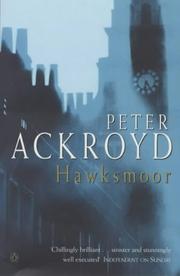
Hawksmoor is a 1985 novel by English writer Peter Ackroyd. It won Best Novel at the 1985 Whitbread Awards and the Guardian Fiction Prize. It tells the parallel stories of Nicholas Dyer, who builds seven churches in 18th-century London for which he needs human sacrifices, and Nicholas Hawksmoor, detective in the 1980s, who investigates murders committed in the same churches. Hawksmoor has been praised as Peter Ackroyd's best novel and an example of postmodernism.
Story
In the early 18th century, architect Nicholas Dyer is progressing work on several churches in London's East End. He is, however, involved in Satanic practices (something inculcated in him as an orphan), a fact which he must keep secret from all his associates, including his supervisor Sir Christopher Wren. This is all the more challenging since he indulges in human sacrifice as part of the construction of the buildings. Dyer's simmering contempt for Wren is brought closest to the surface in discussions they have concerning rationalism versus Dyer's own carefully disguised brand of mysticism.
In the 20th century, DCS Nicholas Hawksmoor is called in to investigate a bizarre series of murders by strangulation that have occurred in and around the churches designed by Dyer. The murders are all the more mystifying since the murderer appeared to have left no identifying traces, not even fingerprints on the victims' necks.
However the area is stalked by mysterious shadows, and it becomes clear that not only the weight of the investigation, but unseen forces from the past come to bear on Hawksmoor in a powerful, destructive manner.
Historical background
Peter Ackroyd stressed the fact that Hawksmoor is not a historical novel in the strict sense of the word: "I have employed many sources in the preparation of Hawksmoor, but this version of history is my own invention."
Nevertheless, Ackroyd uses historical characters, sites and occurrences in his book. Nicholas Dyer, the architect of the seven churches, is modelled on Nicholas Hawksmoor but doesn't share his death date (Dyer disappears in 1715, Hawksmoor died in 1736). As said in the novel, the Commission for Building Fifty New Churches, which had been established by an Act of Parliament in 1711, commissioned Hawksmoor to build six churches, all of which are dealt with in the novel:
Christ Church, Spitalfields,
St George's, Bloomsbury,
St Mary Woolnoth,
St George in the East,
St Anne's Limehouse,
St Alfege Church, Greenwich.
The only fictional church in the book is Little St Hugh, venerating the historical Little Saint Hugh of Lincoln.
Hawksmoor was indeed assistant of Sir Christopher Wren, who is shown in the novel, historically correct, as profoundly interested in science and an active member of the Royal Society. Wren studied anatomy through dissection and vivisection so that the dissection of a killed woman by Wren in the novel refers to actual actions by Wren but maybe not on human beings. It is not certain but possible that Christopher Wren visited Stonehenge. The third historical character in the novel is Sir John Vanbrugh.
Historical occurrences Ackroyd refers to are the Great Plague of London of 1665/1666 and the Great Fire of London of 1666. Bedlam was actually not only a lunatic asylum but also an attraction for paying guests in the 18th century. For a penny visitors could look into the patients' cells, view the freaks of the "show of Bethlehem" and laugh at their antics. In 1814 alone, there were 96,000 such visits.
Themes
Much of the novel is concerned with the disconnection between the 20th-century London of DCS Hawksmoor and its past, with Dyer's churches being both banal and mysterious to Hawksmoor. Wren's rationalism has succeeded in Hawksmoor's world, but we see Dyer's mysticism reassert itself in the form of murder and mystery. One critic has argued that Dyer's churches come to stand for the persistence of popular history and culture, in opposition to Wren's devotion to a rational progress driven by power and money.
Occultism
Nicholas Dyer believes in a syncretistic religion based on an utterly pessimistic view of man and world, represented by London: "In keeping with his Biblical belief that 'it was Cain who built the first City', Dyer leads us through the 'monstrous Pile of London' – 'Nest of Death and Contagion', 'Capital City of the World of Affliction', 'Hive of Noise and Ignorance'."
Mirabilis, Nicholas Dyer's spiritual teacher, is the leader of an underground sect known as "Enthusiasticks". Mirabilis preaches that "Christ was the Serpent who deceiv'd Eve, and in the form of a Serpent entered the Virgin's womb" and that "Sathan is the God of this World and fit to be worshipp'd." Among the sources he merges for his religion are the Ammonites, the Carthaginians, "the Straw Man of our Druides," the Syrian Beel-Zebub, the Assyrians, the Jews, the Cabbala, Joseph of Arimathea, the Cathedral of Bath, the Temple of Moloch, Westminster and Anubis. The sect "sacrificed Boys since it was their Opinion that Humane life, either in desperate sicknesse or in danger of Warre, could not be secured unless a vyrgyn Boy suffered in stead." A four-liner expresses the syncretist nature of Mirabilis's sect:
Pluto, Jehova, Satan, Dagon, Love,
Moloch, the Virgin, Thetis, Devil, Jove,
Pan, Jahweh, Vulcan, he with th'awfull Rod,
Jesus, the wondrous Straw Man, all one God."
以上文字摘自英文维基百科「Hawksmoor (novel)」(有删节,去掉了参考文献等尾部小节),按 CC BY-SA 4.0 使用,作者为维基百科的各位编者。
资料卡
- 原题
- Hawksmoor
- 原作语言
- 英语
- 首次出版
- 1985 年 9 月
- 作品形式
- 长篇小说
- 体裁
- 奇幻
- 首版出版社
- 哈米什·汉密尔顿
- 故事发生地
- 伦敦
资料卡来自 Wikidata Q5685281(CC0),众包数据,个别字段可能不全。
更多资料与书评
在哪读
彼得·阿克罗伊德 的其他作品
作者页 ›
相似的书
 豆瓣 #25
 豆瓣 #199