 书单
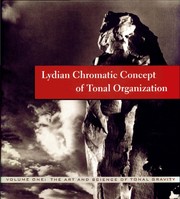
Lydian Chromatic Concept of Tonal Organization (1953)
- 作者
- George Russell
- 首版
- 1953 年
- 国家/地区
- 美国
- Open Library
- 1 个版本
百科
这个词条暂时没有中文维基百科条目,下面是英文维基百科的内容(英文原文):
The Lydian Chromatic Concept of Tonal Organization is a 1953 jazz music theory book written by George Russell. The book is the founding text of the Lydian Chromatic Concept (LCC), or Lydian Chromatic Theory (LCT). Russell's work postulates that all music is based on the tonal gravity of the Lydian mode.
Deriving Lydian
Russell believed that dominant function is the driving force behind all harmonic motion. Russell focuses on the Lydian mode because it can be built with fifths. For instance, to construct a C Lydian scale one could list the first seven tones on the circle of fifths starting with C, the desired Lydian Tonic. This process would yield C, G, D, A, E, B, F♯. If these tones are voiced in the space of an octave, they form the Lydian mode; specifically, C Lydian (C, D, E, F♯, G, A, B). Additionally, Russell observed, when these tones are voiced in thirds they form the preferred form of a major 13 (#11) chord.
The Lydian Chromatic Scale
Russell builds a prototype chromatic scale starting on the Lydian Tonic by stacking fifths, skipping the interval between the seventh and eighth tones, and placing the skipped tone at the end for having the lowest level of tonal gravity. Using C as the Lydian Tonic yields the following 12-note scale with enharmonic respellings: C, G, D, A, E, B, F♯, G♯, E♭ (D♯), B♭ (A♯), F (E♯), D♭ (C♯). Thus the Lydian Chromatic Scale and all its derivatives contain only Pythagorean intervals.
Tonal gravity
Russell posited that tonal gravity emanates from the first seven tones of the Lydian mode. As the player ventures further from the Lydian tonic however (and further up the circle of fifths), the tonal gravity shifts. For example, if notes further up the circle of fifths (e.g. ♯2/♭3) are used, the tonal gravity is probably shifting.
Influence
Russell's theory has had far-reaching effect especially in the realm of modal jazz. Art Farmer said that it "opens the door to countless means of melodic expression" and critic Joachim-Ernst Berendt described it as "the first work deriving a theory of jazz harmony from the immanent laws of jazz" and as "the pathbreaker for Miles Davis's and John Coltrane's 'modality'". Bill Evans and Miles Davis used the theory to record modal jazz such as the album Kind of Blue. John Coltrane's modal jazz is usually analyzed using Russell's method. In arguably his most famous piece, "Giant Steps," Coltrane can be heard traveling through a succession of three parent Lydian Chromatic scales: C Lydian, A♭ Lydian, and E Lydian. Additionally, many conservatories teach Russell's theory to varying degrees.
以上文字摘自英文维基百科「Lydian Chromatic Concept of Tonal Organization」(去掉了参考文献等尾部小节),按 CC BY-SA 4.0 使用,作者为维基百科的各位编者。
资料卡
- 原题
- Lydian Chromatic Concept of Tonal Organization
- 原作语言
- 英语
- 首次出版
- 1953 年
- 体裁
- 非虚构作品
- 主题
- 音乐理论
资料卡来自 Wikidata Q6707707(CC0),众包数据,个别字段可能不全。