书单
百科
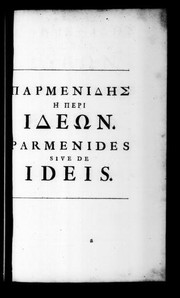
巴曼尼得斯篇(古希腊语:Παρμενίδης Parmenídēs)为柏拉图对话录之一,也被视为最难理解的一篇。
对话内容为当时两大哲学家巴门尼德与埃利亚的芝诺的会面,以及年轻的苏格拉底。会面的内容是埃利亚的芝诺主张他的一元论而与当时主张多元论的学者相互冲突,这些学者认为一元论当中充斥着荒谬与矛盾。
以上文字摘自维基百科「巴曼尼得斯篇」(去掉了参考文献等尾部小节),按 CC BY-SA 4.0 使用,作者为维基百科的各位编者。
中文维基百科的条目比较短,下面附上英文维基百科的内容(英文原文):
Parmenides (Greek: Παρμενίδης) is one of the dialogues of Plato. It is widely considered to be the most challenging and enigmatic of Plato's dialogues.
The Parmenides purports to be an account of a meeting between the two great philosophers of the Eleatic school, Parmenides and Zeno of Elea, and a young Socrates. The occasion of the meeting was the reading by Zeno of his treatise defending Parmenidean monism against those partisans of plurality who asserted that Parmenides' supposition that there is a one gives rise to intolerable absurdities and contradictions. The dialogue is set during a supposed meeting between Parmenides and Zeno of Elea in Socrates' home city of Athens. The dialogue is chronologically the earliest of all, as Socrates is only nineteen years old, so he takes the unusual position of the student, while Parmenides serves as the lecturer.
Most scholars agree that the dialogue does not record historic conversations and is most likely an invention by Plato.
Discussion with Socrates
The heart of the dialogue opens with a challenge by Socrates to the elder and revered Parmenides and Zeno. Employing his customary method of attack, the reductio ad absurdum, Zeno has argued that if—as the pluralists say—things are many, then they will be both like and unlike; but this is an impossible situation, for unlike things cannot be like, nor like things unlike. But this difficulty vanishes, says Socrates, if we are prepared to make a distinction between sensibles, on one hand, and Forms (in which sensibles participate) on the other—then it is the Form of Likeness that cannot be, and is not, unlike, while one and the same sensible thing can indeed be simultaneously like and unlike (or one and many), by participating in the Forms of both Likeness and Unlikeness (or both Unity and Plurality):
"But if someone should show that I am both one and many, what is so astonishing about that? When he intends to show that I am many, he says that my right side is different from my left, and my front different from my back, and likewise with my upper and lower parts—for, I believe, I do partake of multitude. But when he intends to show that I am one [thing], he will say I am one man among the seven of us; since I also partake of oneness, he therefore proves both to be true. So if someone attempts to show that the same things—such as stones and sticks and the like—are [both] many and one, then we will say that he demonstrates these to be many and one, and not that 'the one' is many, nor 'the many' one."
Hence, concludes Socrates, there is no problem in demonstrating that sensible things may have opposite attributes; what would cause consternation—and earn his admiration—would be if someone were to show that the Forms themselves were capable of admitting contrary predicates.
At this point, Parmenides takes over as Socrates' interlocutor and dominates the remainder of the dialogue. After establishing that Socrates himself has made the distinction between Forms and sensibles, Parmenides asks him what sorts of Form he is prepared to recognize. Socrates replies that he has no doubt about the existence of mathematical, ethical and aesthetic Forms (e.g., Unity, Plurality, Goodness, Beauty), but is unsure of Forms of Man, Fire and Water; he is almost certain, though admits to some reservations, that undignified objects like hair, mud and dirt do not have Forms. Parmenides suggests that when he is older and more committed to philosophy, he will consider all the consequences of his theory, even regarding seemingly insignificant objects like hair and mud.
For the remainder of the first part of the dialogue, Parmenides draws Socrates out on certain aspects of the Theory of Forms, and in the process brings to bear five arguments against the theory; these can be summarized as follows:
以上文字摘自英文维基百科「Parmenides (dialogue)」(有删节,去掉了参考文献等尾部小节),按 CC BY-SA 4.0 使用,作者为维基百科的各位编者。
资料卡
- 原题
- Παρμενίδης
- 原作语言
- 古希腊语
- 所属系列
- Platonic dialogue
- 主要人物
- 苏格拉底
资料卡来自 Wikidata Q1130762(CC0),众包数据,个别字段可能不全。
更多资料与书评
在哪读
同系列 / 前后作品
 豆瓣 #207
 豆瓣 #225