书单
百科
这个词条暂时没有中文维基百科条目,下面是英文维基百科的内容(英文原文):
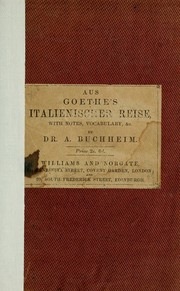
Italian Journey (in the German original: Italienische Reise [itaˈli̯eːnɪʃə ˈʁaɪzə]) is Johann Wolfgang von Goethe's report on his travels to Italy from 1786 to 1788 that was published in 1816 & 1817. The book is based on Goethe's diaries and is smoothed in style, lacks the spontaneity of his diary report and is augmented with the addition of afterthoughts and reminiscences.
At the beginning of September 1786, when Goethe had just turned 37, he "slipped away," in his words, from his duties as Privy Councillor in the Duchy of Weimar, from a long platonic affair with a court lady and from his immense fame as the author of the novel The Sorrows of Young Werther and the stormy play Götz von Berlichingen, and he took what became a licensed leave of absence. He was able to persuade his employer, Duke Karl August, to agree to a paid absence.
By May 1788 he had travelled to Italy via Innsbruck and the Brenner Pass and visited Trento, Lake Garda, Verona, Vicenza, Padua, Venice, Bologna, Rome and Alban Hills, Naples and Sicily. He wrote many letters to a number of friends in Germany, which he later used as the basis for Italian Journey.
Appraisal
Et in Arcadia ego
Italian Journey initially takes the form of a diary, with events and descriptions written up apparently quite soon after they were experienced. The impression is in one sense true, since Goethe was clearly working from journals and letters he composed at the time – and by the end of the book he is openly distinguishing between his old correspondence and what he calls reporting. But there is also a strong and indeed elegant sense of fiction about the whole, a sort of composed immediacy. Goethe said in a letter that the work was "both entirely truthful and a graceful fairy-tale." It had to be something of a fairy-tale, since it was written between thirty and more than forty years after the journey, in 1816 and 1828–29.
The work begins with a famous Latin tag, Et in Arcadia ego, although originally Goethe used the German translation, Auch ich in Arkadien, which alters the meaning. This Latin phrase is usually imagined as spoken by Death – this is its sense, for example, in W. H. Auden's poem called "Et in Arcadia ego" – suggesting that every paradise is afflicted by mortality. Conversely, what Goethe's Auch ich in Arkadien says is "Even I managed to get to paradise," with the implication that we could all get there if we chose. If death is universal, the possibility of paradise might be universal too. This possibility wouldn't preclude its loss, and might even require it, or at least require that some of us should lose it. The book ends with a quotation from Ovid's Tristia, regretting his expulsion from Rome. Cum repeto noctem, Goethe writes in the middle of his own German, as well as citing a whole passage: "When I remember the night..." He is already storing up not only plentiful nostalgia and regret, but also a more complicated treasure: the certainty that he didn't merely imagine the land where others live happily ever after.
Content
"We are all pilgrims who seek Italy," Goethe wrote in a poem two years after his return to Germany from his almost two-year spell in the land he had long dreamed of. For Goethe, Italy was the warm passionate south as opposed to the dank cautious north; the place where the classical past was still alive, although in ruins; a sequence of landscapes, colours, trees, manners, cities, monuments he had so far seen only in his writing. He described himself as "the mortal enemy of mere words" or what he also called "empty names." He needed to fill the names with meaning and, as he rather strangely put it, "to discover myself in the objects I see," literally "to learn to know myself by or through the objects." He also writes of his old habit of "clinging to the objects," which pays off in the new location. He wanted to know that what he thought might be paradise actually existed, even if it wasn't entirely paradise, and even if he didn't in the end want to stay there.
While in Italy, Goethe aspired to witness and to breathe the conditions and milieu of a once highly – and in certain respects still – cultured area endowed with many significant works of art. Apart from the impetus to study the Mediterranean's natural qualities, he was first and foremost interested in the remains of classical antiquity, furthermore in Renaissance, but much less in the then predominant Baroque art. Medieval art he treated with complete contempt. During his stay in Assisi, he did not visit the famous Giotto frescoes in the Basilica of San Francesco d'Assisi. Many critics have questioned this strange choice. In Verona, where he enthusiastically commends the harmony and fine proportions of the city amphitheater, he asserts this is the first true piece of Classical art he has witnessed. Venice, too, holds treasures for his artistic education, and he soon becomes fascinated by the Italian style of living. He acquires Andrea Palladio's printed works and studies them intensively.
After a longer stop in Venice and a very short stop in Florence, he arrives in Rome. It was here that he met several respected German artists, and made friends with Johann Heinrich Wilhelm Tischbein and notable Neoclassical painter, Angelica Kauffman. He visited the famous art collections of Rome with her and her husband Antonio Zucchi. Other artists he frequently met were the painter Johann Friedrich Reiffenstein and the writer Karl Philipp Moritz.
以上文字摘自英文维基百科「Italian Journey」(有删节,去掉了参考文献等尾部小节),按 CC BY-SA 4.0 使用,作者为维基百科的各位编者。
资料卡
- 原题
- Italienische Reise
- 原作语言
- 德语
- 首次出版
- 1816 年
- 体裁
- 游记
- 前作
- 论色彩学
- 续作
- 论色彩学
- 改编自 / 取材于
- From my Life : Poetry and Truth、Travel diary of the Italian journey for the period from September 3 to October 30, 1786, written by Johann Wolfgang von Goethe for Charlotte von Stein
- 主题
- 意大利
- 故事发生地
- 维罗纳、维琴察、帕多瓦、威尼斯、费拉拉、博洛尼亚 等 13 项
资料卡来自 Wikidata Q455305(CC0),众包数据,个别字段可能不全。