书单
百科
这个词条暂时没有中文维基百科条目,下面是英文维基百科的内容(英文原文):
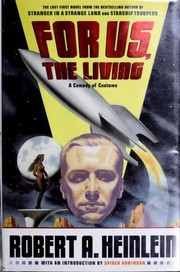
For Us, the Living: A Comedy of Customs is a science fiction novel by American writer Robert A. Heinlein. It was written in 1938 and published for the first time in 2003. Heinlein admirer and science fiction author Spider Robinson titled his introductory essay "RAH DNA", as he believes this first, unpublished novel formed the DNA of Heinlein's later works.
The novel's manuscript was lost until biographer Robert James traced down references to it. His research led to its rediscovery in a box left in a garage. Heinlein had apparently sent it to an earlier biographer, Leon Stover.
Plot summary
Perry Nelson, a normal 1939 engineer and Navy pilot, is driving his automobile when he has a blowout, skids over a cliff, and wakes up in the year 2086. Though he was apparently killed in the summer, he re-appears in extremely cold snow, nearly dies again by freezing, and is saved by a fur-clad woman named Diana. The exact circumstances of his being killed and reborn after a century and a half are never explained.
The later 21st century people seem strangely incurious, showing little interest in how he had come to be among them and rather take his appearance for granted and proceed to explain to him the details of the social and political set-up of their world.
Background
The book is akin more to a lecture series than a novel. A number of people have remarked on its resemblance to H. G. Wells' The Shape of Things to Come where the sleeper wakes into pseudo-utopia. The character Diana's background is clarified in a multiple-page footnote from the author. The future society has a version of a Social Credit structure with a central government-run bank exclusively controlling the monetary supply to prevent overproduction and remaining private banks prohibited from lending money they do not actually have on hand and which not had been explicitly designated for investment risk.
The book does not tell precisely how the protagonist came to wake up a century and a half after being killed in a car accident, and find himself wandering in the snow in the body of a denizen of the future who had had enough of life and chose to commit suicide. It is mentioned that his last sight before crashing down and getting killed was a girl in a green bathing suit who had the same face as the Diana which he meets in the future; it turns out that her name had been Diana, too, and that to her fell the disagreeable task of finding Perry's broken body and reporting the accident. There is the clear implication that the later Diana was an avatar or reincarnation of the earlier one, but this is not stated explicitly. As noted by reviewer Nancy Green, this aspect of the book gives the impression of a draft which Heinlein intended to further work on, but never did.
Connections to other Heinlein works
Appearing already in this early stage of Heinlein's career is the fanatic and dictatorial religious leader Nehemiah Scudder. However, in Heinlein's later Future History Scudder succeeds in getting elected President and establishing a theocratic dictatorship dominating the U.S. for most of the 21st century. Conversely, in For Us, the Living, Scudder does establish for several years a de facto domination over the Mississippi Valley, and terrorizes much of the rest of the country by Ku Klux Klan–type thugs—but he is stopped at the last moment by the counter-mobilization of libertarians, and despite mass voter intimidation carries only Tennessee and Alabama.
In fact, the new regime seen in full bloom in the book's 2086 came into being in direct reaction to Scudder's attempt to impose Puritanical mores on the entire American society—for example, the complete abolition of the nudity taboo, which is an important aspect of the book's plot.
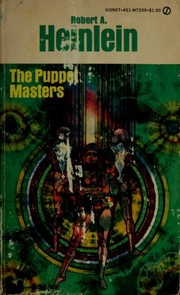
The abolition of the taboo on public nudity would re-appear as a major issue in Heinlein's The Puppet Masters—though under radically different circumstances to those in the present book.
A major difference between the time line of For Us, the Living and Heinlein's later Future History is the time when space exploration begins. In the Future History, Heinlein assumed that long before the end of the 20th century an extensive human exploration and colonization would take place all over the Solar System; the same assumption was made also in other works not fitting into the Future History's framework. However, in his earlier book dealt with here, Heinlein was far more cautious, placing the first circumlunar flight (not yet an actual landing) only in 2089.
Ward Carson wrote: "In For Us, the Living, space colonization waits until the end of the Twenty-First Century and Scudder is defeated; in the Future History it happens a century earlier and Scudder takes over the US. Heinlein made no explicit remark on this, but a causal connection could be made: in the Future History the bold individualistic Americans emigrated into space at the end of the Twentieth Century, and were not present in America to stop it from falling into the fanatic's hands".
A brief summary is given of David Lamb, whose tale is fully developed in Time Enough For Love as "The Man Who Was Too Lazy to Fail".
Concepts and themes
The Second World War
At the time of writing, there was already a widespread expectation of a new war breaking out in Europe in the near future, and Heinlein followed this assumption. However, in the book's timeline the US stays out of the war, and it ends due to Germany's economic collapse rather than its military defeat (similar to the scenario given in H. G. Wells' The Shape of Things to Come, four years before). Heinlein did correctly guess that Adolf Hitler would end up committing suicide, once his schemes of conquest collapsed.
以上文字摘自英文维基百科「For Us, the Living」(有删节,去掉了参考文献等尾部小节),按 CC BY-SA 4.0 使用,作者为维基百科的各位编者。
资料卡
- 原题
- For Us, The Living: A Comedy of Customs 等 2 项
- 原作语言
- 英语
- 首次出版
- 2003 年 11 月 28 日
- 作品形式
- 长篇小说
- 体裁
- 科学幻想
- 首版出版社
- 斯克里布纳之子公司
- 主题
- 时间旅行
- 故事发生地
- 美国
资料卡来自 Wikidata Q2678988(CC0),众包数据,个别字段可能不全。