书单
百科
这个词条暂时没有中文维基百科条目,下面是英文维基百科的内容(英文原文):
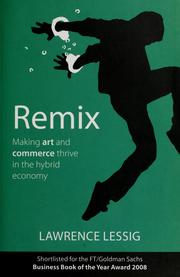
Remix: Making Art and Commerce Thrive in the Hybrid Economy is Lawrence Lessig's fifth book. The book was made available for free download and remixing under the CC BY-NC Creative Commons license via Bloomsbury Academic. It is still available via the Internet Archive. It details a hypothesis about the societal effect of the Internet, and how this will affect production and consumption of popular culture to a "remix culture".
Summary
In Remix, Lawrence Lessig, a Harvard law professor and a respected voice in what he deems the "copyright wars", describes the disjuncture between the availability and relative simplicity of remix technologies and copyright law. Lessig insists that copyright law as it stands now is antiquated for digital media since every "time you use a creative work in a digital context, the technology is making a copy". Thus, amateur use and appropriation of digital technology is under unprecedented control that previously extended only to professional use.
Lessig insists that knowledge and manipulation of multi-media technologies is the current generation's form of "literacy"- what reading and writing was to the previous. It is the vernacular of today. The children growing up in a world where these technologies permeate their daily life are unable to comprehend why "remixing" is illegal. Lessig insists that amateur appropriation in the digital age cannot be stopped but only 'criminalized'. Thus most corrosive outcome of this tension is that generations of children are growing up doing what they know is "illegal" and that notion has societal implications that extend far beyond copyright wars. The book is now available as a free download under one of the Creative Commons' licenses (CC BY-NC 3.0).
Read-only culture vs. read/write culture
Lessig outlines two cultures - the read-only culture (RO) and the read/write culture (RW). The RO culture is the culture we consume more or less passively. The information or product is provided to us by a 'professional' source, the content industry, that possesses an authority on that particular product/information. Analog technologies inherently supported RO culture's business model of production and distribution and limited the role of the consumer to just that, 'consuming'.
Digital technology, however, does not have the 'natural' constraints of the analog that preceded it. "What before was both impossible and illegal is now just illegal"(38). Steve Jobs was the first to see potential in this new market made possible by digital technology. RO culture had to be recoded in order to compete with the "free" distribution made possible by the Internet. iTunes Music store was proof of this. While it provided digital music it was protected by a digital rights management (DRM) code from re-distribution. Lessig uses this key example to show that it is possible to achieve a business model which balances access and control and is equally attractive to both the consumers and the creators. In addition, digital technologies have changed the way we think about 'access'. Today, most of us would never structure our day around a particular program because we know that it is most likely available online - even if it is not necessarily free of charge. Lessig insists, using Amazon as his premiere example, that the future of entertainment and advertising lies in accumulating information about a consumer and tailoring the product to their preferences.
As opposed to RO culture, Read/Write culture has a reciprocal relationship between the producer and the consumer. Taking works, such as songs, and appropriating them in private circles is exemplary of RW culture, which was considered to be the 'popular' culture before the advent of reproduction technologies. The technologies and copyright laws that soon followed, however, changed the dynamics of popular culture. As it became professionalized people were taught to defer production to the professionals.
Lessig posits that digital technologies provide the tools for reviving RW culture and democratizing production. He uses blogs to explain the three layers of this democratization. Blogs have redefined our relationship to the content industry as they allowed access to non-professional content. The 'comments' feature that soon followed provided a space for readers to have a dialogue with the amateur contributors. 'Tagging' of the blogs by users based on the content provided the necessary layer for users to filter the sea of content according to their interest. The third layer added bots that analyzed the relationship between various websites by counting the clicks between them and, thus, organizing a database of preferences. The three layers working together established an "ecosystem of reputation"(61) that served to guide users through the blogosphere. Lessig uses the blog model to demonstrate a wider conclusion - while there is no doubt many amateur online publications cannot compete with the validity of professional sources, the democratization of digital RW culture and the 'ecosystem of reputation' provides a space for many talented voices to be heard that was not available in the pre-digital RO model.
Hybrid economies
There are three economies that Lessig introduced in his book. The first is the commercial economy. He says that commercial economies at their very center value money the most and build value around the monetary. Second to this is the sharing economy which completely ignores money as an item of value and instead focuses on valuing things that are not monetary. But settled in between the two is a third, the hybrid economy. He asserts that the hybrid economy will be the dominant force with the rise of the web, and in order for it thrive the two economies from which it borrows from must be preserved. Conceptually the monetizing nature from the commercial, and the 'lending' quality of the sharing economy are necessary to ensure that the hybrid doesn't lose sight of economic gain or doesn't lose the willingness to obtain economic resources.
以上文字摘自英文维基百科「Remix (book)」(有删节,去掉了参考文献等尾部小节),按 CC BY-SA 4.0 使用,作者为维基百科的各位编者。
资料卡
- 原题
- Remix
- 原作语言
- 英语
- 首次出版
- 2008 年
- 前作
- Code: Version 2.0
- 续作
- Republic, Lost
资料卡来自 Wikidata Q7311931(CC0),众包数据,个别字段可能不全。