书单
百科
这个词条暂时没有中文维基百科条目,下面是英文维基百科的内容(英文原文):
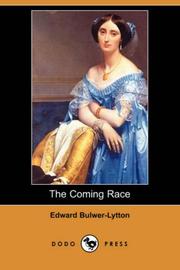
Vril: The Power of the Coming Race, originally published as The Coming Race, is a science and subterranean fiction novel by the British politician and writer Edward Bulwer-Lytton, published anonymously in 1871.
Some readers have believed the account of a superior subterranean master race and the energy-form called "Vril" to be, at least partially, true. Some theosophists, notably Helena Blavatsky, William Scott-Elliot, and Rudolf Steiner, accepted the book as based on occult truth. The 1960 book The Morning of the Magicians by Jacques Bergier and Louis Pauwels suggested that a secret Vril Society existed in Weimar Berlin.
The name "Vril" was apparently derived from the word virile.
History
The original British edition, titled as The Coming Race, was published anonymously in May 1871 by Blackwood and Sons of Edinburgh and London. Blackwood published four more impressions in 1871. Anonymous American and Canadian editions were published in August 1871 as The Coming Race or The New Utopia by Francis B. Felt & Co. in New York City and by Copp, Clark & Co. in Toronto. Erewhon, which was published anonymously in March 1872, was initially assumed to be a sequel to The Coming Race, which by then Bulwer-Lytton was known to have written. When it was revealed that Samuel Butler was the author of Erewhon in the 25 May 1872 issue of The Athenaeum, sales dropped by 90 per cent.
Plot summary
A young, independent, wealthy traveller (the Narrator) visits a friend, a mining engineer. They explore a natural chasm in a mine which has been exposed by an exploratory shaft. Using a grappling hook and rope, the Narrator reaches the bottom of the chasm safely, but as the engineer follows, the hook dislodges and the engineer falls to his death. The Narrator is unable to ascend back up the chasm, so makes his way into a subterranean world occupied by beings who in some ways seem to resemble angels and their face that of a sphinx. They have a skin tone similar to that of Amerindians, however "richer and softer", large black eyes, and "brows arched as a semicircle". He befriends the first being he meets, who guides him around a city that is reminiscent of ancient Egyptian architecture. The Narrator meets his host's wife, two sons and daughter who learn to speak English by way of a makeshift dictionary during which the narrator unconsciously teaches them the language.
The Narrator discovers that these beings, who call themselves Vril-ya, have great telepathic and other parapsychological abilities, such as being able to transmit information, get rid of pain, and put others to sleep. The Narrator is offended by the idea that the Vril-ya are better adapted to learn about him than he is to learn about them. Nevertheless, the guide (who turns out to be a magistrate) and his son Taë behave kindly towards him.
The Narrator soon discovers that the Vril-ya are descendants of an antediluvian civilisation called the Ana, who live in networks of caverns linked by tunnels. Originally surface-dwellers, they fled underground thousands of years ago to escape a massive flood and gained greater power by facing and dominating the harsh conditions of the Earth. The place where the Narrator descended houses 12,000 families, one of the largest groups and at the upper limit of population size before a chunk of the population will be splintered off and sent to build a new city on un-inhabited land. Their society is a technologically supported Utopia, chief among their tools being an "all-permeating fluid" called "Vril", a latent source of energy that the spiritually elevated hosts are able to master through training of their will, to a degree that depends on their hereditary constitution. This mastery gives them access to an extraordinary force that can be controlled at will. It is this fluid that the Vril-ya employ to communicate with the Narrator. The powers of the Vril include the ability to heal, change, and destroy beings and things; the destructive powers in particular are immense, allowing a few young Vril-ya children to destroy entire cities if necessary.
Men (called An, pronounced "Arn") and women (called Gy, pronounced "Gee") have equal rights. The women are stronger, larger, and more sensitive to Vril than the men. The women are also the pursuing party in romantic relationships. They marry for three years, after which the men choose whether to remain married, or be single. The female may then pursue a new husband. However, they seldom make the choice to remarry.
Their religion posits the existence of a superior being but does not dwell on his nature. The Vril-ya believe in the permanence of life, which according to them is not destroyed but merely changes form.
以上文字摘自英文维基百科「Vril」(有删节,去掉了参考文献等尾部小节),按 CC BY-SA 4.0 使用,作者为维基百科的各位编者。
资料卡
- 原题
- The Coming Race
- 原作语言
- 英语
- 作品形式
- 长篇小说
- 体裁
- 社会科学幻想运动、失落的世界、推想虚构作品、奇幻、反乌托邦作品
- 主要人物
- Vril
资料卡来自 Wikidata Q510699(CC0),众包数据,个别字段可能不全。