书单
百科
这个词条暂时没有中文维基百科条目,下面是英文维基百科的内容(英文原文):
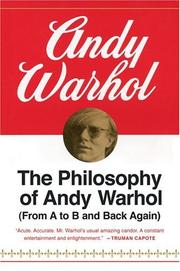
The Philosophy of Andy Warhol (From A to B & Back Again) is a 1975 book by the American artist Andy Warhol. It was first published by Harcourt Brace Jovanovich.
The book is an assemblage of vignettes about love, beauty, fame, work, sex, time, death, economics, success, and art, among other topics, by the "Prince of Pop".
Background
Warhol signed two book contracts in 1974 with Harcourt, one for The Philosophy and the second for a biography of Paulette Goddard, which was never completed.
The Philosophy was ghostwritten by Warhol's frequent collaborator, Pat Hackett, and Interview magazine editor Bob Colacello. Much of the material is drawn from taped interviews Hackett did with Warhol specifically for the book, and also from conversations Warhol had taped between himself and Colacello and Brigid Berlin.
Publication
The Philosophy was published by Harcourt Brace Jovanovich in August 1975. In May, Warhol signed 6,000 copies of the book at HBJ's warehouse in Saddle Brook, New Jersey in advance of its release. When orders exceeded the number of signed copies, he returned to the warehouse in July and signed an additional 8,000 copies.
An excerpt from the book appeared in the September 1975 issue of Cosmopolitan. Art dealer Leo Castelli hosted a reception for Warhol at his New York gallery, while fashion designer Halston held a party for him at his home on September 13. The following day, Warhol began a promotional tour at the Baltimore Museum of Art, where his exhibition Andy Warhol: Paintings 1962–1975 was on view.
Promotional tour
In September, Warhol embarked on an extensive U.S. promotional tour with his editor Bob Colacello, business manager Fred Hughes, boyfriend Jed Johnson, and bodyguard Lady Anne Lambton. He signed copies of the book in department-store windows, art galleries, bookstores, and at cocktail parties hosted by art collectors. The tour subsequently continued in England and Canada. Warhol would sign almost anything brought to him, but when presented with a copy of the new book, he would draw a Campbell's Soup can on it.
Critical reception
Barbara Goldsmith of The New York Times noted that "Warhol's basic philosophical premise is 'nothing'; not the futility of human endeavor of Sartre and Camus, or the void beyond pain of Joan Didion, but simply—nothing added." "The sections of this book that tell us about Andy's own life are fresh and illuminating," she added. Although unsure that Warhol wrote the book himself, Goldsmith said, "It doesn't really matter, which is his point exactly. The important message is how Warhol managed to make himself into a machinelike presence devoid of empathy."
John Raymond of The Atlanta Journal-Constitution wrote: "Andy Warhol's philosophy is not a philosophical system in the accepted sense … Even esthetics, which as an artist you might think would interest him, doesn't really. 'After I did the thing called "art,"' he tells us, 'or whatever it's called, I went into business art. I wanted to be an art business man or a business artist. Being good in business is the most fascinating kind of art."
Owen Findsen of The Cincinnati Enquirer observed that "the book reads like a Richard Brautigan novel about a character that combines the humor and self-image of Woody Allen with the moral ethics of Tiny Tim.
Caroline Tisdall of The Guardian wrote, "It's not often you find a personal philosophy that is both comforting and funny. Warhol's is. The comfort comes from his treatment of the big issues: love, sex, time, fame, and death. The fun lies in the spaces in between: art, economies, work, and underwear. … This is a highly moral book, and the morality lies in its tolerance. This is applied not just to people but even extended to critics: for Warhol, nothing that is said about him can be dismissed as 'wrong.' since it is a reaction, and therefore has a cause. There are only a couple of artists working now who are big enough to recognise that."
Lou Reed musical
In 1975, Warhol told The Daily Illini that Lou Reed had written a musical based on The Philosophy of Andy Warhol (From A to B & Back Again) in a single day. Warhol said Reed had asked for his permission to adapt the book and subsequently presented him with the completed work, which Warhol was expected to develop further with additional ideas. Warhol also said that Reed hoped to bring the musical to Broadway, with Lorna Luft and David Cassidy in the cast. In October 2019, music by Reed based on the book was reported to have been discovered in the archives of the Andy Warhol Museum in Pittsburgh.
以上文字摘自英文维基百科「The Philosophy of Andy Warhol」(去掉了参考文献等尾部小节),按 CC BY-SA 4.0 使用,作者为维基百科的各位编者。
资料卡
- 原题
- The Philosophy of Andy Warhol
- 原作语言
- 英语
- 首次出版
- 1975 年
- 主题
- 哲学
资料卡来自 Wikidata Q7756933(CC0),众包数据,个别字段可能不全。