书单
百科
这个词条暂时没有中文维基百科条目,下面是英文维基百科的内容(英文原文):
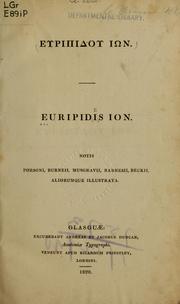
Ion (Ancient Greek: Ἴων, Iōn) is an ancient Greek tragedy by Euripides. On the subject of dating this work, no scholarly consensus exists; this is due to the fact that no certain reliable criterion that could potentially be utilised for this purpose has been found. Various possible dates have been proposed. Of these, the "dates most commonly proposed by modern scholarship are 418/7, 414/3 and 412". Central to the plot is the story of its namesake, Ion, a young and willing servant in Apollo's temple who inadvertently discovers his biological origins. Of equal import to the plot is the story of Creusa, Ion's mother, whose words and actions are heavily informed by the abuse she previously experienced at the hands of Apollo.
Euripides' retelling of this myth departs from the norm in that it calls the morality and superiority of the gods into question. Though the theme of individuals rising up against disasters that the Fates or the gods have wrought is oft-seen in tragedy, by explicitly challenging the notion that gods have a right to govern the destinies of human beings, Creusa and Ion depart from convention. In the end, however, Euripides takes a step back from this precipitous development: Creusa retracts her earlier criticism of Apollo, and the status quo is preserved.
Background
Creusa, daughter of Erechtheus, was a noble native of Athens and daughter of the king. The god Apollo raped her in a cave; there she secretly gave birth to his son whom she intended to kill by exposure to the elements for fear of the terrible punishment she would receive at the hands of her parents for having a child apparently out of wedlock. Throughout her life only she knows of this secret. Many years later, near the end of childbearing age and so far unable to have a child with her husband Xuthus, a Thessalian and son of Aeolus, they traveled to Delphi to seek a sign from the oracles regarding whether there was any hope of their having any children in the future.
Story
Outside the temple of Apollo at Delphi, Hermes recalls the time when Creusa, the daughter of Erectheus, was raped by Apollo in a cave at Long Rocks under the Acropolis. A boy—Ion—was born from that liaison. Apollo concealed her pregnancy from her father and Creusa secretly gave birth to the child, whom she placed in a basket along with the adornments she possessed (amongst them snakes of beaten gold, as was customary) and left for dead. Then, at Apollo's request, Hermes brought the child to Delphi, where he was taken in by a priestess. He says that from then until now, the boy has lived a respected life as a temple servant.
Hermes then goes on to describe Creusa's life. Creusa was married to the foreign-born Xuthus, son of Aeolus, the son of Zeus. Xuthus won Creusa by assisting the Athenians in a war against the Chalcidians. Their marriage has been childless thus far; thus, Xuthus and Creusa have come to Delphi to seek a remedy for this affliction. Hermes says that Apollo is directing events to this conclusion, and that he will give the boy to Xuthus, who will take him home to Athens where he will be recognised by his mother. He then calls the boy Ion, "his destined name".
Hermes steps into a wooded grove when Ion arrives to begin his morning chores. As Ion sweeps the steps of the temple with a broom of laurel, he sings the praise of the god who is like a father to him. His reveries are disturbed by birds which he shoos away with his arrows in order to keep the sacred temple clean, though not without a twinge of regret as he sees them as the gods' messengers.
The Chorus, consisting of Athenian maidens, arrives at the temple and marvels at the stonework depicting ancient legends. They identify themselves to Ion as servants of the Athenian rulers and soon spot their mistress arriving at the temple doors.
Creusa introduces herself to Ion as the daughter of Erectheus. Ion is impressed, as he is familiar with the old stories about her family. Ion's casual mention of Long Rocks startles Creusa but she reveals nothing of her past. She tells him that she has married a foreigner, Xuthus, who won her as a prize for helping the Athenians in battle. They are here to ask about having children. Ion introduces himself as an orphan slave who was brought up by the priestess of Apollo. When Creusa asks if he has ever tried to find his mother, he says he has no token of her. Moved by the thought of his mother, Creusa tells Ion that she has come in advance of her husband to question the oracle on behalf of "a friend" who had a child by Apollo, which she abandoned. She has come, she tells him, to ask the god if her friend's child is still alive. Relating to Ion that the child disappeared from the cave where her "friend" left him, she tells Ion that the child would be about his age had he survived. Ion warns her to abandon the inquiry, saying that no one would dare accuse the god of such a deed in his own temple. Seeing Xuthus approaching, Creusa asks Ion to reveal nothing of their conversation. Xuthus arrives and expresses confidence that he will receive good news from the oracle. He sends Creusa with laurel branches to make the rounds of the external altars and goes into the sanctuary. After they both leave, Ion questions how the gods, who punish evildoing among mortals, can engage in abusive behavior themselves. Before going off to finish his chores, he indignantly advises the gods not to sleep with mortal women just because they can.
While Xuthus is inside, the Chorus of Creusa's servants prays to Athena and Artemis, recalling the joys of fertility and raising children. Recalling the story of the daughters of Cecrops and Aglauros, they conclude that children born of mortals by gods are fated for ill-fortune.
以上文字摘自英文维基百科「Ion (play)」(有删节,去掉了参考文献等尾部小节),按 CC BY-SA 4.0 使用,作者为维基百科的各位编者。
资料卡
- 原题
- Ἴων
- 原作语言
- 古希腊语
- 作品形式
- 剧作
- 体裁
- 古希腊悲剧、情节剧
- 故事发生地
- 德尔斐
- 主要人物
- 伊翁、雅典的克瑞乌萨、克苏托斯、赫耳墨斯、雅典娜
资料卡来自 Wikidata Q614607(CC0),众包数据,个别字段可能不全。
改编作品
取材于它的书1
名单来自 Wikidata(CC0):只列条目里写明「改编自 / 取材于」这本书的作品,不按名字猜;众包数据,可能不全。