书单
大逻辑 (1812)
百科
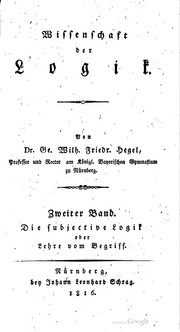
《逻辑学》(德语:Wissenschaft der Logik)是德国哲学家黑格尔一部哲学著作。通称《大逻辑》,以区别于《哲学全书》中的第一部分“逻辑学”(通称《小逻辑》)。本书共分为“有论”“本质论”“概念论”三部分,前两部分合称客观逻辑,分别出版于1812年和1813年,第三部分称主观逻辑,出版于1816年。
黑格尔著作共有三种全集本,即米希勒本,格罗克纳本和拉松本。中文译本(商务印书馆,杨一之译)依拉松本的编例,以“有论”为上卷,“本质论”和“概念论”为下卷。译文亦以拉松本为主要依据,并参考了格罗克纳本。
核心观点
本书中黑格尔所探讨的内容,只是关于黑格尔哲学中逻辑学的相关内容,是研究理念自在自为的科学,是黑格尔辩证法的核心。关于黑格尔哲学的其他内容,黑格尔在另外两部著作《自然哲学》、《精神哲学》中另有阐述。另外,黑格尔在《小逻辑》中阐述了比此书更加成熟的观点。
在此书中,黑格尔把逻辑学分为了三部分,就是“有论”(存在论)、“本质论”和“概念论”。关于这三部分的关系,是层层渐进的:只有概念是真理,或者说,概念是存在与本质的真理。因为存在与本质只是直接的和间接的东西,所以如果两者坚持在孤立的状态中,那么其都不能是真理。
以上文字摘自维基百科「逻辑学 (黑格尔著作)」(去掉了参考文献等尾部小节),按 CC BY-SA 4.0 使用,作者为维基百科的各位编者。
中文维基百科的条目比较短,下面附上英文维基百科的内容(英文原文):
Science of Logic (German: Wissenschaft der Logik), first published between 1812 and 1816, is the work in which Georg Wilhelm Friedrich Hegel outlined his vision of logic. Hegel's logic is a system of dialectics, i.e., a dialectical metaphysics: it is a development of the principle that thought and being constitute a single and active unity. Science of Logic also incorporates the traditional Aristotelian syllogism: it is conceived as a phase of the "original unity of thought and being" rather than as a detached, formal instrument of inference.
For Hegel, the most important achievement of German idealism, starting with Immanuel Kant and culminating in his own philosophy, was the argument that reality (being) is shaped by thought and is, in a strong sense, identical to thought. Thus ultimately the structures of thought and being, subject and object, are identical. Since for Hegel the underlying structure of all of reality is ultimately rational, logic is not merely about reasoning or argument but rather is also the rational, structural core of all of reality and every dimension of it. Thus Hegel's Science of Logic includes among other things analyses of being, nothingness, becoming, existence, reality, essence, reflection, concept, and method.
Hegel considered it one of his major works and therefore kept it up to date through revision.
Science of Logic is sometimes referred to as the Greater Logic to distinguish it from the Lesser Logic, the moniker given to the condensed version Hegel presented as the "Logic" section of his Encyclopedia of the Philosophical Sciences.
Publication history
Hegel wrote Science of Logic after he had completed his Phenomenology of Spirit and while he was in Nuremberg working at a secondary school and courting his fiancée. It was published in two volumes. The first, 'The Objective Logic', has two parts (the Doctrines of Being and Essence) and each part was published in 1812 and 1813 respectively. The second volume, 'The Subjective Logic', was published in 1816 the same year he became a professor of philosophy at the University of Heidelberg. Science of Logic is too advanced for undergraduate students so Hegel wrote an encyclopaedic version of the logic which was published in 1817 and expanded in 1827 with additional revisions in 1831.
In 1826, Science of Logic went out of stock. Instead of reprinting, as requested, Hegel undertook some revisions. By 1831, Hegel completed a greatly revised and expanded version of the "Doctrine of Being", but had no time to revise the rest of the book. The Preface to the second edition is dated 7 November 1831, just before his death on 14 November 1831. This edition appeared in 1832, and again in 1834–5 in the posthumous Works. Only the second edition of Science of Logic is translated into English.
Hegel's general concept of logic
According to Hegel, logic is the form taken by the science of thinking in general. He thought that, as it had hitherto been practiced, this science demanded a total and radical reformulation "from a higher standpoint." At the end of the preface he wrote that "Logic is the thinking of God". His stated goal with The Science of Logic was to overcome what he perceived to be a common flaw running through all other former systems of logic, namely that they all presupposed a complete separation between the content of cognition (the world of objects, held to be entirely independent of thought for their existence), and the form of cognition (the thoughts about these objects, which by themselves are pliable, indeterminate and entirely dependent upon their conformity to the world of objects to be thought of as in any way true). This unbridgeable gap found within the science of reason was, in his view, a carryover from everyday, phenomenal, unphilosophical consciousness.
以上文字摘自英文维基百科「Science of Logic」(有删节,去掉了参考文献等尾部小节),按 CC BY-SA 4.0 使用,作者为维基百科的各位编者。
资料卡
- 原题
- Wissenschaft der Logik
- 原作语言
- 德语
- 首次出版
- 1812 年
- 体裁
- 随笔
- 前作
- 精神现象学
- 续作
- 哲学科学百科全书纲要
- 主题
- 哲学
资料卡来自 Wikidata Q374811(CC0),众包数据,个别字段可能不全。