书单
百科
这个词条暂时没有中文维基百科条目,下面是英文维基百科的内容(英文原文):
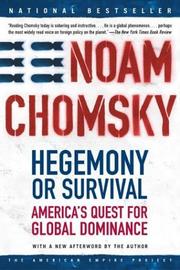
Hegemony or Survival: America's Quest for Global Dominance is a book about the United States and its foreign policy written by American political activist and linguist Noam Chomsky. It was first published in the United States in November 2003 by Metropolitan Books and then in the United Kingdom by Penguin Books. It was republished by Haymarket Books in January 2024.
Chomsky's main argument in Hegemony or Survival is that the socio-economic elite who control the United States have pursued an "Imperial Grand Strategy" since the end of World War II to maintain global hegemony through military, political, and economic means. He argues that in doing so they have repeatedly shown a total disregard for democracy and human rights, in stark contrast to the US government's professed support for those values. He further argues that this continual pursuit of global hegemony threatens the existence of humanity itself because of the increasing proliferation of weapons of mass destruction.
Drawing historical examples from 1945 through to 2003, Chomsky looks at the US government's support for regimes responsible for mass human rights abuses—including ethnic cleansing and genocide—namely El Salvador, Colombia, Turkey, Israel, Egypt, South Africa, and Indonesia. He also discusses US support for militant dissident groups widely considered "terrorists", particularly in Nicaragua and Cuba, as well as direct military interventions, such as the Vietnam War, NATO bombing of Yugoslavia, Afghan War and Iraq War, to further its power and grasp of resources. He argues that US foreign policy—whether controlled by Republican or Democratic administrations—pursues the same agenda of gaining access to lucrative resources and maintaining US world dominance.
Mainstream press reviews in the US were mixed and were largely negative in the UK, although a review in Asia was more positive. In a speech before the UN General Assembly in September 2006, Venezuelan President Hugo Chávez openly praised the work. Sales of the book surged after the recommendation, its rank on Amazon.com rising to No. 1 in paperback and No. 6 in hardcover in only a few days.
Background
Noam Chomsky (born 1928) was born in Philadelphia, Pennsylvania, to Jewish immigrants from Eastern Europe. Becoming academically involved in the field of linguistics, Chomsky gained a PhD and secured a teaching job at the Massachusetts Institute of Technology. In the field of linguistics, he is credited as the creator or co-creator of the Chomsky hierarchy and the universal grammar theory, achieving international recognition for his work.
Politically, Chomsky had held radical leftist views since childhood, identifying himself with anarcho-syndicalism and libertarian socialism. A staunch critic of U.S. foreign policy, he arose to public attention for these views in 1967, when The New York Times published his article, "The Responsibility of Intellectuals", a criticism of the Vietnam War.
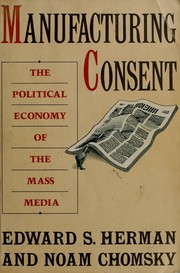
His media criticism has included Manufacturing Consent: The Political Economy of the Mass Media (1988), co-written with Edward S. Herman, an analysis articulating the propaganda model theory for examining the media.
Chomsky is the author of over 100 books, and has been described as a prominent cultural figure. According to the Arts and Humanities Citation Index in 1992, Chomsky was cited as a source more often than any other living scholar from 1980 to 1992, and was the eighth most cited source overall.
The book was published as the first in The American Empire Series, edited for Metropolitan Books by Steve Fraser and Tom Engelhardt. The series had been devised as a vehicle for works of anti-imperialism that were critical of U.S. foreign policy. Engelhardt informed an interviewer that the series reflected their "counterinterventionary impulse" and represented an attempt to reclaim "the word" from the political right in the United States. They agreed to publish with Metropolitan because it was co-run by Engelhardt and Sara Bershtel. In conjunction with the publication of the book, Chomsky answered a series of public questions on the website of The Washington Post.
Synopsis
Chomsky's first chapter, "Priorities and Prospects", provides an introduction to U.S. global dominance at the start of 2003. He looks at the role of propaganda – employed by government and mass media – in shaping public opinion in both the U.S. and United Kingdom, arguing that it allows a wealthy elite to thrive at the expense of the majority. As evidence for the manner in which the media shapes public opinion on foreign policy, he discusses the role of the U.S. government in protecting its economic interests in Nicaragua, first by supporting the military junta of General Somoza and then by supporting the Contra militias, in both instances leading to mass human rights abuses which were ignored by the mainstream U.S. media.
Chapter two, "Imperial Grand Strategy", looks at the U.S. government's belief that it should take part in "preventative war" against states who threaten its global hegemony, despite the illegality of these actions under international law. Chomsky argues that the targets of U.S. preventative war must be weak, yet important and easy to depict as a threat to the U.S. populace. Using the 2003 invasion of Iraq as an example, he discusses how the U.S. government and media portrayed the Iraqi government of Saddam Hussein as a threat to the U.S. and other Middle Eastern states, something which Chomsky argues it was not.
以上文字摘自英文维基百科「Hegemony or Survival」(有删节,去掉了参考文献等尾部小节),按 CC BY-SA 4.0 使用,作者为维基百科的各位编者。
资料卡
- 原题
- Hegemony or Survival
- 原作语言
- 英语
- 首次出版
- 2003 年 11 月
- 主题
- 美国、美国帝国主义、外交关系、被国家支持的恐怖主义、军事政策
- 故事发生地
- 美国
资料卡来自 Wikidata Q2386750(CC0),众包数据,个别字段可能不全。
更多资料与书评
在哪读
诺姆·乔姆斯基 的其他作品
作者页 ›