书单
百科
这个词条暂时没有中文维基百科条目,下面是英文维基百科的内容(英文原文):
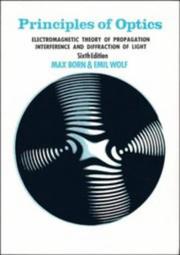
Principles of Optics, colloquially known as Born and Wolf, is an optics textbook written by Max Born and Emil Wolf that was initially published in 1959 by Pergamon Press. After going through six editions with Pergamon Press, the book was transferred to Cambridge University Press who issued an expanded seventh edition in 1999. A 60th anniversary edition was published in 2019 with a foreword by Sir Peter Knight. It is considered a classic science book and one of the most influential optics books of the twentieth century.
Background
In 1933, Springer published Max Born's book Optik, which dealt with all optical phenomena for which the methods of classical physics, and Maxwell's equations in particular, were applicable. In 1950, with encouragement from Sir Edward Appleton, the principal of Edinburgh University, Born decided to produce an updated version of Optik in English. He was partly motivated by the need to make money, as he had not been working long enough at Edinburgh to earn a decent pension, and at that time, was not entitled to any pension from his time working in Germany.
The first problem that Born had to tackle was that after the US joined the war in 1941, Optik had been reproduced and sold widely in the US, along with many other books and periodicals. This had been done under the aegis of the Office of Alien Property which was authorised to confiscate enemy property, so that neither the authors nor the publishers received any payment for these sales. When the war ended, the printing continued, still with no payment of royalties to authors or publishers. Born had been writing regularly to try and reclaim his book, pointing out that he was not an alien, as he had been a British citizen at the start of the war. He enlisted the support of various people and organisations, including the British Ambassador in Washington. In response, he got a letter saying that he would have to pay 2% of the retail price of any new book he wrote which was based on Optik. An article in the Manchester Guardian about how Jean Sibelius had been deprived of royalties in the same way, prompted him to write a letter describing his own situation. Eventually, his rights to the book were returned and he received backdated royalties.
He quickly realised that the important developments in optics which had occurred in the years since the original book had been written would need to be covered. He approached Dennis Gabor, the inventor of holography to collaborate with him in writing the book. Emil Wolf, a research assistant at Cambridge University, was invited to write a chapter in the book. Gabor subsequently dropped out because of time constraints. Born and Wolf were then the main authors with specialist contributions from other authors. Wolf wrote several chapters and edited the other contributions; Born's input was a modified version of Optik and also collaboration with Wolf in the planning of the book, and many discussions concerning disputed points, presentation and so on.
They hoped to complete the book by the end of 1951, but they were "much too optimistic". The book was actually first published in December 1959.
Problems with Pergamon Press and Robert Maxwell
Pergamon Press was a scientific publishing company which was set up in 1948 by Robert Maxwell and Paul Rosbaud. The latter had been a scientific advisor for Springer in Germany before and during the war and was one of the editors dealing with Optik. He was also an undercover agent for the Allies during the war. He persuaded the authors to place the book with Pergamon Press, a decision which they would later regret.
A detailed account is given by Gustav Born, Max's son He explains how the libel laws in the UK prevented him from speaking about this until after Maxwell's death.
Maxwell tried to get the authors to agree to a much lower rate of royalties for US sales than was agreed in their contract because the book was to be marketed by a different publisher which would mean reduced profits for Pergamon. It was then actually marketed through the US branch of Pergamon but the authors still received reduced royalties. They also found that the sales figures in their statements were lower than the true figures. A clause in the contract meant that they had to go to arbitration rather than go to court to resolve this. Gustav acted for his father in the matter as Max Born was now living in Germany and was in his late seventies. The case was heard by Desmond Ackner(later Lord Ackner) in 1962. He found in favour of the authors on all counts. Nonetheless, they continued to be underpaid. Opening figures in one year's statement did not agree with closing figures from the previous year's statement. Some editions were reprinted several times but did not appear in the accounts at all. After Born's death, Wolf found that an international edition was being distributed in the Far East which he had not been told about. Pergamon sent him a small cheque when he raised the matter with them. When he threatened them with legal action, they sent another cheque for three times the amount. Wolf said that the book was re-printed seventeen times (not counting unauthorized editions and translations).
Rosbaud left Pergamon Press in 1956 “because he found Maxwell to be completely dishonest”. Other authors told Gustav Born that they had had the same problems with Maxwell. They included Sir Henry Dale, who shared the Nobel prize in medicine in 1936 and Edward Appleton.
Contents
1st edition
The book aimed to cover only those optical phenomena which can be derived from Maxwell's electromagnetic theory and is intended to give a complete picture of what was then known derived from Maxwell's equations.
2nd edition
This was published in 1962. It contained corrections of errors and misprints.
Lasers had been developed since the 1st edition was published but were not covered because laser operation is outside the scope of classical optics. Some references to research which used lasers were included.
以上文字摘自英文维基百科「Principles of Optics」(有删节,去掉了参考文献等尾部小节),按 CC BY-SA 4.0 使用,作者为维基百科的各位编者。
资料卡
- 原题
- Principles of Optics
- 原作语言
- 英语
- 主题
- 光学
资料卡来自 Wikidata Q15076680(CC0),众包数据,个别字段可能不全。