书单
百科
这个词条暂时没有中文维基百科条目,下面是英文维基百科的内容(英文原文):
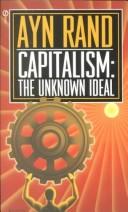
Capitalism: The Unknown Ideal is a collection of essays, mostly by the Russian-born American philosopher Ayn Rand, with additional essays by her associates Nathaniel Branden, Alan Greenspan, and Robert Hessen. The authors focus on the moral nature of laissez-faire capitalism and private property. They have a very specific definition of capitalism, a system they regard as broader than simply property rights or free enterprise. It was originally published in 1966.
Summary
Rand intended Capitalism: The Unknown Ideal to focus on the moral nature of capitalism, as opposed to focusing on its economic aspects. She contrasts this with what she says is the failure of most other defenders of capitalism to provide a moral defense of that system.
After an introduction by Rand, the book is divided into two main sections. The first section, "Theory and History", contains essays that focus on the theoretical basis for capitalism and historical arguments related to it. This section includes essays arguing against common objections to capitalism. The second section, "Current State", focuses on contemporary political issues from the 1960s. The topics covered in this section include the Vietnam War, student protests, and the papal encyclical Populorum progressio. An "Appendix" section reprints two essays on political theory previously published in Rand's earlier book, The Virtue of Selfishness. A recommended reading list about capitalism is also provided.
Themes
Rand applies her philosophy of Objectivism to the subject of politics. When Rand talks of capitalism, she means laissez-faire capitalism, in which there is a complete separation of state and economics "in the same way and for the same reasons as the separation of church and state". Rand says, "Objectivists are not 'conservatives'. We are radicals for capitalism; we are fighting for that philosophical base which capitalism did not have and without which it was doomed to perish." Rand says that most people do not know what capitalism is, which is why it is "the unknown ideal".
What is capitalism?
As understood by Rand, capitalism is the system that emerges among a group of free individuals, each applying time and reason to sustain his or her own life, each the owner of the means to do so, freely trading among themselves. Rand regarded a mixed economy as a dangerous and unstable combination of freedom and controls that tends to develop into ever increasing statism.
Reason and values
Rand held capitalism to be the only moral social system, that is, one consistent with an objective theory of value and ethical individualism. According to Rand, the creation of wealth is a fusion of mind and matter, and she argued that reason is the most fundamental tool of survival for human beings; however, rational thought is rendered inoperative under conditions of compulsion, coercion, or as she puts it, the initiation of physical force. Whether it is the force of an armed robber or the force of a law, an actor's own judgment is rendered irrelevant to his actions by a threat of force, compelling him to act on the judgment or will of another, thus neutralizing the source of wealth and survival itself. Only voluntary trade can ensure that human interaction is mutually beneficial, and an analysis of history shows that only economic and political freedom has worked to create significant growth and economic development, precisely by liberating the rational faculties of ever wider numbers of individuals, according to Rand.
Individual rights
In its most basic form, the right to life (as understood by Rand) is the right of each human to do any and all activities necessary to sustain his or her own life. Rand further argued that one's selfish interests can never rationally entail the use of physical force or violence against the person or the property of another. Rand saw humans as thriving only as independent beings, reason being a faculty of the individual, with each freely expending their time, effort, and reason to sustain their own life.
Rand suggested that through the division of labor, specialization, and voluntary trade, other people are of enormous value to an individual. Moreover, knowledge, skills, and interests vary from human to human. One person may be better at shaping flint into arrowheads, another may have acquired the skill to turn mud into pottery. If the first wants a pot to cook in, he or she may trade an arrowhead for a pot. The central feature of free trade is that each participant judges that he or she has gained from the transaction.
According to Rand, when physical force is banned, persuasion alone can organize or coordinate human activity, and, consequently, the use of reason is both liberated and rewarded. The technological innovation which characterizes capitalist systems is thus directly related to conditions of economic freedom. A producer profits and becomes wealthy only by satisfying the voluntary choices of other market participants and in direct proportion to the value those participants find in transactions with that producer. In this way, individuals who themselves could have never invented, for example, the light bulb or the steam engine can nonetheless benefit from the creativity of others; this can be only ensured when both the innovator and the consumer are free to refuse the proposed trade. According to Rand, this is the mechanism behind America's rapid economic development, its liberation of human reason.
以上文字摘自英文维基百科「Capitalism: The Unknown Ideal」(有删节,去掉了参考文献等尾部小节),按 CC BY-SA 4.0 使用,作者为维基百科的各位编者。
资料卡
- 原题
- Capitalism: The Unknown Ideal
- 原作语言
- 英语
- 首版出版社
- 新美洲图书馆
- 主题
- 资本主义
- 故事发生地
- 美国
资料卡来自 Wikidata Q2937458(CC0),众包数据,个别字段可能不全。