书单
百科
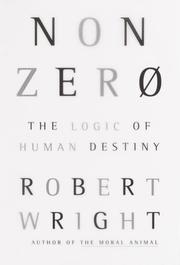
《非零和时代:人类命运的逻辑》(英语:Nonzero: The Logic of Human Destiny)是美国记者和作家罗伯特·赖特的著作,讨论生物演化与文化演化中的非零和博弈,1999年出版。
以上文字摘自维基百科「非零和时代」(去掉了参考文献等尾部小节),按 CC BY-SA 4.0 使用,作者为维基百科的各位编者。
中文维基百科的条目比较短,下面附上英文维基百科的内容(英文原文):
Nonzero: The Logic of Human Destiny is a 1999 book by Robert Wright, in which the author argues that biological evolution and cultural evolution are shaped and directed first and foremost by "non-zero-sumness" i.e., the prospect of creating new interactions that are not zero-sum.
Thesis
The principal argument of Nonzero is to demonstrate that natural selection results in increasing complexity within the world and greater rewards for cooperation. Since, as Wright puts it, the realization of such prospects is dependent upon increased levels of globalization, communication, cooperation, and trust, what is thought of as human intelligence is really just a long step in an evolutionary process of organisms (as well as their networks and individual parts) getting better at processing information.
Through this lens, and an overview of human history, Wright typifies the argument against the views of noted paleontologist Stephen Jay Gould. Gould wrote that "Humans are here by the luck of the draw." Wright acknowledges one aspect of Gould's argument—that the evolutionary process was not such that it would inevitably create humans as we know them today ("five fingers, five toes, and so on") but that evolution would almost certainly result in the creation of highly intelligent, communicating organisms, who would in turn develop tools and advanced technologies.
Evidence for natural selection driving improvements in information processing is given throughout, including the case of the bombardier beetle, an insect that developed the ability to spray its attackers with harsh chemicals. This, in turn, favored predators via natural selection who had techniques to avoid the spray. As Wright puts it, "complexity breeds complexity." This is the often referred to evolutionary phenomenon of the "arms race," wherein competing organisms stack up their developments in competition with one another.
Via this increasing complexity, according to Nonzero, higher intelligence was thus destined to happen, perhaps even "inevitable".
Complexity and zero-sum solutions in human society
Wright argues that as complexity in human society increases, the ability to reap "non-zero-sum gains" increases. For example, electronic communications enable trade at a global level, and allow various societies to trade in items they could not produce or obtain otherwise, resulting in benefits for everyone: new goods. Similarly, global governments allow global solutions to common problems. Were aliens to attack, or the Arctic glaciers to melt, the world would be able to use its communicative technologies to band societies together and defend itself at large. In fact, this view of the world as an organic entity itself is touched upon in the penultimate chapter of the book, and is similar to that of Gaia theory.
Of course, when societies band together to fight a common enemy, that enemy is not always an Arctic glacier, but rather, other human societies. Wright discusses this as well, arguing that war between nations often resulted in technological and cultural evolution. For example, World War II spurred the development of the Manhattan Project and, in turn, nuclear power and related research—a technology that may ultimately benefit the world at large. Further, societies with advanced governments were more likely to succeed in war, spreading government systems as a technology in and of itself.
Structure
The book is composed in three sections, each one more or less independent, but contributing to the development of his overall thesis.
Part I: A brief history of Humankind
This section is a sound summary of human cultural development, fairly conventional, except for his references to game theory and the occasional interjection of metaphysical speculation.
以上文字摘自英文维基百科「Nonzero: The Logic of Human Destiny」(有删节,去掉了参考文献等尾部小节),按 CC BY-SA 4.0 使用,作者为维基百科的各位编者。
资料卡
- 原题
- Nonzero
- 原作语言
- 英语
- 首次出版
- 1999 年
资料卡来自 Wikidata Q16958646(CC0),众包数据,个别字段可能不全。