书单
百科
这个词条暂时没有中文维基百科条目,下面是英文维基百科的内容(英文原文):
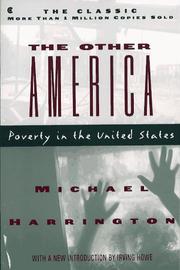
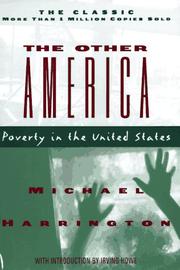
The Other America: Poverty in the United States is a 1962 book by socialist writer Michael Harrington on the dire living conditions of the American poor. It was a muckraking-style exposé which spotlighted the entrenched poverty of 40–50 million people in a country that was being touted as "the affluent society".
The Other America became a publishing phenomenon after Dwight Macdonald gave it a laudatory review in The New Yorker in January 1963. His review reportedly prompted President Kennedy to read the book, and then to propose anti-poverty legislation later in 1963. The book was also said to have been a catalyst for the Johnson administration's War on Poverty program.
Harrington would go on to write over a dozen more works such as The Accidental Century (1965), Toward a Democratic Left (1968), and Socialism (1972), but none was as impactful as The Other America, which was listed by TIME magazine as one of the 10 most influential nonfiction books of the 20th century.
Background
Economist John Kenneth Galbraith's 1958 bestseller The Affluent Society contained a critique of U.S. government policy that had allowed an "indefensible disparity between the opulence of the private sector and the starvation level at which the public sector was forced to operate." But Galbraith downplayed the problems of the underclass, saying poverty was no longer "a massive affliction [but] more nearly an afterthought." The book's title, combined with its analysis of the post-WWII expansion of the American middle class, led many to interpret The Affluent Society as a celebration of widespread prosperity.
It was against this backdrop that Harrington began his investigation of the poor. Monica Potts notes that he "was among the only writers to see the persistence of poverty despite the country's historically large middle class." The Other America grew out of his research for an article titled "Our Fifty Million Poor: Forgotten Men of the Affluent Society", published in the July 1959 issue of Commentary magazine. In the article, he wrote that if a $3,000 annual income was necessary for a family of four to stay out of poverty, then nearly a third of the U.S. population lived "below those standards which we have been taught to regard as the decent minimums for food, housing, clothing and health."
Harrington recalled in his autobiography that he initially ignored inquiries from publishers about converting his Commentary article into a book "until Emile Capouya at Macmillan and a few of my socialist friends convinced me that no one else would translate the available data into readable English. When The Other America turned into a success, I was astounded. Like the Zen archer who hits the target because he does not aim at it, I had given birth to a kind of classic without thinking too much about it."
Book summary
The invisible poor
In the opening chapter, Harrington challenges the notion that mass poverty was largely eliminated in the U.S. He says the misconception arose because the poor are increasingly invisible:The other America, the America of poverty, is hidden today in a way that it never was before. Its millions are socially invisible to the rest of us. No wonder that so many misinterpreted Galbraith's title and assumed that 'the affluent society' meant that everyone had a decent standard of life. Harrington offers various reasons for why the poor are not seen, among them that rural poverty is usually found off the beaten path, away from main highways, and that urban poverty had become remote from most people's daily experience because of the post-WWII suburbanization of American cities: "Living out in the suburbs, it is easy to assume that ours is, indeed, an affluent society."
以上文字摘自英文维基百科「The Other America」(有删节,去掉了参考文献等尾部小节),按 CC BY-SA 4.0 使用,作者为维基百科的各位编者。
资料卡
- 原作语言
- 英语
- 首次出版
- 1962 年
资料卡来自 Wikidata Q7755461(CC0),众包数据,个别字段可能不全。