书单
百科
这个词条暂时没有中文维基百科条目,下面是英文维基百科的内容(英文原文):
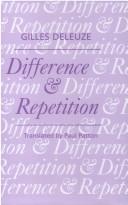
Difference and Repetition (French: Différence et répétition) is a book by French philosopher Gilles Deleuze. Originally published in France by Presses Universitaires de France in 1968, it was translated into English by Paul Patton in 1994.
Difference and Repetition was Deleuze's principal thesis for his doctoral degree, advised by Maurice de Gandillac. He also wrote a secondary historical thesis, Expressionism in Philosophy: Spinoza.
The work is a critique of what Deleuze calls 'representation': a mode of thought where things become intelligible only by being placed under concepts, compared, categorized, and recognized. For example: this object is a tree because it fits the basic conceptual identity of “tree.” Instead of treating identity as basic and difference as secondary, Deleuze treats difference as primary and identity as a temporary effect. He develops concepts of difference in itself and repetition for itself, that is, concepts of difference and repetition that are logically and metaphysically prior to any concept of identity. True repetition is the repetition of difference.
Some commentators interpret the book as Deleuze's attempt to rewrite Immanuel Kant's Critique of Pure Reason (1781) from the viewpoint of genesis itself.
Survey outline of the work
Difference and Repetition contains five chapters, along with a preface, introduction, and conclusion.
Preface
Deleuze uses the preface to relate the work to other texts. He describes his philosophical motivation as "a generalized anti-Hegelianism" (xix) and notes that the forces of difference and repetition can serve as conceptual substitutes for identity and negation in Hegel. The importance of this terminological change is that difference and repetition are both positive forces with unpredictable effects. Deleuze suggests that, unlike Hegel, he creates concepts out of a joyful and creative logic that resists the dualism of dialectic: "I make, remake and unmake my concepts along a moving horizon, from an always decentered centre, from an always displaced periphery which repeats and differentiates them" (xxi).
In the preface to the English edition, Deleuze highlights the third chapter (The Image of Thought) as foreshadowing his later work with Félix Guattari.
He also suggests not only that "conclusions should be read at the outset," but also that "This is true of the present book, the conclusion of which could make reading the rest unnecessary" (ix).
Introduction: Repetition and Difference
Deleuze uses the introduction to clarify the term "repetition." Deleuze's repetition can be understood by contrasting it to generality. Both words describe events that have some underlying connections.
Generality refers to events that are connected through cycles, equalities, and laws. Most phenomena that can be directly described by science are generalities. Seemingly isolated events will occur in the same way over and over again because they are governed by the same laws. Water will flow downhill and sunlight will create warmth because of principles that apply broadly. In the human realm, behavior that accords with norms and laws counts as generality for similar reasons. Science deals mostly with generalities because it seeks to predict reality using reduction and equivalence.
Repetition, for Deleuze, can only describe a unique series of things or events. The Borges story, in which Pierre Menard reproduces the exact text of Miguel de Cervantes's Don Quixote, is a quintessential repetition: the repetition of Cervantes' work by Menard takes on a magical quality by virtue of its translation into a different time and place. Art is often a source of repetition because no artistic use of an element is ever truly equivalent to other uses.
For humans, repetition is inherently transgressive. As in Masochism: Coldness and Cruelty, Deleuze identifies humor and irony as lines of escape from the generalities of society. Humor and irony are in league with repetition because they create distance from laws and norms even while re-enacting them.
Deleuze describes repetition as a shared value of an otherwise rather disparate trio: Kierkegaard, Nietzsche, and Péguy. He also connects the idea to Freud's death drive.
He goes on to define repetition as "difference without a concept" (13). Repetition is thus reliant on difference more deeply than it is opposed . Further, profound repetition will be characterized by profound difference.
I. Difference in Itself
Deleuze paints a picture of philosophical history in which difference has long been subordinated to four pillars of reason: identity, opposition, analogy, and resemblance. He argues that difference has been treated as a secondary characteristic which emerges when one compares pre-existing things; these things can then be said to have differences. This network of direct relations between identities roughly overlays a much more subtle and involuted network of real differences: gradients, intensities, overlaps, and so forth (50).
The chapter contains a discussion of how various philosophers have treated the emergence of difference within Being. This section uses Duns Scotus, Spinoza, and others to make the case that "there has only ever been one ontological proposition: Being is univocal. ... A single voice raises the clamor of being" (35). One then tries to understand the nature of differences that arise within Being. Deleuze describes how Hegel took contradiction—pure opposition—to be the principle underlying all difference and consequently to be the explanatory principle of all the world's texture. He accuses this conception of having a theological and metaphysical slant.
以上文字摘自英文维基百科「Difference and Repetition」(有删节,去掉了参考文献等尾部小节),按 CC BY-SA 4.0 使用,作者为维基百科的各位编者。
资料卡
- 原题
- Différence et répétition
- 译者
- Paul R. Patton
- 原作语言
- 法语
- 首次出版
- 1968 年
- 首版出版社
- 法国大学出版社
- 页数
- 409
- 主题
- 欧陆哲学
资料卡来自 Wikidata Q1451094(CC0),众包数据,个别字段可能不全。