书单
判断力批判 (1790)
百科
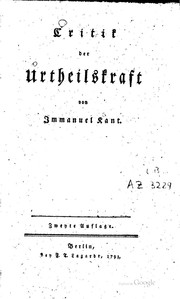
《判断力批判》(德语:Kritik der Urteilskraft,初版于1790年),因出版于《纯粹理性批判》和《实践理性批判》之后而常被称作“第三批判”,是伊曼努尔·康德的一部哲学著作。主要是阐明人类在理性与感性的判断力。
中译本
1964年 商务印书馆出版
上卷 宗白华译
下卷 韦卓民译
1992年 牟宗三译本 台湾学生书局出版
2002年 邓晓芒译本 人民出版社出版
2007年 李秋零译本 《康德著作全集》(第五卷) 中国人民大学出版社出版
2013年 曹俊峰译本 《美,以及美的反思---康德美学全集》金城出版社出版
以上文字摘自维基百科「判断力批判」(去掉了参考文献等尾部小节),按 CC BY-SA 4.0 使用,作者为维基百科的各位编者。
中文维基百科的条目比较短,下面附上英文维基百科的内容(英文原文):
The Critique of Judgment (German: Kritik der Urteilskraft), also translated as the Critique of the Power of Judgment, is a 1790 book by the German philosopher Immanuel Kant. Sometimes referred to as the "third critique", the Critique of Judgment follows the Critique of Pure Reason (1781) and the Critique of Practical Reason (1788).
Context
Immanuel Kant's Critique of Judgment is the third critique in Kant's Critical project begun in the Critique of Pure Reason and the Critique of Practical Reason (the First and Second Critiques, respectively). The book is divided into two main sections: the Critique of Aesthetic Judgment and the Critique of Teleological Judgment, and also includes a large overview of the entirety of Kant's Critical system, arranged in its final form. The so-called First Introduction was not published during Kant's lifetime, for Kant wrote a replacement for publication.
The Critical project, that of exploring the limits and conditions of knowledge, had already produced the Critique of Pure Reason, in which Kant argued for a Transcendental Aesthetic, an approach to the problems of perception in which space and time are argued not to be objects. The First Critique argues that space and time provide ways in which the observing subject's mind organizes and structures the sensory world. The end result of this inquiry in the First Critique is that there are certain fundamental antinomies in the dialectical use of Reason, most particularly that there is a complete inability to favor on the one hand the argument that all behavior and thought is determined by external causes, and on the other that there is an actual "spontaneous" causal principle at work in human behavior.
The first position, of causal determinism, is adopted, in Kant's view, by empirical scientists of all sorts; moreover, it led to the Idea (perhaps never fully to be realized) of a final science in which all empirical knowledge could be synthesized into a full and complete causal explanation of all events possible to the world.
The second position, of spontaneous causality, is implicitly adopted by all people as they engage in moral behavior; this position is explored more fully in the Critique of Practical Reason.
The Critique of Judgment constitutes a discussion of the place of Judgment itself, which must overlap both the Understanding ("Verstand") (whichsoever operates from within a deterministic framework) and Reason ("Vernunft") (which operates on the grounds of freedom).
Judgments of taste
The first half of Kant's book presents what Kant calls the four moments of the "Judgment of Taste". These are given by Kant in sequence as the (1) First Moment. Of the Judgment of Taste: Moment of Quality"; (2) Second Moment. Of the Judgment of Taste: Moment of Quantity"; (3) Third Moment: Of Judgment of Taste: Moment of the Relation of the ends brought under Review in such Judgments"; and (4) Fourth Moment: Of the Judgment of Taste: Moment of the Modality of the Delight in the Object". After the presentation of the four moments of the Judgment of Taste, Kant then begins his discussion of Book 2 of the Third Critique titled Analytic of the Sublime.
Aesthetic judgments
The first half of the book aims to distinguish the judgment of taste properly speaking – judgments of beauty and of the sublime – from judgments of agreeableness and goodness. Judgments of taste are distinctive to the extent that they are grounded in the faculty of judgment in its reflective use alone and is merely contemplative, as opposed to the agreeable and the good, which rely on the existence of the object in order to satisfy us.
"Reflective judgments" differ from determinative judgments (those of the first two critiques). In reflective judgment we seek to find unknown universals for given particulars; whereas in determinative judgment, we just subsume given particulars under universals that are already known, as Kant puts it:
以上文字摘自英文维基百科「Critique of Judgment」(有删节,去掉了参考文献等尾部小节),按 CC BY-SA 4.0 使用,作者为维基百科的各位编者。
资料卡
- 原题
- Kritik der Urteilskraft
- 原作语言
- 德语
- 首次出版
- 1790 年
- 体裁
- 随笔
- 前作
- 实践理性批判
- 改编自 / 取材于
- Aesthetica
- 主题
- 美学、目的论、康德义务主义
资料卡来自 Wikidata Q1056332(CC0),众包数据,个别字段可能不全。