书单
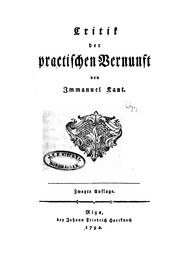
实践理性批判 (1788)
百科
《实践理性批判》(德语:Kritik der praktischen Vernunft)初版于1788年,伊曼努尔·康德三大批判中的第二部,位于《纯粹理性批判》、《道德形而上学基础》之后,《判断力批判》之前。康德在本书中主要探讨了道德哲学的问题。
自费希特《知识学》(Doctrine of Science)始,《实践理性批判》对其后伦理学以及道德哲学领域的发展产生了决定性的影响。它是二十世纪所有包含义务论(义务伦理学)色彩伦理学的出发点。
中译本
1936年 张铭鼎译本 商务印书馆出版
1960年 关文运译本 商务印书馆出版(2002年 广西师大新版)
1982年 牟宗三译注本《康德的道德哲学》 台湾学生出版社出版
1999年 韩水法译本 商务印书馆出版
2003年 邓晓芒译本 人民出版社出版
2007年 李秋零译本 《康德著作全集》(第五卷) 中国人民大学出版社出版
以上文字摘自维基百科「实践理性批判」(去掉了参考文献等尾部小节),按 CC BY-SA 4.0 使用,作者为维基百科的各位编者。
中文维基百科的条目比较短,下面附上英文维基百科的内容(英文原文):
The Critique of Practical Reason (German: Kritik der praktischen Vernunft) is the second of Immanuel Kant's three critiques, published in 1788. Hence, it is sometimes referred to as the "second critique". It follows on from Kant's first critique, the Critique of Pure Reason, and is one of his major works on moral philosophy. While Kant had already published one significant work in moral philosophy, the Groundwork of the Metaphysics of Morals (1785), the Critique of Practical Reason was intended to develop his account of the will as determinable by (or able to act from) the moral law alone, place his ethical views within the larger framework of his system of critical philosophy, and expand on certain themes in his moral philosophy such as the feeling of respect for the moral law and the concept of the highest good.
Context
Kant did not initially plan to publish a separate critique of practical reason. He published the first edition of the Critique of Pure Reason in May 1781 as a "critique of the entire faculty of reason in general" (viz., of both theoretical and practical reason) and a "propaedeutic" or preparation investigating "the faculty of reason in regard to all pure a priori cognition" to set up for a metaphysics of nature and a metaphysics of morals.
Next, Kant began work on a metaphysics of morals by writing the Groundwork of the Metaphysics of Morals, published in 1785. Certain remarks in that work show that Kant had changed his mind about the idea of a critique of practical reason. In the Preface, Kant distinguished between a "critique of pure practical reason" and a "critique of pure speculative reason". He also came to think that a metaphysics of morals could only really be founded on the former critique just as a metaphysics of nature needed the latter critique. A critique of pure practical reason, Kant thought, was less necessary than a critique of pure speculative reason since "in moral matters human reason can easily be brought to a high degree of correctness and accomplishment, even in the most common understanding". The third section titled "Transition from metaphysics of morals to the critique of pure practical reason" was written to accomplish what he originally thought was at least partially needed in a critique of pure practical reason to properly set up a metaphysics of morals.
However, Kant then changed his mind again and planned the Critique of Practical Reason as an appendix to the second edition of the Critique of Pure Reason to respond to some of the criticisms made by reviewers and commenters against the latter work. He declared his plan in an announcement he published in the Allgemeine Literatur-Zeitung in November 1786, but shortly abandoned it and completed the second edition of the Critique of Pure Reason, published in April 1787, without an appended critique of practical reason.
Finally, in June 1787, Kant sent the completed manuscript of his new Critique of Practical Reason to printers in Halle where it was finally published in December 1787 but listed as published in 1788.
Structure of the work
The work's structure is based on his earlier text, the Critique of Pure Reason. After a preface and an introduction, the second Critique is split into a Doctrine of Elements and a Doctrine of Method. The former part is further separated into an Analytic and a Dialectic of pure practical reason.
The Analytic establishes Kant's theory of practical rationality. There he outlines and analyzes the principles of morality, shows that pure reason is practical (viz. that reason can drive or motivate our actions independently of any empirical conditions lying in the senses and feeling), discusses the object or aim of pure practical reason (the good), and deals with the non-empirical/pure incentives or "motivating springs" (Triebfeder) of morals.
以上文字摘自英文维基百科「Critique of Practical Reason」(有删节,去掉了参考文献等尾部小节),按 CC BY-SA 4.0 使用,作者为维基百科的各位编者。
资料卡
- 原题
- Critik der practischen Vernunft
- 译者
- 托马斯·金斯米尔·雅培
- 原作语言
- 德语
- 首次出版
- 1788 年
- 体裁
- 随笔
- 前作
- 纯粹理性批判
- 续作
- 判断力批判
- 主题
- 康德伦理学
资料卡来自 Wikidata Q870851(CC0),众包数据,个别字段可能不全。