 书单
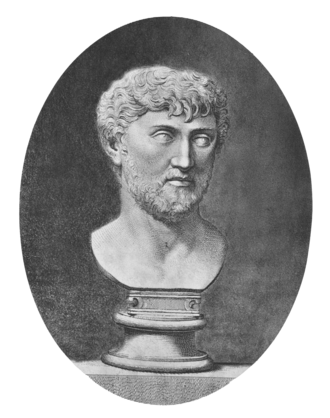
卢克莱修
- 生卒
- 公元前 94 – 公元前 55
- 国籍
- 古罗马
- 外文名
- Lucretius
照片:作者不详,CC0,来自维基共享资源「Lucretius1.png」(经缩小)。
生平与创作
提图斯·卢克莱修·卡鲁斯(拉丁语:Titus Lucretius Carus,前99年—前55年),罗马共和国末期的诗人和哲学家,以哲理长诗《物性论》(De Rerum Natura)著称于世,44岁时自杀身亡。
简介
关于卢克莱修的生平,历史学家所知甚少。唯一可以确定的是他是当时在罗马上层很有影响力的贵族诗人盖乌斯·梅米乌斯的朋友或门客,《物性论》一书就是献给梅米乌斯的。西塞罗在写给弟弟昆图斯的书信中简短地提到卢克莱修,但只是提到名字并赞赏其才华而已;有的学者据此认为,《物性论》最初就是由西塞罗出版的。维吉尔引用过卢克莱修的诗句,但这对确定卢克莱修的生平毫无帮助。4世纪时的两位教会作家埃利乌斯·多纳图斯和圣哲罗姆的著作中有关于卢克莱修的一些极简短的记述,通过它们可大致推断出卢克莱修的生卒年;当然,这两位教会作家的记述的可靠性也存疑。
从卢克莱修的唯一传世作品《物性论》来看,他是个伊壁鸠鲁学派的学者。与不少前苏格拉底时期的哲学家一样,他用诗歌的方式来阐述哲学思想。《物性论》一诗分为6卷,用抑扬六步格写成,其内容主要是阐明伊壁鸠鲁的哲学,尤其是原子论学说。由于伊壁鸠鲁本人著作的大量散失,卢克莱修的《物性论》对研究伊壁鸠鲁学派的思想具有重大意义。
从其著作来看,卢克莱修可归为唯物主义者。他反对当时盛行的毕达哥拉斯学派关于灵魂不灭和轮回转世的学说。卢克莱修亦反对神创论,认为物质的存在是永恒的,整个世界包括神都是由原子组成的。
以上文字摘自维基百科「卢克莱修」(去掉了参考文献等尾部小节),按 CC BY-SA 4.0 使用,作者为维基百科的各位编者。
中文维基百科的条目比较短,下面附上英文维基百科的内容(英文原文):
Titus Lucretius Carus ( TY-tuhs loo-KREE-shuhs; Latin: [ˈtitʊs lʊˈkreːtɪ.ʊs ˈkaːrʊs]; c. 99 – October 15, 55 BC) was a Roman poet and philosopher. His only known work is the philosophical poem De rerum natura, a didactic work about the tenets and philosophy of Epicureanism, which usually is translated into English as On the Nature of Things—and somewhat less often as On the Nature of the Universe.
Very little is known about Lucretius's life; the only certainty is that he was either a friend or client of Gaius Memmius, to whom the poem was addressed and dedicated. De rerum natura was a considerable influence on the Augustan poets, particularly Virgil (in his Aeneid and Georgics, and to a lesser extent on the Eclogues) and Horace. The work was almost lost during the Middle Ages, but was rediscovered in 1417 in a monastery in Germany by Poggio Bracciolini. It played an important role both in the development of atomism (Lucretius was an important influence on Pierre Gassendi) and the efforts of various figures of the Enlightenment era to construct a new Christian humanism.
Biography
Virtually nothing is known about the life of Lucretius, and there is insufficient basis for a confident assertion of the dates of Lucretius's birth or death in other sources. A brief biographical note is found in Aelius Donatus's Life of Virgil, which seems to be derived from an earlier work by Suetonius. The note reads: "The first years of his life Virgil spent in Cremona until the assumption of his toga virilis on his 17th birthday (when the same two men held the consulate as when he was born), and it so happened that on the very same day Lucretius the poet passed away." However, although Lucretius certainly lived and died around the time that Virgil and Cicero flourished, the information in this particular testimony is internally inconsistent: if Virgil was born in 70 BC, his 17th birthday would be in 53. The two consuls of 70 BC, Pompey and Crassus, stood together as consuls again in 55, not 53.
Another, yet briefer, note is found in the Chronicon of Donatus's pupil, Saint Jerome. Writing four centuries after Lucretius's death, he enters under the 171st Olympiad: "Titus Lucretius the poet is born." If Jerome is accurate about Lucretius's age (43) when Lucretius died (discussed below), then it may be concluded he was born in 99 or 98 BC. Less specific estimates place the birth of Lucretius in the 90s BC and his death in the 50s BC, in agreement with the poem's many allusions to the tumultuous state of political affairs in Rome and its civil strife.
Lucretius probably was a member of the aristocratic gens Lucretia, and his work shows an intimate knowledge of the luxurious lifestyle in Rome. Lucretius's love of the countryside invites speculation that he inhabited family-owned rural estates, as did many wealthy Roman families, and he certainly was expensively educated with a mastery of Latin, Greek, literature, and philosophy.
Another note regarding Lucretius's biography found in Jerome's Chronicon, claims that Lucretius "was driven mad by a love potion, and when, during the intervals of his insanity, he had written a number of books, which were later emended by Cicero, he killed himself by his own hand in the 44th year of his life." The claim that he was driven mad by a love potion, although defended by such scholars as Reale and Catan, is often dismissed as the result of historical confusion, or anti-Epicurean bias. In some accounts the administration of the toxic aphrodisiac is attributed to his wife Lucilia. Regardless, Jerome's image of Lucretius as a lovesick, mad poet continued to have significant influence on modern scholarship until quite recently, although it now is accepted that such a report is inaccurate.
以上文字摘自英文维基百科「Lucretius」(有删节,去掉了参考文献等尾部小节),按 CC BY-SA 4.0 使用,作者为维基百科的各位编者。
资料卡
- 母语名
- T.Lucretius Carus 等 2 项
- 出生
- 公元前 94 年
- 出生地
- 庞贝
- 逝世
- 公元前 55 年 10 月 15 日
- 逝世地
- 罗马
- 职业
- 诗人、哲学家、作家
- 使用语言
- 拉丁语
- 写作语言
- 拉丁语
- 文学运动 / 流派
- 原子论
- 领域
- 哲学
- 配偶
- Lucilia
资料卡来自 Wikidata Q47154(CC0),众包数据,个别字段可能不全。
本站收录的作品(1)
作品年表(2 本)
本站书库里署名卢克莱修的书(Open Library 上至少 10 人加过书架的才收),其中 2 本记的年份比作者去世晚 50 年以上或者早于他出生(多半是后世的版本、译本或占位年份),不列年份,按首版年份排(有本站书页的用 Wikidata 记的首版年,其余用 Open Library 的);年份偶尔记成后来的版本或译本,以原书为准。全部作品见 Open Library。
- 年份不详物性论De rerum natura书架 442
- 年份不详The way things are书架 11