 书单
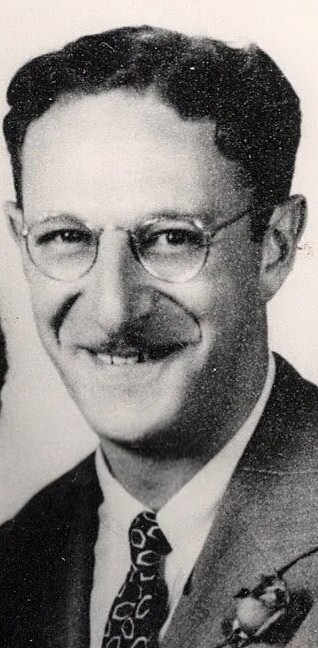
Eric Berne
- 生卒
- 1910 – 1970
- 国籍
- 加拿大、美国
照片:作者不详,公有领域,来自维基共享资源「Eric Berne at his wedding in 1942.jpg」(经缩小)。
生平与创作
这个词条暂时没有中文维基百科条目,下面是英文维基百科的内容(英文原文):
Eric Berne (May 10, 1910 – July 15, 1970) was a Canadian-born psychiatrist who created the theory of transactional analysis as a way of explaining human behavior.
Berne's theory of transactional analysis was based on the ideas of Freud and Carl Jung but was distinctly different. Freudian psychotherapists focused on talk therapy as a way of gaining insight to their patient's personalities. Berne believed that insight could be better discovered by analyzing patients' social transactions.
Background and education (1927–1938)
Eric Berne was born on May 10, 1910, in Montreal, Quebec, Canada, as Eric Lennard Bernstein. He was the son of David Hillel Bernstein, MD, a general practitioner, and Sarah Gordon Bernstein, writer and editor. His only sibling, his sister Grace, was born five years later. The family immigrated to Canada from Poland and RSFSR. Both parents graduated from McGill University in Montreal. Eric was close to his father and spoke fondly of how he accompanied his father on rounds, traveling by horse-pulled sleigh on cold Montreal winters to visit patients.
Berne's father died of tuberculosis when Berne was 11. His mother then supported herself and her two children working as an editor and writer. She encouraged her son to follow in his father's footsteps and to study medicine. In 1931, Berne graduated from McGill, in 1935 an M.D. and C.M. (Master of Surgery) from McGill University Medical School.
Berne came to the United States in 1935 when he began an internship at Englewood Hospital in New Jersey. After completing his one-year internship in 1936, he began his psychiatric residency at the Psychiatric Clinic of Yale University School of Medicine, where he worked for two years.
In 1939, Berne became an American citizen and shortened his name from Eric Lennard Bernstein to Eric Berne.
In 1949, he was admitted as a Fellow in the American Psychiatric Association.
Career (1938–1970)
From 1938 to 1940, Berne was an assistant physician at Ring Sanitarium, Arlington Heights, Massachusetts.
From 1940 to 1943 he was employed as a psychiatrist in a sanitarium in Connecticut, and concurrently as a clinical assistant in psychiatry at Mt. Sinai Hospital in New York. He also maintained a private practice.
In 1943, during World War II, Berne joined the United States Army Medical Corps and served as a psychiatrist. He rose from the rank of Lieutenant, to Captain, and then to Major. His assignments included Spokane, Washington, Ft. Ord, California and Brigham City, Utah.
After his discharge in 1946, Berne settled in Carmel-by-the-Sea, California. From 1949 to 1964, Berne had a private practices in both Carmel and San Francisco and kept up a demanding pace of research, teaching in addition.
Berne resumed his psychoanalytic training that he had begun in New York City, prior to the War, at the San Francisco Psychoanalytic Society and Institute. During 1947–1949 Berne studied under Erik Erikson. He took an appointment in 1950 as Assistant Psychiatrist at Mt. Zion Hospital, San Francisco, and simultaneously began serving as a Consultant to the Surgeon General of the U.S. Army. In 1951, he accepted a position of Adjunct and Attending Psychiatrist at the Veterans Administration and Mental Hygiene Clinic, San Francisco.
The years from 1964 to 1970 were restless ones for Berne. His personal life became chaotic and he concentrated on his writing.
Transactional analysis
Berne created the theory of transactional analysis as a way to explain human behavior. Berne's theory was based on the ideas of Freud but his were distinctly different. Freudian psychotherapists focused on patient's personalities. Berne believed that insight could be better discovered by analyzing patients' social transactions. Berne mapped interpersonal relationships to three ego-states of the individuals involved: the Parent, Adult, and Child state. He then investigated communications between individuals based on the current state of each. He called these interpersonal interactions transactions and used the label games to refer to certain patterns of transactions which popped up repeatedly in everyday life.
The origins of transactional analysis can be traced to the first five of Berne's six articles on intuition, which he began writing in 1949. Even at this early juncture and while still working to become a psychoanalyst, his writings challenged Freudian concepts of the unconscious.
In 1956, after 15 years of psychoanalytic training, Berne was refused admission to the San Francisco Psychoanalytic Institute as a fully-fledged psychoanalyst. He interpreted the request for several more years of training as a rejection and decided to walk away from psychoanalysis.
Before the end of the year, he had written two seminal papers, both published in 1957.
In the first article, "Intuition V: The Ego Image", Berne referenced P. Federn, E. Kahn, and H. Silberer, and indicated how he arrived at the concept of ego states, including his idea of separating "adult" from "child".
The second paper, "Ego States in Psychotherapy", was based on material presented earlier that year at the Psychiatric Clinic, Mt. Zion Hospital, San Francisco, and at the Langley Porter Neuropsychiatric Clinic, U.C. Medical School. In that second article, he developed the tripartite scheme used today (Parent, Adult, and Child), introduced the three-circle method of diagramming it, showed how to sketch contaminations, labeled the theory, "structural analysis", and termed it "a new psychotherapeutic approach".
以上文字摘自英文维基百科「Eric Berne」(有删节,去掉了参考文献等尾部小节),按 CC BY-SA 4.0 使用,作者为维基百科的各位编者。
资料卡
- 母语名
- Eric Berne
- 本名
- Eric Lennard Bernstein
- 出生
- 1910 年 5 月 10 日
- 出生地
- 蒙特利尔
- 逝世
- 1970 年 7 月 15 日
- 逝世地
- 蒙特雷 等 2 项
- 职业
- 军医、学者、非虚构文学作家、心理治疗师、精神科医师、作家、心理学家
- 使用语言
- 英语
- 就读学校
- 麦吉尔大学
- 领域
- 精神医学、心理学、人际沟通分析理论
- 受谁影响
- 西格蒙德·弗洛伊德
资料卡来自 Wikidata Q44836(CC0),众包数据,个别字段可能不全。
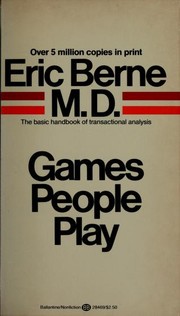
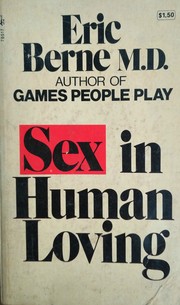
本站收录的作品(2)
作品年表(12 本)
本站书库里署名Eric Berne的书(Open Library 上至少 10 人加过书架的才收),按首版年份排(有本站书页的用 Wikidata 记的首版年,其余用 Open Library 的);年份偶尔记成后来的版本或译本,以原书为准。全部作品见 Open Library。
- 1947Mind in action书架 21
- 1957A layman's guide to psychiatry and psychoanalysis书架 10
- 1961Transactional analysis in psychotherapy书架 36
- 1964Games People Play书架 2,048
- 1970Sex in human loving书架 16
- 1972What do you say after you say hello?书架 83
- 1973What do you say after you say hello?书架 43
- 1973The structure and dynamics of organizations and groups书架 18
- 1973What Do You Say After Hello?书架 17
- 1974Qué dice usted después de decir "hola"?书架 32
- 1976Beyond games and scripts书架 14
- 1977Intuition and ego states书架 31